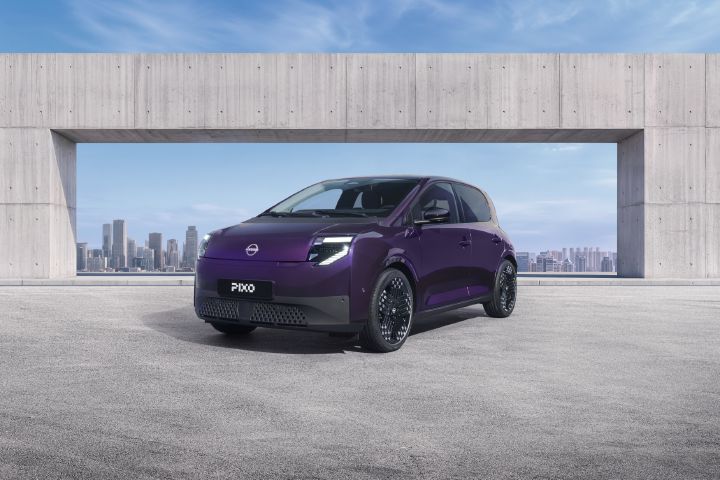
Nissan PIXO Shows Why Canada Still Needs Smaller EVs
Nissan's Europe-only PIXO city EV has a 27.5-kWh LFP battery, 259 km of WLTP range and 50-kW charging. Here is why that tiny formula matters even if Canada never gets it.
Nissan’s newest EV is not another long-range crossover. The PIXO is a tiny European city car with a 27.5-kWh LFP battery, 259 km of WLTP range and just 60 kW of output. In a North American market obsessed with bigger batteries and crossover shapes, that sounds almost rebellious.
It is also exactly the kind of electric car Canada rarely gets.
Nissan unveiled the PIXO on September 23 as an A-segment EV designed specifically for European towns and cities. Customer deliveries are scheduled to begin in early 2027, with market-specific pricing and pre-order details due from December. Nissan has not announced a Canadian launch, and shoppers should not treat this as a coming LEAF sibling for local dealers.
Still, the PIXO matters because it highlights a missing part of Canada’s EV conversation: genuinely small, lower-battery, city-focused electric cars that do not try to be the one vehicle for every road trip, cottage weekend and winter highway run.
Quick Verdict
Canadian buyers should not wait for the Nissan PIXO. It is a Europe-focused city EV, built in Slovenia by Renault for Nissan, and there is no Canadian sales plan.
The idea behind it is still worth watching. A small LFP-battery EV could make sense for urban drivers, condo households, second-car shoppers and delivery-heavy city use if the price were low enough and the charging setup fit local infrastructure.
The trade-off is range confidence. A 259-km WLTP city-car rating is useful in Europe, but Canada would need a separate Natural Resources Canada rating and a hard look at winter highway use. The PIXO would be a daily tool, not a universal family EV.
The Canadian gap remains affordability. MotorLinks’ Canadian EV incentive guide shows why final transaction price matters so much. Bigger EVs can be more versatile, but small EVs are one of the clearest ways to lower battery cost, weight and purchase price.
| Item | Nissan PIXO | Why it matters |
|---|---|---|
| Battery | 27.5-kWh LFP | A smaller, lower-cost chemistry aimed at daily urban use rather than maximum range |
| Range | Up to 259 km WLTP | Enough for city routines, but not a Canadian winter-road-trip answer |
| DC charging | 50 kW; 15-80% in about 28 minutes | Modest peak power, acceptable because the battery is small |
| AC charging | 11 kW, bidirectional | Strong for home, workplace and urban charging routines |
| Size | 3,796 mm long and 1,790 mm wide | Far smaller than Canada's mainstream electric crossovers |
| Cargo space | 356 L with rear seats up; 1,221 L folded | Surprisingly useful packaging for a city car |
| Launch timing | European deliveries from early 2027 | Pricing and market specifications are due from December |
Why This Is Not A Canadian Launch Story
The PIXO is built around European assumptions. Nissan says it was designed at Nissan Design Europe in London, developed for European customers and will be manufactured by Renault at Novo Mesto, Slovenia. That tells you the intended job: dense cities, shorter trips, tight parking and buyers who want a practical electric runabout rather than a compact SUV.
Canada has different pressures. Longer commuting corridors, harsher winter range losses, stronger preference for crossovers and a smaller small-car market all make the business case harder. A vehicle that feels perfectly rational in Paris, Amsterdam or Milan may look too short-legged in suburban Ontario or on a Prairie highway day in February.
Even if Nissan ever reconsidered, incentive eligibility would not be automatic. Canada’s Electric Vehicle Affordability Program depends on factors such as final transaction value, program rules, vehicle eligibility and dealer participation. A European-built EV could be interesting under the rules, but a model has to actually be sold, listed and priced here before shoppers can count anything.
The Small Battery Is The Point
The PIXO’s 27.5-kWh pack is tiny beside Canadian-market EVs such as the latest Nissan LEAF, Chevrolet Bolt, Kia EV4 or Hyundai Kona Electric. That is not a mistake. Small batteries reduce material demand, curb weight and cost. They also charge quickly in real time even when the peak power number looks unimpressive.
A 50-kW DC limit would be underwhelming on a large crossover. On the PIXO, Nissan estimates a 15-to-80-percent charge in about 28 minutes. That is not fast-road-trip hardware, but it is workable for an urban EV whose owner mostly charges at home, at work or during routine stops.
The LFP chemistry also fits the mission. Lithium iron phosphate batteries are generally attractive for lower-cost EVs because they avoid nickel and cobalt, can tolerate frequent high states of charge better than many nickel-rich chemistries, and suit vehicles where absolute energy density is less important than price and durability.
The catch is obvious: a small pack gives you less buffer. Cold weather, highway speed, snow tires, slush and cabin heat would all eat into the usable margin. In Canada, a PIXO-like EV would need honest marketing. It would be a city car first and a regional errand car second.
Canada Keeps Asking Small EVs To Do Big-EV Jobs
One reason affordable EVs are hard here is that shoppers often expect one vehicle to do everything. It should commute cheaply, carry kids, handle winter, drive to the cottage, recharge quickly on the highway and still qualify for incentives. That pushes automakers toward larger batteries and crossover bodies, which pushes prices up.
The PIXO takes a different view: make the vehicle small enough that it does not need a huge battery in the first place.
That will not fit every Canadian household. It might not fit most one-car households. But it could fit a lot of real use cases: a city commuter with reliable overnight charging, a retiree doing local trips, a household that already owns a larger vehicle, a student in a dense urban area, or a small business doing predictable short routes.
The problem is availability. Canada’s affordable EV set is improving, but it still leans toward larger, more versatile vehicles. The 2027 Nissan LEAF S is a good example: at C$34,998 with 341 km of estimated range, it is far more Canada-ready than the PIXO would be, but it is also a bigger, more expensive answer to a different question.
What Canadian Buyers Should Take From It
Do not put a deposit aside for the PIXO. Nissan has not announced it for Canada, and importing a small European EV privately would bring certification, warranty, charging and service headaches that make no sense for normal shoppers.
Do watch the formula. If the next wave of affordable EVs is going to reach more people, automakers need more than one recipe. Canada needs long-range mainstream crossovers, yes. It also needs cheaper daily EVs that are honest about being short-trip tools.
The right Canadian version would need:
- a genuinely low starting price after freight and fees
- clear EVAP eligibility where applicable
- winter-friendly equipment such as a heat pump and battery conditioning
- charging hardware that fits Canadian public and home infrastructure
- enough safety and driver-assistance equipment to avoid feeling like a penalty box
- marketing that explains the use case instead of pretending it replaces every SUV
That is a hard brief, but the alternative is also hard: keep making affordable EVs larger and more expensive until many buyers simply stay with gasoline or hybrids.
Bottom Line
The Nissan PIXO is not the Canadian affordable EV answer. It is too Europe-specific, too small for many households and not announced for this market.
But it is a useful reminder that EV affordability is not only about bigger incentives or cheaper financing. Sometimes it starts with using less battery, less car and less weight for the drivers who genuinely do not need more.
Canada’s market will still reward vehicles such as the LEAF, Bolt, Equinox EV, Kona Electric and EV4 because they offer broader range and family usability. The PIXO points to the other end of the spectrum: a right-sized EV for daily urban life. If automakers can make that idea work here without asking buyers to accept a toy-like product, Canada’s affordable-EV choices would get a lot more interesting.
FAQ
Is the Nissan PIXO coming to Canada?
Nissan has announced the PIXO for Europe, with customer deliveries scheduled from early 2027. There is no announced Canadian launch.
How much range does the Nissan PIXO have?
Nissan lists up to 259 km WLTP from a 27.5-kWh LFP battery. A Canadian NRCan rating has not been announced.
How fast does the Nissan PIXO charge?
Nissan says the PIXO supports 50-kW DC charging and can charge from 15 to 80 percent in about 28 minutes. It also has 11-kW AC charging.
Would a small EV like the PIXO make sense in Canada?
It could make sense as an urban commuter, second household vehicle or short-route business car. It would be a poor fit for shoppers who need frequent long highway trips or a single all-purpose family vehicle.
Sources
- Nissan Europe: all-new electric PIXO announcement
- Government of Canada: electric-vehicle incentives overview