Toyota Canada's 2026 EV and PHEV Lineup: Which One Fits Your Driveway?
Toyota Canada now has a much broader 2026 electrified showroom, from the C-HR, bZ and bZ Woodland EVs to the RAV4 Plug-in Hybrid and Prius Plug-in Hybrid. Here is the practical buyer read.
Photo: Toyota
Update Highlander year/timing while preserving genuinely sourced June bZ and RAV4 PHEV range figures and dating lineup targets.
Toyota Canada’s electrified lineup used to be easy to summarize: hybrids everywhere, one awkward early EV, and a plug-in RAV4 that did a lot of the heavy lifting for shoppers who wanted to charge at home.
That is not really true anymore.
After its June 2026 Unplug and Drive event in Quebec, Toyota Canada is now talking about a much broader showroom. In its Canadian lineup summary, the company said it planned to offer 21 electrified Toyota models by the end of 2026, including four unique battery-electric options. The same summary highlights the 2026 C-HR, 2026 bZ, 2026 bZ Woodland, 2026 RAV4 Plug-in Hybrid, 2026 Prius Plug-in Hybrid, and the upcoming 2028 Highlander EV.
That is a lot of overlap for one brand. It is also the point. Toyota is not asking every Canadian buyer to make the same leap at the same time.
Quick Verdict
The practical Toyota Canada shopping answer is this: choose the powertrain around your charging life, not the badge on the hatch.
The bZ is the cleanest mainstream EV choice if you want a compact Toyota SUV and can charge reliably. The C-HR is the sharper, smaller EV if style, city-friendly size, and available all-wheel-drive punch matter more than maximum space. The bZ Woodland is the adventure-flavoured option for buyers who want more ground-clearance confidence, cargo usefulness, and a towing rating.
The RAV4 Plug-in Hybrid is still the safer one-vehicle answer for many Canadian households because it combines daily electric driving with gasoline backup. The Prius Plug-in Hybrid is the efficiency play for drivers who do not need SUV space. The future Highlander EV is the one to watch if you need three rows and can wait for final pricing.
If you are shopping on budget, incentives, or total ownership cost, start with the MotorLinks Canadian EV incentive guide, then get a written dealer quote. Toyota’s lineup is broader now, but the best deal still depends on trim, fees, lease terms, eligibility, and where you live.
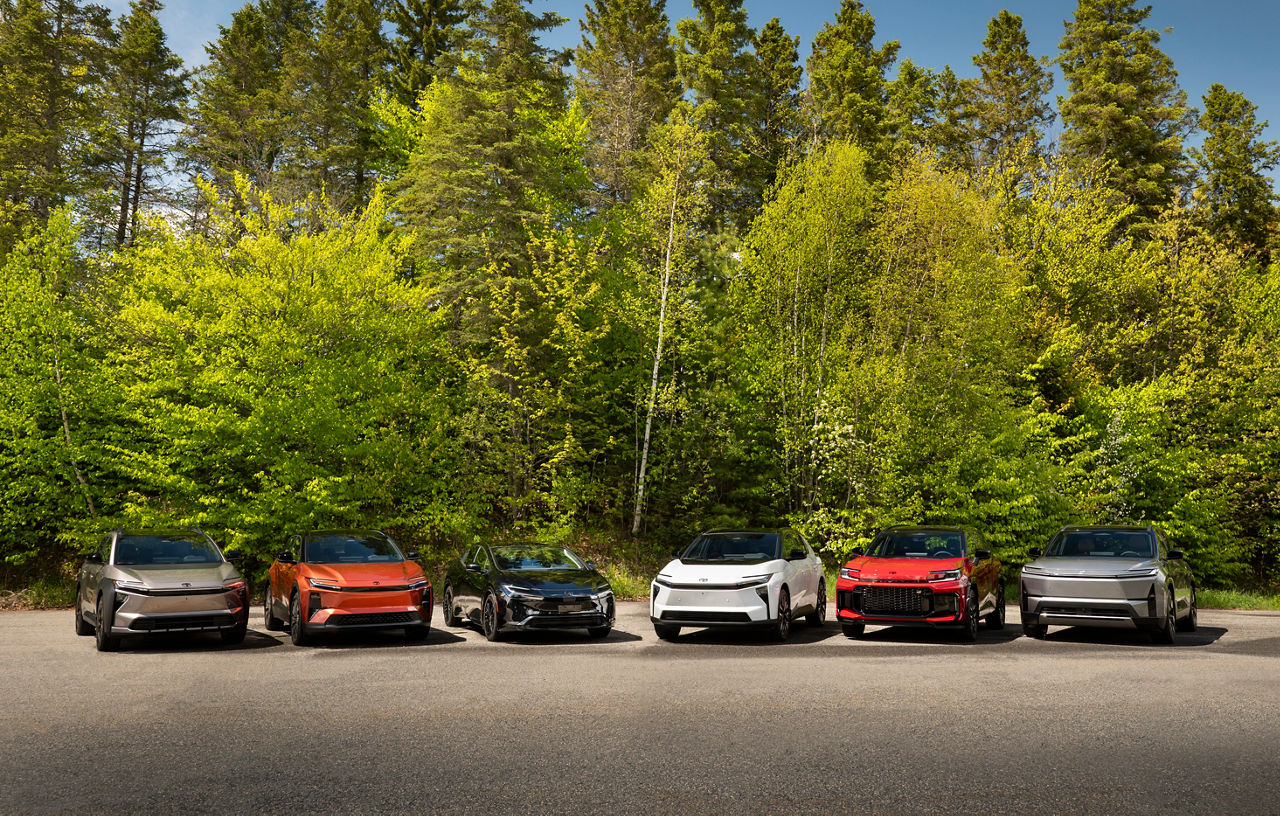
Toyota Canada's 2026 EV and plug-in hybrid lineup in official images
13


Toyota Canada used its Quebec Unplug and Drive event to put its 2026 EV and plug-in hybrid lineup in front of Canadian media.
The Lineup At A Glance
Toyota Canada’s latest lineup summary gives Canadian shoppers a useful snapshot because it puts the full zero-emission and plug-in-hybrid spread in one place.
| Model | Toyota Canada headline | Best fit for Canadian buyers |
|---|---|---|
| 2026 Toyota C-HR BEV | From $44,900; up to 496 km of range; front-wheel drive for range or all-wheel drive with up to 338 net hp | Urban and suburban EV shoppers who want a smaller Toyota with more style and stronger performance than the old bZ4X image suggested |
| 2026 Toyota bZ | From $45,990; up to 486 km of range; refreshed design, more power, and faster charging | The mainstream Toyota EV buyer who wants a practical compact electric SUV and has charging sorted |
| 2026 Toyota bZ Woodland | From $59,900; standard AWD; up to 452 km of range; 375 hp; 3,500-lb towing rating | Drivers who want a rugged EV image, more utility, and light towing ability without leaving Toyota |
| 2026 Toyota RAV4 Plug-in Hybrid | From $48,750; 324 hp; up to 89 km of all-electric range in Toyota Canada's lineup summary | One-car households, winter-road-trip drivers, and buyers who can charge at home but still want gasoline backup |
| 2026 Toyota Prius Plug-in Hybrid | From $40,050; up to 72 km of electric range; 4.5 L/100 km combined hybrid efficiency | Efficiency-first commuters who want plug-in benefits without SUV size or pricing |
| 2028 Toyota Highlander EV | Current Highlander release: model year 2028, expected early 2027; up to 511 km manufacturer-estimated | Families who want a three-row Toyota EV and can wait for pricing and availability |
The bZ Is The Sensible EV Anchor
The bZ is the Toyota EV that should matter to the broadest group of shoppers.
Toyota Canada describes the 2026 bZ as its core compact electric SUV, with three grades, a $45,990 starting MSRP, up to 486 km of range in the latest lineup summary, and faster charging than before. That is the kind of spec sheet Toyota needed. The old bZ4X conversation was too easy to dismiss on range, charging, and price. The renamed bZ has a cleaner job: give Toyota loyalists a straightforward electric crossover that no longer feels like an afterthought.
The bZ still needs the right owner. It makes the most sense if you can charge at home or at work, drive predictable routes, and want a normal-sized Toyota SUV without gasoline. If your charging situation is weak, the bZ will feel less convenient than the numbers suggest.
The useful buyer question is not “Is this the best EV on sale?” It is “Is this finally a Toyota EV worth cross-shopping?” For many Canadian households, the answer is now yes.
The C-HR Is The Personality Play
The C-HR gives Toyota something its EV lineup badly needed: a bit of personality.
Toyota Canada says the 2026 C-HR starts at $44,900, offers up to 496 km of range, and is available as a front-wheel-drive model for maximum range or all-wheel-drive versions with up to 338 net horsepower. That makes it more than a cheap entry. It is the style-led compact EV, aimed at buyers who want a Toyota but do not want the most conventional electric SUV in the showroom.
The trade-off is size. The C-HR should suit city drivers, couples, small families, and commuters who want something easier to park and more visually interesting than a typical compact crossover. If you need maximum cargo room, rear-seat space, or cottage-trip flexibility, the bZ or RAV4 Plug-in Hybrid probably makes more sense.
Toyota has hybrids for sensible shoppers. The C-HR is for the Toyota buyer who still wants sensible, but not sleepy.
The bZ Woodland Is The Niche EV That Makes Sense
The bZ Woodland could sound like a styling package if you only skim the name. The numbers make it more serious than that.
Toyota Canada lists the bZ Woodland from $59,900, with standard all-wheel drive, up to 452 km of range, 375 horsepower, generous cargo capacity, higher ground clearance, and a 3,500-lb towing rating. That gives it a clearer use case than simply being the expensive bZ.
This is the Toyota EV for buyers who want to carry bikes, skis, camping gear, dogs, winter tires, or a small trailer and still stay fully electric. It is not a rock-crawler, and EV towing still needs sober range planning. But the Woodland positioning is useful because it answers a real objection: many Canadians do not want their EV to feel fragile or urban-only.
The price will narrow the audience. But as a signal, the bZ Woodland matters. Toyota is finally treating EVs as lifestyle vehicles, not just efficiency appliances.
The RAV4 Plug-In Hybrid Is Still The Low-Stress Pick
For a lot of Canadian families, the RAV4 Plug-in Hybrid remains the easiest Toyota electrified vehicle to recommend.
Toyota Canada says the 2026 RAV4 Plug-in Hybrid starts at $48,750, uses Toyota’s sixth-generation plug-in hybrid system, makes 324 horsepower, and delivers up to 89 km of all-electric range in the company’s June lineup summary. That is enough electric range for many commutes, errands, school runs, and local trips if the owner plugs in regularly.
Then, when the weather gets ugly or the route gets long, it behaves like a hybrid.
That fallback matters in Canada. Public charging is improving, but winter highway range, rural routes, condo charging, cottage drives, and one-car household needs can still make a full EV feel like work. A plug-in hybrid is not as clean as a BEV, but it can be the more practical emissions cut if it gets charged every night and used properly.
The warning is simple: do not buy a PHEV to never plug it in. Without regular charging, the RAV4 Plug-in Hybrid becomes an expensive way to carry around a bigger battery.
The Prius Plug-In Hybrid Deserves More Attention
The Prius Plug-in Hybrid is easy to overlook because SUV fever is real. That does not make it irrelevant.
Toyota Canada lists the 2026 Prius Plug-in Hybrid from $40,050, with up to 72 km of electric range and 4.5 L/100 km combined hybrid fuel efficiency. For commuters, smaller households, and drivers who care more about operating costs than ride height, that is a strong formula.
It is also the cleanest answer for shoppers who do not need an SUV. A lighter, lower, more efficient plug-in hybrid can make better use of its battery than a bigger crossover. If most of your driving is solo commuting or two-person errands, the Prius PHEV may be the smarter electrified Toyota even if the RAV4 gets more attention.
The limitation is obvious: space and image. If you need cargo volume, rear-seat room, winter ground clearance, or family-SUV familiarity, Toyota has other answers. If you want to spend less fuel and less money without going full EV, keep the Prius on the list.
The Highlander EV Is The Wait-And-See Family Choice
The 2028 Highlander EV is not a simple buy-now recommendation yet because final Canadian pricing is still the missing piece.
But it changes the future Toyota EV conversation. Toyota Canada says the upcoming three-row electric SUV will offer up to 511 km of range and arrive later this year. A three-row Toyota EV is a bigger deal than another niche crossover because Highlander is already a familiar family name.
If you need three rows immediately, the Hyundai IONIQ 9 and Kia EV9 have clearer showroom visibility today. If you want a Toyota badge, a mainstream dealer network, and can wait for pricing, the Highlander EV belongs on the watch list.
The key is not to pause your life for a spec sheet. Wait only if the timing works and your current vehicle can carry you comfortably until Toyota publishes the final deal math.
Bottom Line
Toyota Canada’s 2026 electrified lineup is not one answer. That is the strength.
The bZ is the sensible full-EV SUV. The C-HR is the smaller EV with more style. The bZ Woodland is the rugged electric branch. The RAV4 Plug-in Hybrid is the low-stress family compromise. The Prius Plug-in Hybrid is the efficiency-first commuter. The Highlander EV is the three-row wildcard coming next.
For Canadian buyers, that means the old question of whether Toyota is serious about electrification is less useful now. The better question is which version of electrification fits your driveway, your winter driving, your charging access, and your budget.
Which Toyota EV has the best range in Canada?
In Toyota Canada’s June 2026 lineup summary, the C-HR is listed with up to 496 km of range, the bZ with up to 486 km, the bZ Woodland with up to 452 km, and the upcoming Highlander EV with up to 511 km. Final range depends on trim, wheels, drivetrain, conditions, and official testing context.
Is the Toyota RAV4 Plug-in Hybrid better than a Toyota EV?
It depends on charging and driving pattern. A Toyota EV is better if you can charge reliably and want to stop using gas. The RAV4 Plug-in Hybrid is better if you can charge often but still want gasoline backup for winter trips, rural routes, or one-vehicle household flexibility.
Should Canadians wait for the Toyota Highlander EV?
Wait only if you need a three-row Toyota EV, can delay the purchase, and are comfortable waiting for final pricing. If you need a three-row EV sooner, compare the Hyundai IONIQ 9 and Kia EV9 because both have clearer Canadian retail visibility today.
Related Articles
- Toyota Canada’s 70% Electrified May Shows Where Buyers Really Are
- Toyota bZ vs RAV4 Plug-in Hybrid: Which Electrified Toyota Makes More Sense in Canada?
- 2028 Toyota Highlander EV vs IONIQ 9 and EV9: Canada’s Three-Row Electric SUV Choice Gets Harder
Update, October 2026: Toyota Canada now lists the electric Highlander as a 2028 model arriving in early 2027. The bZ and RAV4 PHEV range figures here are from Toyota’s June 2026 summary; check the current specification sheet for your exact grade.