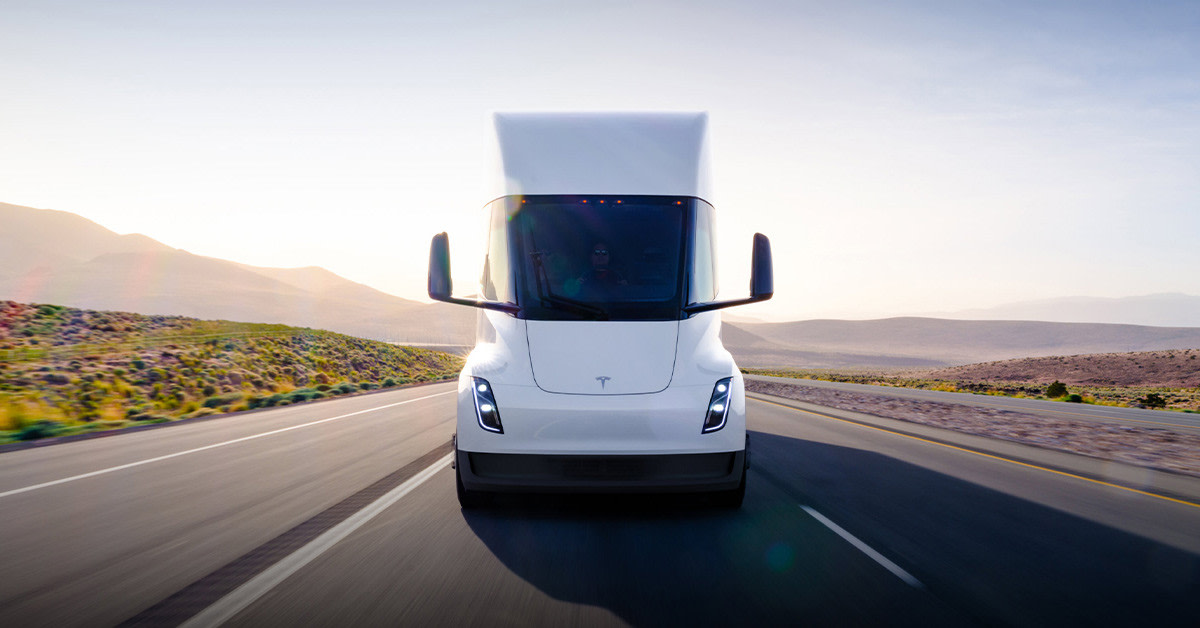
Tesla Semi's European Specs Are Official: 550 km Range and 800 kW Charging
Tesla has published European Semi specifications ahead of IAA Transportation, confirming 550 km of estimated range, 800 kW charging and 2027 deliveries.
Photo: Tesla
Tesla’s range, power, weight and charging figures remain manufacturer estimates with configuration and operating conditions; they are not independent fleet tests or homologation evidence.
Tesla has finally put European numbers on the Semi.
Ahead of the truck’s appearance at IAA Transportation in Hannover, the company has published a regional specification sheet confirming an estimated 550 km (342 miles) of range, energy consumption of 1.0 kWh per kilometre, a roughly 9.1-tonne tractor curb weight and charging at up to 800 kW.
Tesla’s European Semi product page also says customer deliveries will begin in 2027. Pricing, the first delivery markets and a detailed European charging-network plan remain unannounced.
The specifications answer several of the biggest questions raised when Tesla confirmed the Semi was coming to Europe. They also reveal a truck aimed more squarely at regional and medium-distance freight than the 500-mile Long Range version advertised in North America.
Tesla Semi European Specifications
| Specification | European Tesla Semi |
|---|---|
| Estimated range | 550 km (342 miles) |
| Estimated energy consumption | 1.0 kWh/km |
| Gross combination weight | 40 tonnes |
| Tractor curb weight | About 9,100 kg |
| Drive power | Up to 800 kW |
| Fast-charging capability | Up to 800 kW |
| Charging recovery | Up to 60% of range in 30 minutes |
| Charge interface | MCS 3.2 |
| Electric power take-off | Up to 25 kW |
| European customer deliveries | Beginning in 2027 |
The European truck uses three independent motors on its rear axles. Tesla lists both maximum drive output and maximum charging capability at 800 kW, so the repeated number refers to two different systems.
Tesla also identifies MCS 3.2 as the charge type. MCS, or the Megawatt Charging System, is designed for commercial vehicles that need far more power than a typical passenger-EV fast charger can provide. Tesla says a 30-minute session can recover up to 60% of the truck’s range, equal to roughly 330 km under the company’s estimate.
That is a meaningful break-time charge for routes with the right infrastructure. It does not mean every MCS site will supply the full 800 kW, however, and fleets will still need to plan around charger availability, trailer access and site power.
The 550-KM Range Comes With Important Conditions
Tesla’s range figure is an estimate rather than a promise for every route.
The company says its calculation assumes a fully loaded 40-tonne gross combination weight, a steady 80 km/h, 20°C weather, flat terrain and an aerodynamic tandem-axle setup with a dry-van trailer. Tire choice, roof fairing and trailer configuration can all materially change energy use.
Real operations add hills, winter temperatures, wind, traffic, auxiliary loads and time spent at higher speeds. A refrigerated trailer or other power-hungry equipment can also reduce practical driving range, although the Semi’s newly listed 25-kW electric power take-off gives body builders and fleet operators a way to run compatible equipment without a separate diesel unit.
For buyers, the useful takeaway is not that every Semi will cover exactly 550 km. It is that Tesla is targeting about 1.0 kWh/km while moving a 40-tonne combination under a favourable but clearly defined test scenario. Fleets can use that baseline to model their own routes instead of relying on the North American truck’s 325-mile or 500-mile headline.
Payload Looks Competitive on Paper
At about 9.1 tonnes, the European Semi tractor is lighter than many observers expected from a battery-electric heavy truck.
That number is not the truck’s usable payload by itself. Operators still have to subtract the trailer’s weight from the legal combination limit, account for axle-loading rules and configure the fifth wheel and body correctly. European rules may also provide additional weight allowances for zero-emission trucks in eligible configurations.
Even so, publishing the tractor weight is important. Payload can decide whether an electric truck makes financial sense: a few extra tonnes of battery mass may be acceptable for parcel freight, but costly for operations that routinely reach maximum legal weight.
Tesla’s specification gives fleets enough information for an initial calculation. The next step is homologated configuration data for individual markets, including axle ratings and the exact weight of customer-ready tractors with required equipment.
Europe Gets the Standard-Range Proposition
Tesla’s North American lineup has been presented with Standard Range and Long Range configurations. The European page currently shows one 550-km version, placing it close to the American Standard Range truck rather than the 500-mile flagship.
That choice makes practical sense. European long-haul trucks operate under different speed, dimension and weight rules, while many fleet routes can return to a depot or use scheduled charging during mandated driver breaks. A lighter, smaller-battery version can protect payload and reduce purchase cost if 550 km is enough for the duty cycle.
The trade-off is that the Semi will enter a market where established truck makers already sell battery-electric models and support them through mature commercial service networks. Tesla’s efficiency and integrated charging approach are strengths, but fleets buy uptime as much as they buy specifications.
The company still needs to explain where European Semi operators will charge, whether all compatible public MCS stations will work without restrictions, how service coverage will be organized across borders and what the truck will cost.
Why the 2027 Delivery Date Matters
Tesla says European customer deliveries begin in 2027, turning the Hannover appearance into more than another technology preview.
A delivery year gives prospective operators a planning window for depot upgrades, route modelling and vehicle replacement cycles. Heavy-duty charging projects can require significant lead time because utilities may need to increase grid capacity before multiple trucks can charge simultaneously.
The date is still broad. Tesla has not named priority countries, order timing, production allocation or annual European volume. Those details will determine whether 2027 means a limited fleet introduction or the start of a wider commercial rollout.
Pricing may be the biggest missing number. The Semi’s running-cost case depends on electricity prices, annual mileage, payload, financing, charger construction and maintenance savings. An efficient truck can still be a difficult purchase if its upfront price or infrastructure requirements overwhelm the fuel savings.
What Tesla Answered — and What It Didn’t
The European specification resolves several important unknowns:
- Tesla is targeting 550 km of range at a 40-tonne combination weight.
- The tractor weighs about 9.1 tonnes before the trailer and cargo.
- MCS charging peaks at 800 kW, with up to 60% range recovery in 30 minutes.
- The truck includes up to 25 kW of electric power take-off capability.
- Customer deliveries are planned to begin in 2027.
The remaining questions are commercial rather than conceptual: price, country rollout, charging locations, service support and customer-ready payload in common European configurations.
Those are exactly the questions that matter now. Tesla has moved the European Semi from a future announcement to a defined product with a delivery year. If the company follows the specification sheet with credible infrastructure and support plans, the 550-km truck could be a serious regional-freight option rather than simply the most recognizable electric truck at the show.