Ford and Geely Will Build Two Electric SUVs in Spain From 2028
Ford and Geely plan a Valencia joint venture that will build two Geely electric SUVs, a new Ford Bronco, and a jointly developed crossover beginning in 2028.
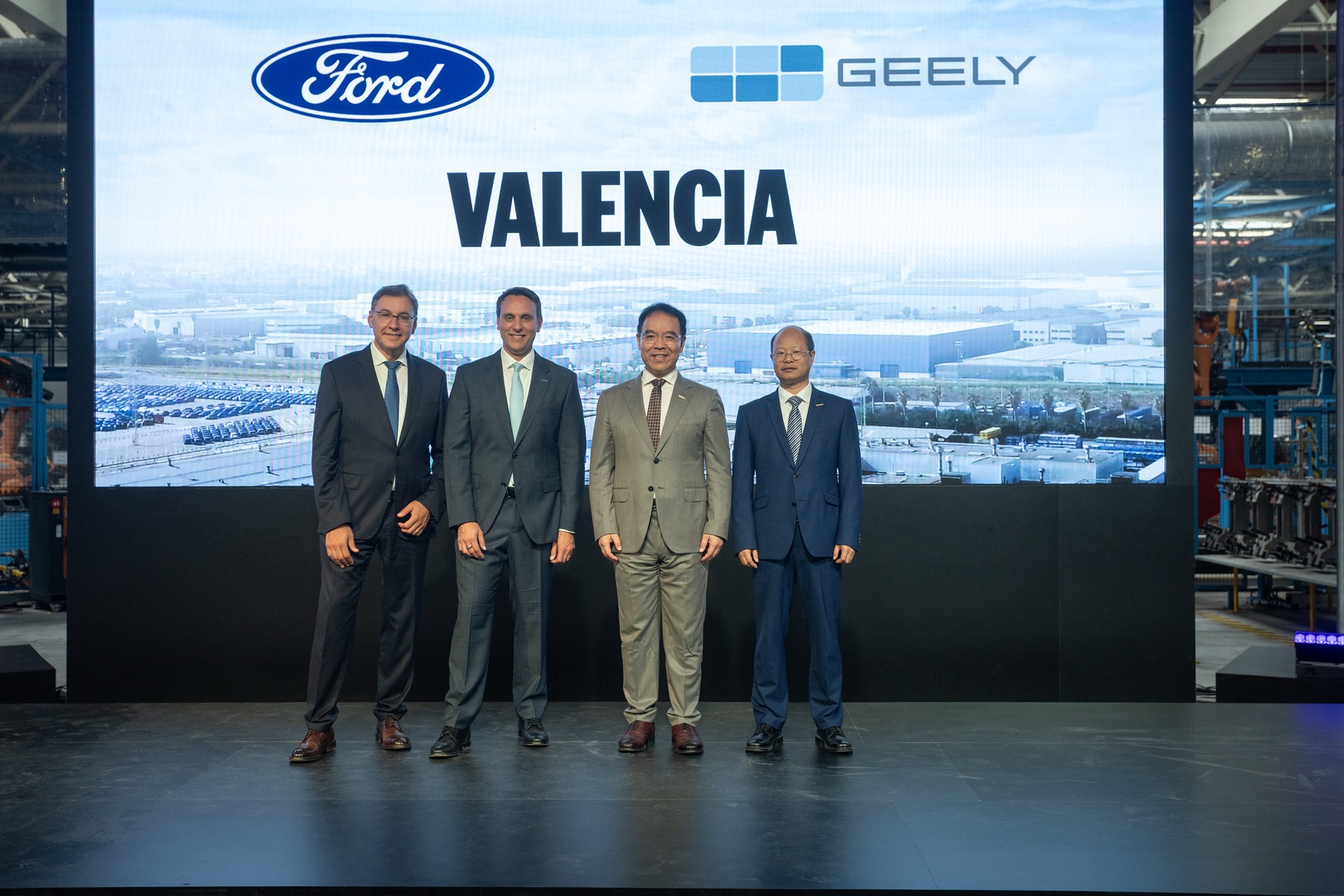
Ford and Geely are turning Ford’s underused Valencia factory into a shared European production hub, with two Geely electric SUVs among the five vehicles planned for the site.
The automakers announced the proposed joint venture on July 23. Pending regulatory approval, Ford will own 66 per cent and Geely Auto 34 per cent. The venture is expected to begin operating in the first half of 2027, with the first new vehicles scheduled to roll off the Spanish assembly line in 2028.
This is more than a factory-utilization deal. Ford gets a partner with serious EV scale, software experience, and cost discipline. Geely gets a European manufacturing base at a plant capable of producing roughly 500,000 vehicles per year. Both companies get to spread the cost of developing and building vehicles across more volume.
For buyers, the most important detail is that this will not be a one-model experiment. Ford and Geely are planning a mixed lineup of electric, plug-in-hybrid, and other powertrain choices built for Europe.
Five Vehicles Are Part of the Plan
The official Ford and Geely announcement outlines five products for Valencia:
- The existing Ford Kuga, including its plug-in-hybrid version, will continue in production
- A new, compact member of the Ford Bronco family will enter production in 2028
- Ford and Geely will jointly develop an all-new multi-energy family crossover for 2028
- Geely will build two electric SUVs at the factory, with the first due in 2028
Ford has not disclosed the powertrain details for the new Bronco, and the companies have not released specifications, battery sizes, range estimates, or prices for the jointly developed crossover.
The two Geely EVs are also mostly under wraps. Reuters reports that the EX5, an electric SUV already sold in parts of Europe, will be one of them. The companies’ own release does not name either model, so the second vehicle remains unknown.
That uncertainty matters. “Two electric SUVs” sounds concrete, but the products are still roughly two years from production. Battery chemistry, charging speed, platform, price, and the markets where each model will be sold will determine whether this becomes a genuine value play or simply another pair of crossovers in a crowded segment.
Why Ford Needs Geely in Europe
Ford’s European passenger-vehicle business has been shrinking. The Associated Press notes that Ford sold more than one million vehicles across Europe a decade ago but fewer than 500,000 last year.
At the same time, European automakers are confronting tighter emissions rules, high development costs, and Chinese competitors that can bring new EVs to market quickly. Ford has capable electric products, but building them competitively at modest volume is a difficult equation.
Geely changes that equation. The Chinese group has broad experience across battery-electric and plug-in-hybrid platforms, and its wider corporate family includes Volvo, Polestar, Zeekr, and Lynk & Co. Geely Auto says it sold 474,228 vehicles outside China during the first half of 2026.
Pooling production at Valencia should give Ford more volume over which to spread the factory’s fixed costs. It also lets Ford add models without carrying every engineering and manufacturing expense alone. The jointly developed crossover is the clearest sign that this relationship goes beyond renting assembly-line space.
Ford is still preserving its identity in the arrangement. Its announcement promises Ford-specific driving dynamics and capability, while Geely brings technology, sourcing, and development scale. The hard work will be making those claims visible in the finished vehicles rather than producing lightly differentiated products under separate badges.
Why Geely Wants a European Factory
For Geely, Valencia provides an established plant, experienced workers, and local production in one of the world’s most competitive EV markets.
That is a quicker route than constructing a factory from scratch. It also puts Geely vehicles closer to European buyers and suppliers while the company expands beyond China. Reuters describes Valencia as Geely Auto’s first European production facility.
Geely is not arriving in Europe without experience. Brands connected to the broader Geely group already sell vehicles across the region, and Volvo has a long-established European manufacturing footprint. What changes here is the scale and visibility of Geely-branded production inside an existing Ford plant.
There is also some shared history. Ford sold Volvo Cars to Geely in 2010, a deal Ford now points to as part of the trust behind the new venture. The companies are not strangers meeting because factory capacity suddenly became available.
What Happens to the Valencia Plant
The Kuga will continue to be built while the venture works through regulatory approval and prepares the new lineup. That continuity is important because the proposed vehicles do not arrive until 2028.
Ford describes Valencia as having potential annual capacity of about 500,000 vehicles. The joint venture is meant to fill more of that capacity and lower the cost of each vehicle produced there. Ford also says the arrangement could support future job growth, but that should be treated as a target rather than a guaranteed employment outcome.
The sequence now looks like this:
- Second half of 2026: regulatory review and detailed planning
- First half of 2027: targeted start of joint-venture operations
- 2028: production begins for the new Bronco, jointly developed crossover, and first Geely electric SUV
- By 2029: Ford plans five new multi-energy passenger vehicles for European showrooms, including products beyond this Valencia announcement
Those dates are company plans and could move as approvals, tooling, supplier contracts, and product development progress.
What It Means for Canadian EV Buyers
The announcement is focused entirely on Europe. It does not confirm Canadian production, pricing, or sales for any of the five vehicles.
Still, the strategy matters to Canada because it shows how quickly the line between “Western automaker” and “Chinese EV company” is blurring. Ford is not importing a finished Geely vehicle and applying a blue oval. It is proposing a shared company, a shared factory, and at least one jointly developed product.
That makes the broader Chinese-EV discussion more complicated. Canada is already navigating a limited quota for China-built EV imports, while automakers are increasingly sharing platforms, battery supply chains, software, and factories across borders. The badge on the nose tells only part of the story.
For now, Canadian shoppers should treat Valencia as an industrial signal, not a product announcement for this market. The useful takeaway is that cost-sharing and local production are becoming central to how established automakers plan to compete with China’s fastest-growing EV companies.
Ford needs more competitive scale in Europe. Geely wants deeper access to European manufacturing. Valencia gives both companies a practical place to meet—and five vehicles will show whether the partnership works.