BMW's iX5 Hydrogen Just Took a Real Step Toward Production
BMW has started pre-series production of the iX5 Hydrogen's Energy Master control unit at Plant Landshut, while expanding the same hardware family for Neue Klasse EVs.
Photo: BMW
BMW’s hydrogen SUV program is no longer just a prototype story.
The company said on May 21 that BMW Group Plant Landshut has started pre-series production of the Energy Master control unit for the upcoming BMW iX5 Hydrogen. At the same time, Landshut is bringing a second production line online for the battery-electric version of the same hardware family, used in Neue Klasse vehicles including the BMW iX3 and BMW i3.
That combination is the interesting part. BMW is not treating hydrogen as a separate science project parked away from its EV work. It is trying to industrialize a shared electrical control architecture that can support battery-electric and fuel-cell electric vehicles in parallel.
The iX5 Hydrogen is still planned for 2028, so this is not a showroom launch. But pre-series hardware production is a meaningful step because it moves the program deeper into the manufacturing system BMW will need if the hydrogen X5 is going to become more than another limited pilot fleet.
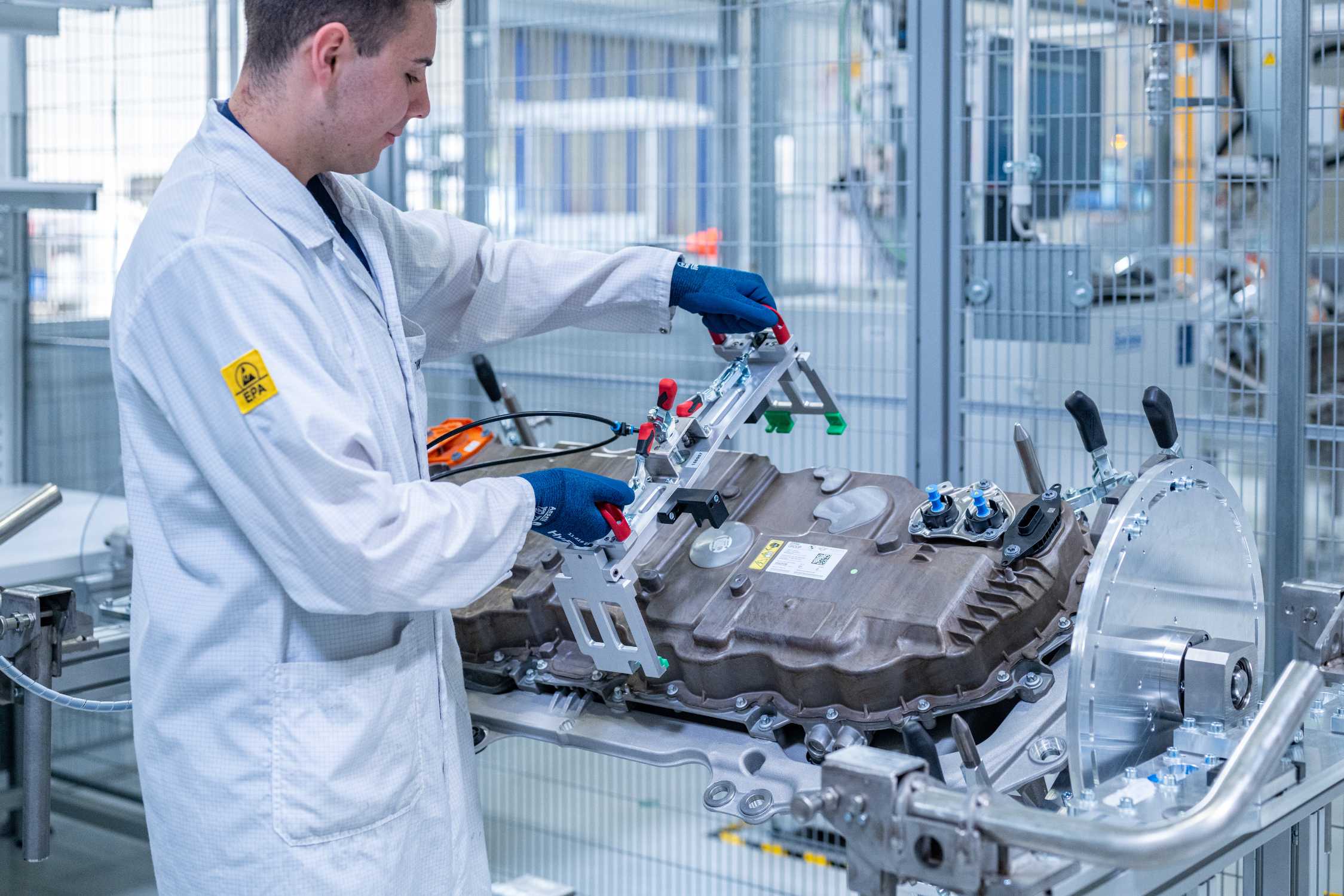
BMW iX5 Hydrogen Energy Master production at Plant Landshut
14


BMW has started pre-series production of the hydrogen-specific Energy Master control unit at Plant Landshut.
What the Energy Master Does
BMW describes the Energy Master as the central control unit for the high-voltage system.
In a battery-electric vehicle, it is mounted on the high-voltage battery. In the iX5 Hydrogen, a modified version is installed on BMW’s Hydrogen Flat Storage system and acts as the key interface between the fuel-cell system, the high-voltage battery, the electric drive machines, and the vehicle’s electrical system.
That sounds like supplier-deck language, but it matters because fuel-cell vehicles are still electric vehicles. The fuel cell generates electricity from hydrogen, the battery helps buffer and deliver power, and the electric motors do the driving. Getting that whole system to feel like a BMW instead of a lab demonstrator depends on the control hardware and software working cleanly together.
BMW says the Energy Master is being developed and produced fully in-house for the first time. That gives the company more control over one of the most important pieces of the drivetrain, especially as it tries to keep commonality between battery-electric and hydrogen systems.
Why Landshut Matters
Plant Landshut is becoming one of BMW’s key electrification sites.
The plant already builds the battery-electric Energy Master for Neue Klasse models, and BMW says the second production line will almost double capacity for that version. At the same time, Landshut is starting pre-series work on the hydrogen-specific unit.
That is the industrial story behind the headline. BMW has invested a high three-digit million-euro sum at Landshut since 2020 to expand electromobility and related key technologies. The site also has hydrogen experience already, including media distribution plates and fuel-cell stack housings for the current iX5 Hydrogen pilot fleet.
For a company that keeps talking about technology openness, this is where the slogan has to become parts, processes, workers, suppliers, and quality checks. It is easy to announce multiple propulsion paths. It is much harder to build them without turning the factory footprint into a costly mess.
The 2028 iX5 Hydrogen Plan
BMW still expects the production iX5 Hydrogen to arrive in 2028.
The company says the vehicle will use a new hydrogen tank concept called BMW Hydrogen Flat Storage, with tank arrangement and size enabling a range of up to 750 kilometres in development form. BMW also says the system is compatible with its Gen6 high-voltage battery setup without taking up interior space, which would allow fuel-cell models to be built on the same production line as other drive systems.
The fuel-cell system itself is the third generation of BMW’s hydrogen technology and is being developed jointly with Toyota. BMW says series production of the fuel-cell systems is scheduled to begin from 2028 at BMW Group Plant Steyr, with Landshut integrated as a technology and component location.
There is public money behind this push too. BMW says the HyPowerDrive project is receiving EUR 191 million from Germany’s Federal Ministry of Transport, with an additional EUR 82 million from the state of Bavaria.
Those numbers underline the reality of hydrogen passenger cars in 2026: the technology is not dead, but it still needs major industrial and infrastructure support.
The Buyer Reality Is Still Complicated
The iX5 Hydrogen could be useful for a very specific kind of future luxury-SUV buyer: someone who wants electric drive, long range, fast refuelling, and a vehicle that does not depend on high-power DC charging stops.
That is the upside BMW is chasing. Hydrogen can store a lot of energy, refuelling can be quick when the station network exists, and a premium SUV gives BMW room to package expensive hardware before trying to scale anything lower in the lineup.
The problem is that the station network is the whole story. Battery-electric drivers can already use expanding public charging networks, home charging, workplace charging, and increasingly the North American Charging Standard ecosystem. Hydrogen passenger-car drivers need hydrogen stations, and those remain highly concentrated in a few markets.
That does not make BMW’s work pointless. It does mean Canadian and U.S. buyers should read this as a technology-development milestone, not a signal to wait on an X5 Hydrogen instead of buying a battery-electric SUV today.
For most luxury EV shoppers, BMW’s battery-electric Neue Klasse models will matter sooner and in far larger numbers. The iX5 Hydrogen is more likely to test whether hydrogen can serve edge cases: long-distance premium use, regions with strong hydrogen policy support, fleet-like duty cycles, or customers who value fast refuelling more than charging-at-home convenience.
The Motorlinks Take
BMW’s Landshut announcement is not big because it proves hydrogen cars are about to go mainstream. It does not.
It is big because it shows BMW is still doing the hard industrial work needed to keep hydrogen alive as a serious option inside its vehicle architecture. The company is connecting fuel-cell development, battery-electric control hardware, Neue Klasse production, Toyota fuel-cell collaboration, and government-backed hydrogen funding into one manufacturing plan.
That is more credible than another concept-car promise. It is also still a long way from proving market demand.
The iX5 Hydrogen’s real test will come in 2028, when BMW has to show whether a fuel-cell X5 can deliver range, performance, packaging, refuelling convenience, and real-world availability in a way that makes sense beside increasingly capable battery-electric SUVs.
For now, BMW has moved the program one step closer to the factory floor. That is progress. It is not yet proof.