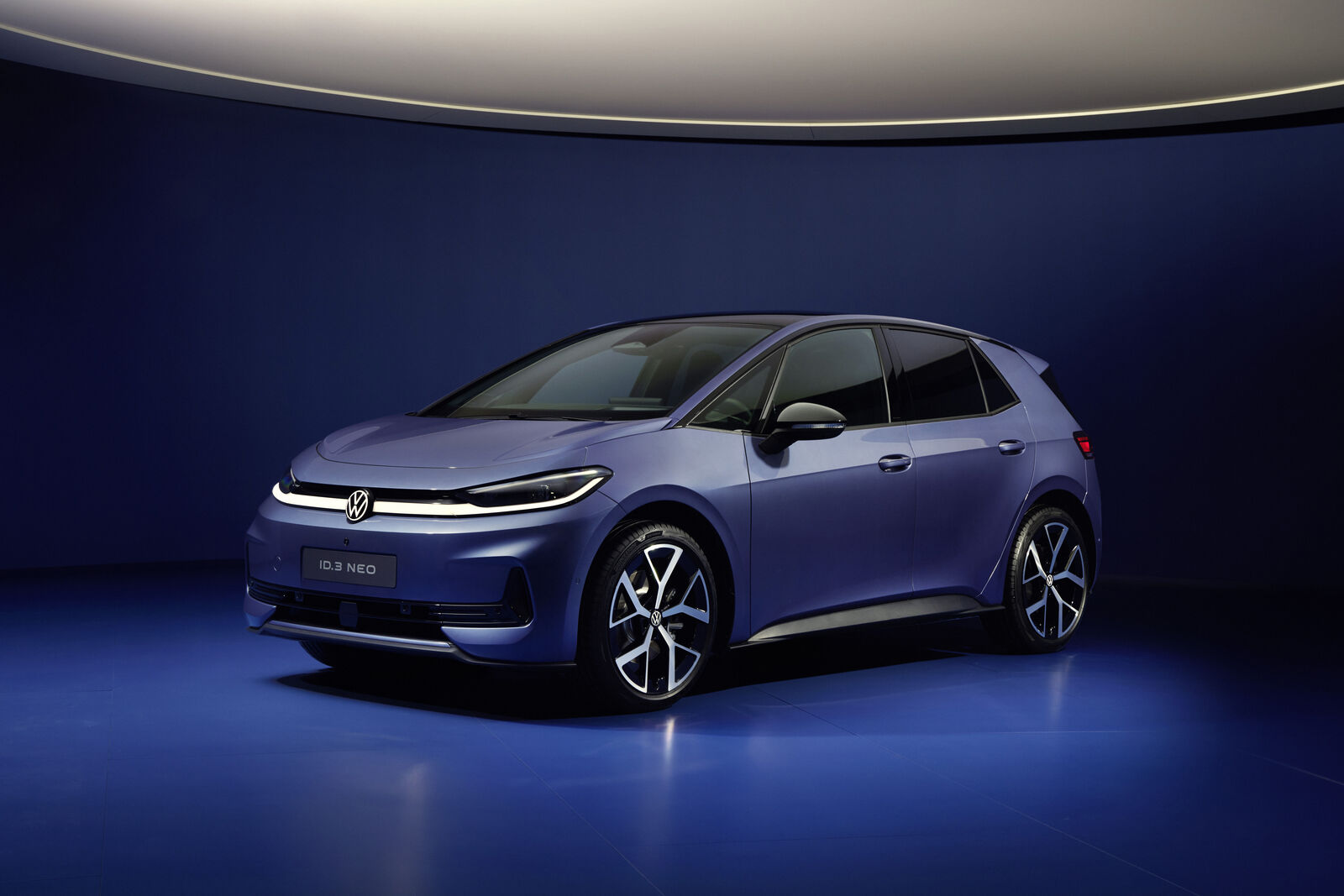
Volkswagen ID.3 Neo Debuts With 630 km Range, New Cabin, and Faster Charging
Volkswagen has unveiled the ID.3 Neo with a sharper design, redesigned interior, new software features, and up to 630 km of WLTP range, with pre-sales opening April 16 in Germany and many European markets.
Photo: Volkswagen

Volkswagen has taken the wraps off the ID.3 Neo, giving its compact EV a new name and a fairly substantial update at the same time.
The headline numbers are strong for this class. With the largest available battery, Volkswagen says the ID.3 Neo can deliver up to 630 km of WLTP range, while DC fast-charging peaks at 183 kW on the 79 kWh battery version. Pre-sales start Thursday, April 16, 2026 in Germany and many European markets.
This is more than a mild facelift. Volkswagen is pitching the ID.3 Neo as a more polished, more intuitive, and more efficient evolution of the original ID.3, with a redesigned front end, a cleaner cockpit, updated infotainment, and several new software-driven features.
Three Trims, Three Power Outputs, Three Battery Sizes
Volkswagen is launching the ID.3 Neo in Trend, Life, and Style trims. Buyers will also get three motor outputs: 125 kW, 140 kW, and 170 kW.
Battery choices are equally straightforward. The entry version pairs the 125 kW motor with a 50 kWh net battery, while upper trims can be configured with a 58 kWh net battery or a 79 kWh net battery. According to Volkswagen, the 50 kWh and 58 kWh versions support up to 105 kW DC charging, while the 79 kWh model can charge at up to 183 kW.
That makes the big-battery version the one to watch if road-trip usability is a priority. A 630 km WLTP claim will not translate directly to real-world highway range, of course, but it still puts the ID.3 Neo in serious territory for a compact electric hatchback.
The Cabin Upgrade Looks Like the Bigger Win
Volkswagen is talking plenty about range and efficiency, but the most important improvement may be inside.
The ID.3 Neo gets a redesigned cockpit, a 10.25-inch Digital Cockpit, and a 12.9-inch central display. Volkswagen is also emphasizing higher-quality materials, clearer horizontal layout lines, and more intuitive controls. That matters because interior usability has been one of the areas where buyers have expected Volkswagen’s EVs to feel more like the brand’s best conventional cars.
On paper, this update looks like a deliberate move back toward familiar Volkswagen strengths: sensible packaging, clear controls, and an interior that does not need a learning curve just to feel normal.
New Tech Focuses on Everyday Driving
Volkswagen is also adding a handful of features that sound more useful than gimmicky.
Among the new highlights are Connected Travel Assist with traffic light recognition, one-pedal driving, and vehicle-to-load capability up to 3.6 kW. That last one means the ID.3 Neo can supply power to external devices directly from its high-voltage battery, which is the kind of feature that sounds niche until you actually want to power bikes, tools, or camping gear.
The company also says the new infotainment setup supports an expanded in-car app ecosystem, while the options list includes items like an augmented reality head-up display, panoramic roof, 360-degree camera view, Harman Kardon audio, and seat massage and memory functions.
Why This Launch Matters
Volkswagen is clearly trying to give the ID.3 a stronger second act rather than simply extending the old formula.
The new name matters because it signals a reset. The new design, new interior, and revised software matter because they address exactly the areas where an electric compact car has to feel easy to live with, not just efficient on a spec sheet. And the range and charging improvements matter because compact EV buyers still care deeply about whether a smaller, more affordable electric car can handle longer trips without feeling compromised.
For now, this is a Europe-focused launch, and Volkswagen’s own announcement is specific about pre-sales beginning in Germany and many European markets. Even so, the ID.3 Neo is still worth watching from a broader EV standpoint because it shows how legacy brands are trying to refine first-generation dedicated EVs into products that feel more mature and less experimental.
The Motorlinks Take
This is the kind of update the ID.3 needed.
Volkswagen did not just add a little range and call it a day. The ID.3 Neo gets a meaningful range headline, stronger charging on the big battery, a cleaner interior story, and features that should make daily use simpler instead of busier. If the real-world execution matches the spec sheet, the ID.3 Neo looks much closer to the compact EV Volkswagen probably wanted to launch in the first place.
The bigger question now is pricing, because that will decide whether the Neo’s stronger hardware and nicer cabin turn into real momentum once pre-sales open on April 16, 2026.