Canada just cut up to $10,000 off pricey EVs. Who actually benefits?
Ottawa raised the EV luxury-tax threshold to $150,000 from Nov. 13, 2026. We ran Porsche and Lucid Canada prices to see who saves up to $10,000 and who doesn't.
Last updated
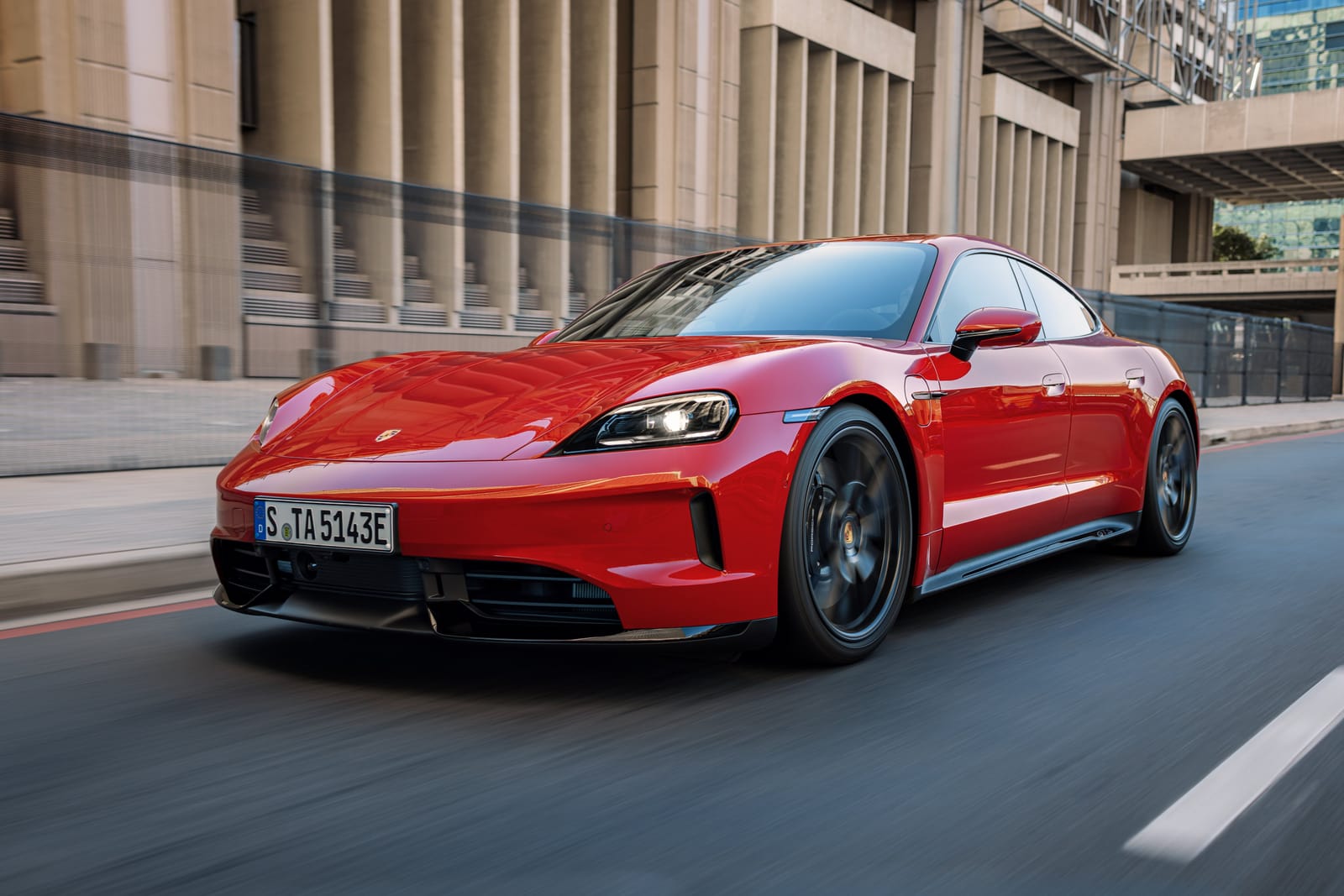
Photo: Porsche
If you’re buying a new battery-electric or hydrogen vehicle priced between $100,000 and $300,000, Canada’s luxury tax on it just dropped, by as much as $10,000. Finance Canada announced on Nov. 12, 2026 that the price threshold for fully electric and hydrogen vehicles would rise from $100,000 to $150,000, effective Nov. 13, subject to later approval by Parliament. Gas cars, hybrids and plug-in hybrids stay at $100,000.
Everyone else gets nothing from this change. A typical EV buyer shopping under $50,000 for the federal EVAP rebate isn’t affected. This explainer, updated Nov. 16, 2026, shows the formula, what it does at $120,000, $150,000 and $175,000, and what it means for real Canadian prices from Porsche and Lucid.
Quick answer
- The threshold for fully electric and hydrogen vehicles moves to $150,000 from $100,000, for sales completed after Nov. 12, 2026, according to Finance Canada’s draft legislation. It still needs Parliament’s approval.
- The formula doesn’t change. The tax is the lesser of 10% of the taxable amount and 20% of the amount above the threshold.
- By our arithmetic, the saving is 20% of the price above $100,000 up to $150,000, then a flat $10,000 up to $200,000. It shrinks after that and disappears at $300,000.
- Plug-in hybrids don’t qualify. A Porsche Cayenne S E-Hybrid still pays about $5,457 by our calculation. A Cayenne Electric at a similar price now pays nothing.
- The rebate and the tax break barely overlap. Transport Canada’s EVAP rebate needs a final transaction value of $50,000 or less unless the car is made in Canada. This break starts at $100,000.
What Ottawa changed, and what it didn’t
The luxury tax has applied since Sept. 1, 2022 to new passenger vehicles priced above $100,000, according to the CRA’s luxury tax notice for vehicles. It covers sedans, coupes, SUVs and light-duty pickups with a gross vehicle weight rating of 3,856 kg or less. It’s charged when a new vehicle is sold, imported, leased or first registered by a dealer.
Finance’s draft adds a new term, “qualifying electric vehicle”: a motor vehicle that is “fully electric,” “fully powered by hydrogen,” or a prescribed motor vehicle. That class gets a $150,000 threshold. Every other subject vehicle keeps $100,000. The release says the change “recognizes the higher upfront cost of zero-emission vehicles.”
The rate stays where it was. Section 34 of the Select Luxury Items Tax Act sets the tax at the lesser of 10% of the taxable amount and 20% of the amount above the price threshold. Raising the threshold changes the second number, which is the one that sets the tax on any vehicle under $200,000.
Not law yet: Finance says the measure “would be effective as of tomorrow, subject to subsequent parliamentary approval.” When we checked on Nov. 16, 2026, section 9 of the Act on the Justice Laws site still read $100,000.
How much the change saves at $120,000, $150,000 and $175,000
The table runs the formula at both thresholds. These are our own calculations from section 34, not figures published by Finance or the CRA. The CRA’s own worked example, a $150,000 sale taxed at $10,000 under the old rule, matches our second row.
| Taxable amount | Tax at $100,000 threshold | Tax at $150,000 threshold | Saving | Saving incl. 13% HST (Ontario) |
|---|---|---|---|---|
| $120,000 | $4,000 | $0 | $4,000 | $4,520 |
| $150,000 | $10,000 | $0 | $10,000 | $11,300 |
| $175,000 | $15,000 | $5,000 | $10,000 | $11,300 |
| $200,000 | $20,000 | $10,000 | $10,000 | $11,300 |
| $250,000 | $25,000 | $20,000 | $5,000 | $5,650 |
| $300,000 | $30,000 | $30,000 | $0 | $0 |
Three things stand out.
There’s no cliff at $150,000. Up to $300,000, the tax is 20% of the amount above the new threshold. An EV that lands $1,000 over the line pays $200, not $15,000. Above $300,000 the 10% cap sets the tax, so each extra $1,000 adds $100.
The $10,000 maximum only applies between $150,000 and $200,000. Above $200,000, the 10%-of-the-whole-price cap kicks in under the old rule, so the gap between the two thresholds narrows by $1 for every $10 of price. At $300,000, both thresholds produce the same $30,000 bill.
The real saving is a bit bigger than the tax line. The CRA’s consideration and retail value page says GST/HST is applied to the final sale price including the luxury tax. In Ontario, with 13% HST, a $10,000 cut in luxury tax takes $11,300 off the bill. In a province that charges only the 5% GST, it’s $10,500.
The threshold counts more than the sticker
The luxury tax isn’t charged on the advertised MSRP. The CRA says the taxable amount includes factory options, dealer-installed improvements, accessories sold with the car, freight, PDI, administration and documentation fees, and levies such as the federal A/C excise tax. It excludes GST/HST, extended warranties, service plans, insurance products and winter tires that aren’t installed at sale.
That matters at the edge. Porsche Canada’s configurator for the 2027 Taycan 4S, checked Nov. 16, 2026, lists a $142,600 base price, a $3,200 destination charge, an estimated maximum dealer fee of $2,750, a $35 tire fee and $100 of A/C tax. By our addition, the base 2027 Taycan 4S comes to $148,685 before luxury tax, which is $1,315 under the new threshold.
On the same page, Porsche was still showing an “Estimated Luxury Tax” of $9,737 for that car, which is the old $100,000 calculation. A $1,630 paint colour would take the taxable amount to $150,315, and under the new rule that adds $63 of tax.
Which EVs on sale in Canada are in the $100,000 to $300,000 band?
Porsche Canada’s comparison pages show “From” prices that include destination, estimated dealer fees, levies and luxury tax at the old threshold. The Taycan 4S breakdown above confirms that. So we removed the tax to get each model’s starting taxable amount, then reran the formula at $150,000. Options will raise every figure.
| Model | Porsche.ca "From" total | Taxable amount (our calc.) | Tax at $100,000 | Tax at $150,000 | Saving |
|---|---|---|---|---|---|
| Macan 4 Electric | $114,382 | $111,985 | $2,397 | $0 | $2,397 |
| Macan Turbo Electric | $148,342 | $140,285 | $8,057 | $0 | $8,057 |
| Cayenne Electric | $144,862 | $137,385 | $7,477 | $0 | $7,477 |
| Taycan 4S | $158,422 | $148,685 | $9,737 | $0 | $9,737 |
| Cayenne S Coupé Electric | $161,902 | $151,585 | $10,317 | $317 | $10,000 |
| Taycan GTS | $188,662 | $173,885 | $14,777 | $4,777 | $10,000 |
| Cayenne Turbo Electric | $201,262 | $184,385 | $16,877 | $6,877 | $10,000 |
| Taycan Turbo | $224,384 | ≈$203,985 | ≈$20,399 | ≈$10,797 | ≈$9,601 |
| Taycan Turbo S | $267,064 | ≈$242,785 | ≈$24,279 | ≈$18,557 | ≈$5,721 |
| Taycan Turbo GT | $304,464 | ≈$276,785 | ≈$27,679 | ≈$25,357 | ≈$2,321 |
The table shows the shape of the change in one brand. The biggest flat saving goes to the Taycan GTS and Cayenne Turbo Electric, at $150,000 to $200,000. The cheapest electric Macan saves about $2,400. Porsche’s $300,000-plus Taycan Turbo GT saves about $2,300.
Lucid sells direct in Canada, and its prices are easier to read. Lucid’s Canadian Air page says its prices include a $2,000 destination fee, a $200 documentation fee and $100 of A/C tax, and exclude the luxury tax. The Gravity page says the same, with a $2,300 destination fee.
| Model | Lucid.com/en-ca "From" price | Tax at $100,000 | Tax at $150,000 | Saving |
|---|---|---|---|---|
| Lucid Air Pure (2027) | $99,900 | $0 | $0 | $0 |
| Lucid Air Touring (2027) | $112,800 | $2,560 | $0 | $2,560 |
| Lucid Gravity Touring | $113,500 | $2,700 | $0 | $2,700 |
| Lucid Gravity Grand Touring | $139,500 | $7,900 | $0 | $7,900 |
| Lucid Air Grand Touring (2027) | $161,200 | $12,240 | $2,240 | $10,000 |
The plug-in hybrid next to it doesn’t qualify
The clearest comparison is inside one Porsche showroom. The same Porsche Canada Cayenne page lists the Cayenne S E-Hybrid, a plug-in hybrid, from $132,742 and the Cayenne Electric from $144,862.
By our calculation, the plug-in hybrid’s taxable amount is about $127,285, and it still pays about $5,457 of luxury tax, because Finance says “all other vehicles would remain subject to the $100,000 price threshold.” The Cayenne Electric’s estimated $7,477 drops to zero. On those base prices, by our arithmetic, the price gap between the two shrinks from about $12,100 to about $4,600 before sales tax.
The draft law also lets the government prescribe vehicles into or out of the new class by regulation. As of Nov. 16, 2026, Finance hadn’t published any such regulation.
When the new threshold applies to your deal
The date that counts is when the sale is completed, not when you signed or ordered. The draft legislation applies the $150,000 threshold to a sale completed after Nov. 12, 2026, a vehicle imported after that date, a dealer-registered demo first registered after it, and a lease where you first have the right to use the car after it.
The CRA says a sale is generally completed when possession or ownership passes to you, whichever is earlier. So an EV ordered in October and delivered on Nov. 20 should fall under the new rule. One delivered on Nov. 10 doesn’t.
Used EVs aren’t affected either way. The CRA says the luxury tax generally doesn’t apply to vehicles that have already been registered with a province.
How this compares with the EVAP rebate
Transport Canada’s Electric Vehicle Affordability Program pays up to $5,000 on a battery-electric or fuel cell vehicle in 2026, falling to $4,000 on Jan. 1, 2027. To qualify, the car must be made in Canada or a free-trade partner country and have a final transaction value of $50,000 or less, “unless it’s made in Canada, then there’s no cap.”
Put the two together and the federal help for EV buyers now has a gap in the middle. A $48,000 EV can get up to $5,000 at the dealer. A $75,000 EV gets neither the rebate nor any luxury-tax break, because it was never taxed. A $175,000 EV saves $10,000 on tax. Our province-by-province rebate guide covers the rebate side in detail.
What we don’t know yet
- When Parliament votes. Finance hasn’t given a date, and the release doesn’t say what happens to sales completed in the meantime if the measure changes.
- The cost and who claims it. The release doesn’t estimate the cost or the number of buyers affected.
- How fast dealers and configurators update. Porsche’s Canadian configurator was still adding the old tax on Nov. 16.
- Provincial taxes. The CRA notes that British Columbia’s luxury vehicle tax is a form of PST. This federal change doesn’t touch it.
The MotorLinks take
The case for the change is real but narrow. A $100,000 line set for all cars catches EVs whose battery pushes them past it, and the release says that’s the point. Fixing that for a $112,800 Lucid Air Touring or a base Cayenne Electric is defensible.
But the formula means the full $10,000 goes to EVs costing $150,000 to $200,000, the buyers who need help the least, while EVAP still stops at $50,000 for an imported car. If Ottawa wants more Canadians in EVs, we think the buyers still on the fence are more likely shopping between $50,000 and $75,000, where neither EVAP nor this measure does anything for an imported car. For a luxury EV buyer, though, it’s a straight saving. Make sure it’s on your bill.
Checklist: what to ask the dealer
- “What’s the taxable amount on this car?” Ask for the total of price, options, accessories, freight, PDI and fees, before GST/HST.
- “Is the luxury tax calculated at $150,000?” Porsche’s configurator was still using $100,000 on Nov. 16. Get the line on the bill of sale recalculated.
- “When is the sale completed?” Possession or ownership after Nov. 12, 2026 uses the new threshold.
- “What happens if Parliament changes it?” Ask how the dealer will handle the tax if the final law differs, and get the answer in writing.
- “Is this a plug-in hybrid?” If so, the threshold is still $100,000.
- Price options with the threshold in mind. Between $150,000 and $300,000, each extra $1,000 adds $200 of tax. Above $300,000 the 10% cap applies, so each extra $1,000 adds $100. Below $150,000, options add none.
Bottom line
The higher threshold saves Canadian buyers of new fully electric and hydrogen vehicles 20% of the price above $100,000, up to $10,000. The full $10,000 applies between $150,000 and $200,000, and the saving fades out by $300,000. On Porsche’s base prices, that’s about $2,400 on a Macan 4 Electric, $9,737 on a Taycan 4S and $10,000 on a Taycan GTS.
It does nothing for most EV buyers, for plug-in hybrids or for used cars. If you’re shopping above $100,000, ask for the tax at $150,000 and check the completion date.
FAQ
Is the EV luxury-tax threshold in Canada now $150,000?
Finance Canada proposed it on Nov. 12, 2026, effective Nov. 13, subject to later approval by Parliament. It covers fully electric and hydrogen vehicles. As of Nov. 16, 2026, the consolidated Select Luxury Items Tax Act on the Justice Laws site still lists $100,000, because the amendment hasn’t passed.
How much does the higher threshold save on an EV?
By our arithmetic from the tax formula, 20% of the price above $100,000 for an EV priced up to $150,000, and a flat $10,000 between $150,000 and $200,000. Above $200,000 the saving shrinks, and it reaches zero at $300,000. GST/HST is charged on the price including luxury tax, so the cash saving is a little larger.
Do plug-in hybrids get the $150,000 threshold?
No. Finance Canada says all other vehicles stay at $100,000, and the draft law gives the higher threshold to vehicles that are fully electric, fully powered by hydrogen, or prescribed by regulation. A plug-in hybrid isn’t fully electric.
Can I get the EVAP rebate and the luxury-tax break on the same car?
Not on an imported EV. EVAP requires a final transaction value of $50,000 or less unless the car is made in Canada, and the luxury tax only starts above $100,000. Only a Canadian-made EV with a final transaction value over $100,000 could in principle qualify for both.
Does the new threshold apply to an EV I ordered before Nov. 13?
Under the draft legislation, it depends on when the sale is completed, not when you ordered. The CRA says a sale is generally completed when you take possession or ownership, whichever is earlier. A sale completed after Nov. 12, 2026 uses the new threshold, if Parliament passes it.
Last updated
How we got these numbers
Luxury tax is the lesser of 10% of the taxable amount and 20% of the amount above the price threshold (Select Luxury Items Tax Act, s. 34). Savings compare that formula at $100,000 and at $150,000. Porsche Canada's 'From' totals include destination, an estimated maximum dealer fee, levies and luxury tax at $100,000, so we subtract the tax to get the taxable amount. Lucid Canada prices include destination, documentation and A/C tax but exclude luxury tax. Prices checked Nov. 16, 2026.
Sources used for these figures
- Finance Canada: Government of Canada adjusts the taxable value threshold for zero-emission vehicles (Nov. 12, 2026)
- Finance Canada: Legislative proposals relating to the Select Luxury Items Tax Act (Nov. 2026)
- Justice Laws: Select Luxury Items Tax Act, section 34 (amount of tax)
- Porsche Canada: Taycan 4S configurator, estimated total price breakdown
- Transport Canada: Electric Vehicle Affordability Program overview
How to cite
Canada just cut up to $10,000 off pricey EVs. Who actually benefits? MotorLinks. Updated November 16, 2026. https://motorlinks.net/articles/features/2026-11-16-ev-luxury-tax-threshold-150000-canada
Key findings
- By our arithmetic, the saving is 20% of the price above $100,000 up to $150,000, then a flat $10,000 up to $200,000.
- By our addition, the base 2027 Taycan 4S comes to $148,685 before luxury tax, which is $1,315 under the new threshold.
- Porsche's $300,000-plus Taycan Turbo GT saves about $2,300.
- A Porsche Cayenne S E-Hybrid still pays about $5,457 by our calculation.
Sources
- Finance Canada: Government of Canada adjusts the taxable value threshold for zero-emission vehicles (Nov. 12, 2026)
- Finance Canada: Legislative proposals relating to the Select Luxury Items Tax Act (Nov. 2026)
- Justice Laws: Select Luxury Items Tax Act, section 9 (price threshold)
- Justice Laws: Select Luxury Items Tax Act, section 34 (amount of tax)
- Canada Revenue Agency: LTN2, Subject vehicles under the Select Luxury Items Tax Act
- Canada Revenue Agency: Luxury tax, consideration and retail value
- Transport Canada: Electric Vehicle Affordability Program overview
- Porsche Canada: Taycan 4S configurator (2027), estimated total price breakdown
- Porsche Canada: Compare Taycan models
- Porsche Canada: Compare Macan models
- Porsche Canada: Compare Cayenne models
- Porsche Newsroom Canada: Model Year 2027 Porsche Taycan updates (June 17, 2026)
- Lucid Canada: Lucid Air
- Lucid Canada: Lucid Gravity
Related Articles
- Which provinces still have EV rebates in 2026, and what changes on Jan. 1?
- What does Budget 2026 mean for Canadian drivers? Fuel tax, EV rebates and chargers
- Lexus TZ vs Cadillac VISTIQ: which luxury three-row EV looks smarter?
Why we use AI
Car news moves fast and the useful details are buried in recall filings, rate bulletins and spec sheets from around the world. AI lets a small team read all of it, so you get the numbers, the sources and the Canadian angle in one place. Every article is checked against its cited sources and reviewed by our editor before it goes up. Spot a mistake? Tell us and we'll fix it.