What does Budget 2026 mean for Canadian drivers? Fuel tax, EV rebates and chargers
Budget 2026 adds $587M for 55,000 more EV chargers and sets the fuel tax return dates. There is no new EV rebate money, and the federal rebate drops Jan. 1.
Last updated
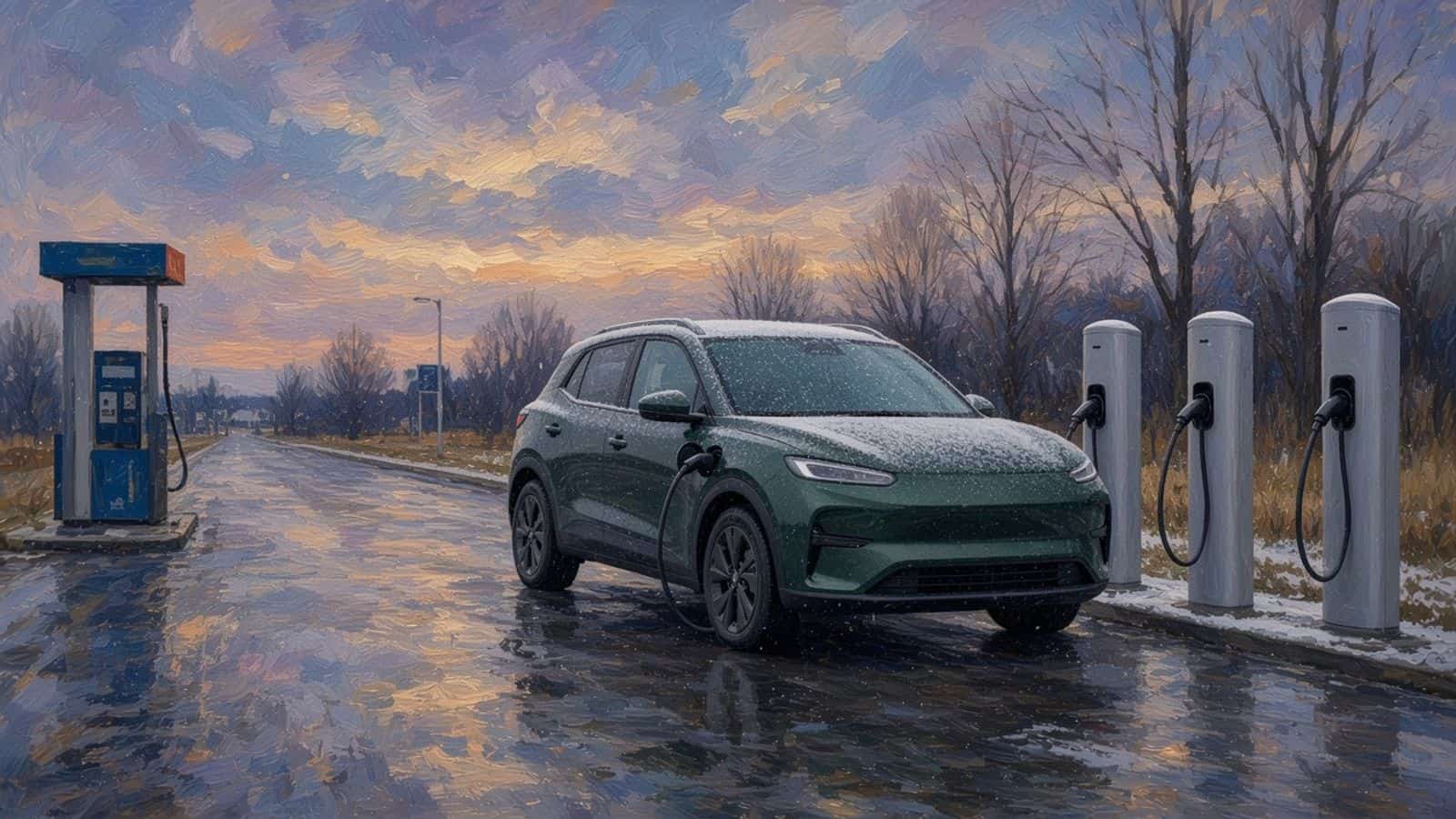
AI-generated illustration
Budget 2026 does three things for Canadian drivers, and none of them is a new EV rebate. Ottawa proposed $587 million over five years, starting in 2027-28, to help install more than 55,000 additional EV chargers. It confirmed that the federal fuel excise tax comes back in two steps, on Feb. 1 and Apr. 1, 2027. And it said it will update vehicle greenhouse gas emissions standards, without giving a target or a date.
The rebate you can use today is unchanged: Transport Canada’s Electric Vehicle Affordability Program (EVAP) pays up to $5,000 on a battery-electric vehicle in 2026 and drops to $4,000 on Jan. 1, 2027.
Updated Nov. 6, 2026, the day after the budget was tabled on Nov. 5. Budget measures are proposals until Parliament passes them; the fuel excise dates below are already law.
Quick answer
- Fuel tax: the 10 cents per litre federal excise tax on gasoline stays at zero through Jan. 31, 2027, then is 5 cents from Feb. 1 and 10 cents from Apr. 1, 2027 (diesel: 2 cents, then 4).
- Chargers: $587 million (plus $45 million for charging research and development) from 2027-28, aimed at “areas where the infrastructure is needed most.” Nothing from this budget can be built this winter.
- EV rebates: no new money. EVAP drops by $1,000 on battery-electric vehicles on Jan. 1, 2027, and Transport Canada reports $1.87 billion of its $2.275 billion still unspent as of Nov. 1, 2026.
- Emissions rules: the budget says vehicle GHG standards will be “updated”. The October freeze of those rules until 2029 is the context.
How much does the fuel tax return cost a driver?
The excise suspension began on April 20, 2026. Finance Canada’s Oct. 29 release on Bill C-38, the Canadian Fuel Affordability Act, sets the schedule: suspended through Jan. 31, 2027, 5 cents per litre on gasoline from Feb. 1 to Mar. 31, and the full 10 cents from Apr. 1, 2027. The budget’s own estimate is that the relief saves $5.75 on a 50-litre tank of gasoline, a figure that includes 15% HST, and $5.3 billion in total across 2026-27.
That is a small number per fill-up, so we worked out what it adds up to over a year of driving. The table uses three illustrative fuel-use levels, not specific models.
| Fuel use | Litres per 10,000 km | Now to Jan. 31, 2027 (0 cents/L) | Feb. 1 to Mar. 31, 2027 (5 cents/L) | From Apr. 1, 2027 (10 cents/L) |
|---|---|---|---|---|
| 6 L/100 km (hybrid or small car) | 600 | $0 | $30 | $60 |
| 8 L/100 km (compact SUV) | 800 | $0 | $40 | $80 |
| 11 L/100 km (pickup or large SUV) | 1,100 | $0 | $55 | $110 |
On the budget’s per-tank figure, the first step in February takes back about $2.88 a tank, and the full return in April takes back $5.75. If you drive 15,000 km a year at 8 L/100 km, that is $120 a year before sales tax once the full tax is back. It matters, but it is not the largest change in a Canadian car buyer’s year, as the next section shows.
Which change moves more money: the fuel tax or the rebate?
The loudest part of the budget is the fuel tax. The part that costs more is the calendar. Transport Canada’s EVAP schedule, a program the budget names but does not change, drops the maximum incentive on Jan. 1, 2027.
| Change | Date | Effect on one household | How often |
|---|---|---|---|
| EVAP drops, battery-electric | Jan. 1, 2027 | Up to $1,000 less ($5,000 to $4,000) | One time |
| EVAP drops, plug-in hybrid | Jan. 1, 2027 | Up to $500 less ($2,500 to $2,000) | One time |
| Fuel excise returns at half | Feb. 1, 2027 | About $40 more | Per 10,000 km driven |
| Fuel excise returns in full | Apr. 1, 2027 | About $80 more | Per 10,000 km driven |
| EVAP drops again | Jan. 1, 2028 | Up to $1,000 less again (to $3,000) | One time |
Here is the comparison that matters. A $1,000 EVAP drop equals the full excise tax on 125,000 km of driving at 8 L/100 km (10,000 litres at 10 cents). For a driver covering 15,000 km a year, that is more than eight years of the returning fuel tax. We think the fuel tax return changes pump prices slightly, but it barely moves the EV-versus-gas maths. The rebate step-down does.
One rule from Transport Canada’s questions and answers is easy to miss. The amount depends on the year the dealership submits the eligibility assessment, not on delivery. Transport Canada’s own example: an assessment submitted on Dec. 2, 2026 for a car delivered on Feb. 21, 2027 still gets the 2026 amount, because a validated assessment lasts 90 days. The reverse also holds: a car delivered in November 2026 but assessed on Jan. 7, 2027 gets the lower 2027 amount.
Canadian buyers: if you want the 2026 rebate level, ask your dealer when they will submit the eligibility assessment, and get the date in writing. Provincial incentives are separate, and EVAP applies on top of them (see our province-by-province rebate guide).
What the budget says about EV rebates
The budget’s $9-billion Automotive Strategy lists “supporting consumer adoption through EV incentives” and the budget’s economic outlook says Canadians are “benefiting from” the Electric Vehicle Affordability Program. We searched the budget text for any new EVAP funding or rule change and found none. Motor Illustrated’s Nov. 5 summary reaches the same conclusion: no new rebate funding and no eligibility changes.
Funding is not the constraint. Transport Canada’s EVAP page shows $1.87 billion remaining of $2.275 billion as of Nov. 1, 2026, so about 82% is still on the table. That is a balance, not an audited payments total, but it means the 2026 rate is more likely to end because the calendar turns than because the money runs out. The program runs to Mar. 31, 2031 or until funds are used up.
The vehicle rules did not change either: a final transaction value of $50,000 or less (no cap for Canadian-made vehicles), built in Canada or a free-trade-agreement country, and new.
Where the new chargers will go, and why it will take time
The budget’s biggest driver-facing line is the renewal of the Zero-Emission Vehicle Infrastructure Program: $587 million over five years from 2027-28 for more than 55,000 chargers, plus $45 million over five years for Natural Resources Canada charging research and $2.2 million for the federal fleet. Finance Canada’s key measures page rounds the whole package to “just over $634 million.” The budget says the aim is to “roughly double” the federally supported network.
Three points follow from the budget’s own numbers.
It is a renewal, so the timing is the weakness. Money that starts in 2027-28 cannot add a single charger this winter, and it is a proposal until Parliament approves it.
The unit cost is modest. Dividing $587 million by 55,000 chargers gives about $10,700 per charger at most, if every dollar went to hardware. That is a ceiling, since “over 55,000” and any program overhead push the real figure lower.
Each federally supported charger already serves about 24 EVs. The budget reports 1,077,457 EVs on the road and 44,539 chargers installed from 2019 to 2026, or 24 EVs per federally supported charger. With the 58,874 planned by 2028-29 that falls to about 18, and with the new 55,000 on top it would be about 9 at today’s fleet size. The fleet will keep growing, so treat that as a snapshot. It also counts only federally supported chargers, not private or provincial networks.
The budget also gives the provincial split of federally supported chargers in operation or planned by 2028-29, under existing funding only. We added population to see who is covered best.
| Province or territory | Chargers | Per 100,000 residents | Share of chargers | Share of population |
|---|---|---|---|---|
| Ontario | 23,802 | 146.4 | 40.4% | 38.9% |
| British Columbia | 17,147 | 300.3 | 29.1% | 13.7% |
| Quebec | 9,555 | 105.4 | 16.2% | 21.7% |
| Alberta | 2,751 | 53.9 | 4.7% | 12.2% |
| Nova Scotia | 1,973 | 178.8 | 3.4% | 2.6% |
| Manitoba | 1,258 | 82.9 | 2.1% | 3.6% |
| New Brunswick | 733 | 83.0 | 1.2% | 2.1% |
| Saskatchewan | 455 | 35.6 | 0.8% | 3.1% |
| Prince Edward Island | 454 | 248.1 | 0.8% | 0.4% |
| Newfoundland and Labrador | 346 | 62.6 | 0.6% | 1.3% |
| Yukon | 246 | 488.5 | 0.4% | 0.1% |
| Northwest Territories | 42 | 91.5 | 0.1% | 0.1% |
| Nunavut | n/a | n/a | n/a | 0.1% |
| Canada (including 112 unplaced) | 58,874 | 140.9 | 100% | 100% |
British Columbia has twice its population share of these chargers, at 300 per 100,000 residents. Alberta and Saskatchewan have the thinnest federal coverage: Alberta holds 12% of Canada’s population but 4.7% of these chargers, and Saskatchewan 3.1% against 0.8%. Quebec is also under-weighted on this measure, but the table leaves out provincial and private networks, so don’t read it as a complete picture. What it does show is where the existing federal money went, and where the new $587 million, aimed at “areas where the infrastructure is needed most”, has the most room to rebalance.
What we don’t know yet
- Which provinces get the new chargers. The budget shows a map of priority areas but no allocation by province.
- What the new GHG standards will say. The budget’s wording is “updating vehicle greenhouse gas emissions standards to reflect changes in consumer demand and advances in vehicle technology,” with no target or timeline.
- Whether Parliament passes the charger renewal unchanged. It is a budget proposal today.
MotorLinks take
This is a budget that leaves the EV decision to the calendar. Charger money is real but late, the emissions rules are open again, and the one thing that affects what a buyer pays this month, the EVAP step-down on Jan. 1, was not touched. The fuel tax return grabs the headlines, but at about $40 to $110 per 10,000 km it is a rounding error next to a $1,000 rebate drop.
For a buyer, the practical read is simple. If an EV was already on your list, the Jan. 1 date matters more than anything in the budget, and what matters is the date your dealer submits the assessment. If you drive a gas vehicle, the extra cost is real but small, and it arrives in two steps you can plan for.
Bottom line
Budget 2026 funds more federal EV chargers from 2027-28, locks in the fuel tax return on Feb. 1 and Apr. 1, 2027, and signals another change to vehicle emissions standards, but adds no new EV rebate money. The EVAP step-down on Jan. 1 ($1,000 on a battery EV) is worth as much as the full fuel excise tax over about 125,000 km of driving. Check your dealer’s assessment date before the year ends, and treat the charger announcement as a 2027-28 story, not a this-winter one.
FAQ
Does Budget 2026 add a new EV rebate?
No. Budget 2026, tabled Nov. 5, 2026, names the Electric Vehicle Affordability Program but, in our reading of the budget text, adds no new rebate money and changes no eligibility rules. EVAP still pays up to $5,000 on a battery-electric vehicle and up to $2,500 on a plug-in hybrid through Dec. 31, 2026, then up to $4,000 and $2,000 from Jan. 1, 2027, according to Transport Canada.
When does the federal fuel tax come back?
The federal fuel excise tax stays suspended until Jan. 31, 2027. From Feb. 1 to Mar. 31, 2027 it is charged at half its normal rate (5 cents per litre on gasoline, 2 cents on diesel), and from Apr. 1, 2027 it returns to the full 10 cents on gasoline and 4 cents on diesel. Parliament passed this extension as Bill C-38, which received Royal Assent on Oct. 29, 2026.
When will the new federal EV chargers be built?
Not this winter. The $587 million renewal of the Zero-Emission Vehicle Infrastructure Program starts in 2027-28 and is a budget proposal that still needs Parliament’s approval. Chargers already funded under the existing program (44,539 installed as of 2026, 58,874 planned in operation by 2028-29) are the ones that can come online in the meantime.
Should I buy an EV before Jan. 1, 2027?
If you want the higher rebate, the date that matters is when the dealership submits your eligibility assessment to Transport Canada, not when you take delivery. A 2026 assessment is valid for 90 days. Waiting past Dec. 31 costs up to $1,000 on a battery-electric vehicle and up to $500 on a plug-in hybrid, so compare that with what you would pay for the car you actually want.
Last updated
How we got these numbers
Charger counts, EV and charger totals, the $587 million and $45 million lines and the fuel excise dates are from the Budget 2026 document and Finance Canada's releases as published Nov. 5 and Oct. 29, 2026. Population is Statistics Canada's July 1, 2026 estimate (17-10-0009-01, released Sept. 23, 2026). Chargers per 100,000 residents is the federal charger count divided by population. Fuel tax per 10,000 km is litres used (fuel use per 100 km times 100) multiplied by the excise rate per litre, before sales tax. The 125,000 km comparison is $1,000 divided by 80 cents per 100 km (8 litres at 10 cents). Dollar figures are CAD.
Sources used for these figures
- Department of Finance Canada: Budget 2026 (PDF)
- Department of Finance Canada: Budget 2026, Key Measures
- Department of Finance Canada: fuel excise tax relief extension (Oct. 29, 2026)
- Transport Canada: Electric Vehicle Affordability Program
- Transport Canada: EVAP overview
- Statistics Canada: Table 17-10-0009-01, Population estimates, quarterly
How to cite
What does Budget 2026 mean for Canadian drivers? Fuel tax, EV rebates and chargers. MotorLinks. Updated November 6, 2026. https://motorlinks.net/articles/features/2026-11-06-budget-2026-drivers-fuel-tax-ev-rebates-chargers-canada
Key findings
- British Columbia has twice its population share of these chargers, at 300 per 100,000 residents.
- If you drive 15,000 km a year at 8 L/100 km, that is $120 a year before sales tax once the full tax is back.
- Dividing $587 million by 55,000 chargers gives about $10,700 per charger at most, if every dollar went to hardware.
- The budget reports 1,077,457 EVs on the road and 44,539 chargers installed from 2019 to 2026, or 24 EVs per federally supported charger.
Sources
- Department of Finance Canada: Budget 2026, Masters of our destiny (PDF, Nov. 5, 2026)
- Department of Finance Canada: Budget 2026, Key Measures
- Department of Finance Canada: Legislation passes to extend the federal fuel excise tax relief for Canadians (Oct. 29, 2026)
- Transport Canada: Electric Vehicle Affordability Program (EVAP), funding balance as of Nov. 1, 2026
- Transport Canada: EVAP overview, incentive amounts by year
- Transport Canada: EVAP questions and answers
- Statistics Canada: Population estimates, quarterly, table 17-10-0009-01
- Motor Illustrated: Budget 2026, what Canada’s new federal budget means for drivers (Nov. 5, 2026)
Related Articles
- Which provinces still have EV rebates in 2026, and what changes on Jan. 1?
- Ottawa freezes new-car emissions rules until 2029: what it means for EV buyers
- CAA EV Circuit 2026: What Canadian EV Buyers Should Compare
Why we use AI
Car news moves fast and the useful details are buried in recall filings, rate bulletins and spec sheets from around the world. AI lets a small team read all of it, so you get the numbers, the sources and the Canadian angle in one place. Every article is checked against its cited sources and reviewed by our editor before it goes up. Spot a mistake? Tell us and we'll fix it.