EV Charging Schedules: Car Timer or Smart Charger?
Overlapping EV and home-charger timers can shrink your charging window. Here is how to choose a scheduler, check the rate plan and avoid a missed overnight charge.
Quick Verdict
Either the car or a smart home charger can schedule overnight charging. For a straightforward setup, choose one primary scheduler and avoid adding a second independent timer unless the equipment or utility program documents how they work together. Keep the car’s battery charge limit in place: that is a different control.
Use the car’s scheduler if its supported location and charging settings meet your needs. Use the wall charger’s scheduler if it offers the timetable you want and works reliably with your vehicle. If a utility already manages charging, check its instructions before layering another restriction on top.
The caveat is simple: a timer cannot create more charging hours or more electrical power. A perfectly functioning schedule can still leave you short if the permitted window is too small.
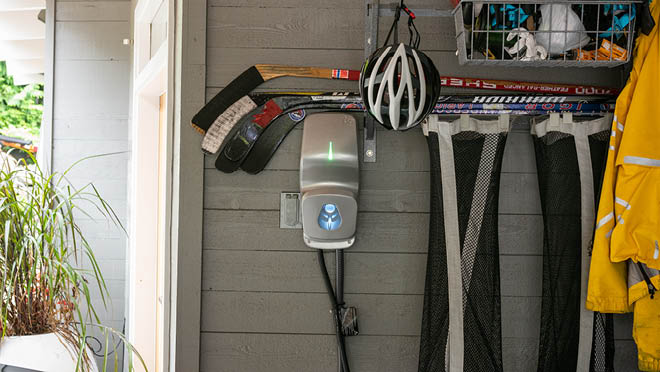
Hero photograph: BC Hydro. It illustrates home charging, not the specific ChargePoint models discussed below or a Motorlinks equipment test.
Two Timers Can Mean a Smaller Window
A car can be ready to accept electricity while its wall unit is waiting. A wall unit can be available while the car is waiting. Charging needs both sides to permit it.
Consider a hypothetical setup:
- The wall charger allows charging from 11 p.m. to 7 a.m.
- The vehicle allows charging from 1 a.m. to 6 a.m.
- The shared permitted window is only 1 a.m. to 6 a.m.
That is five hours, not eight. With non-overlapping windows, there may be no opportunity at all. This is the basic logic of two independent restrictions, not a claim that every car and charger implements timers identically.
An immediate-charge override can also be misunderstood. Overriding the wall unit’s timetable does not necessarily cancel a separate restriction in the vehicle. Check both displays rather than repeatedly tapping the same button.
Our recommendation to start with one scheduler is a troubleshooting approach, not a manufacturer rule banning dual schedules. Documented, coordinated systems can work well.
Separate the Four Controls
A charging app can put several settings close together even though they answer different questions.
| Control | What it decides | What to check |
|---|---|---|
| Charging schedule | When charging is permitted or preferred | Whether the car, wall unit or utility sets the window |
| Battery charge limit | The target battery level | Whether the target follows the vehicle manufacturer’s guidance |
| Departure preparation | When the vehicle should be ready for a journey | Whether cabin and battery preparation require available plug power |
| Electrical current limit | The maximum permitted charging current | The installer-approved setting, not an app-based speed experiment |
Do not disable every setting just to remove a timing conflict. In particular, the battery target and the electrical installation’s approved limits are not redundant timers.
Nor is “departure at 7 a.m.” necessarily an instruction to start charging at 7 a.m. Some systems calculate charging around a ready-by target; others separate charging and climate schedules. Read the instructions for the actual vehicle and software.
A Real Charger Example: Waiting Is Not Always a Fault
ChargePoint’s Canadian Home Flex settings page describes start and end times, separate weekday and weekend schedules, and a way to correct the utility or rate plan selected in its app.
For the models listed on that page—CPH50-NEMA6-50-L23 and CPH50-NEMA14-50-L23—ChargePoint also documents an immediate-charge override: plug in, unplug and reconnect within a few seconds. That is a product-specific instruction, not a universal trick for every wall unit.
Its troubleshooting page says a car may report that it is plugged in but not charging when a schedule is active. The message alone therefore does not establish a failure.
The distinction is whether the system starts when it should. Waiting before the scheduled window is expected; remaining idle throughout that window deserves investigation.
ChargePoint also says those Home Flex units continue to follow their schedule when Wi-Fi is disconnected. Activation and connected features have their own connectivity requirements. Do not diagnose every missed session as an internet outage—or assume another brand has the same offline behaviour.
Keep Departure Preparation in the Picture
As Canadian mornings get colder, a charge schedule and a departure schedule can pull in different directions.
Ford’s official winter EV guidance lists Departure times and Preferred charge times separately under charge settings. It explains that its described departure feature prepares the cabin and battery when plugged in; its off-plug cabin option does not provide battery preconditioning.
That is a Ford example from a US support article, not a promise for every Canadian model year or app interface. It illustrates why owners should check both functions rather than treating “scheduled” as one switch.
If a wall unit stops making power available at the end of a cheap-rate window but departure preparation happens later, being physically plugged in is not sufficient evidence that the vehicle can draw wall power then. Check the equipment’s behaviour and the car’s manual. Do not assume the cabin will stay cold, either: a vehicle may use battery energy depending on its design and settings.
For the broader distinction between cabin warming and battery preparation, see our plugged-in EV preheating explainer.
Match the Timer to Your Actual Electricity Plan
“Overnight” is not a tariff.
Hydro One’s current pricing page distinguishes Time-of-Use, Ultra-Low Overnight and Tiered plans. It also notes seasonal changes to TOU periods and tiered thresholds. A timetable copied from a neighbour may be wrong for your account.
Before saving a schedule, confirm:
- Your enrolled plan: owning an EV does not tell the charger which rate you pay.
- The applicable days and periods: weekday, weekend and holiday rules may differ.
- The local clock and location: verify the displayed time and any location-specific vehicle profile.
- The next seasonal or tariff change: review settings when your utility changes its periods or prices.
- The whole-house result: a low overnight electricity price alone does not prove a plan reduces the total bill.
For a flat energy price, a manual timer may not reduce the electricity charge at all. Utility rewards or other requirements can still matter. If you have enrolled in a program, our managed-charging guide covers control and override questions.
Test the Schedule Before Relying on It
After changing settings, choose an evening when you can check the start—not the night before an early long-distance drive.
First confirm that the car is below its intended charge target. Review active schedules in the vehicle, charger and any utility app. Then choose the primary scheduler, following program instructions where applicable, and remove unintended duplicate timing restrictions.
During the intended window, check for actual charging, not merely a connected icon. Compare the next morning’s battery level with the target and inspect the session history.
If charging starts but misses the target, ask whether enough time and power were available. For example, 30 kWh delivered at the AC connection ÷ 7.2 kW = about 4 hours 10 minutes at constant power. That is an illustrative energy calculation, not a promise that 30 kWh reaches the battery. Losses, conditioning and reduced available power need allowance.
If it never starts, note the car’s message, station status and exact time before contacting support. Follow the manufacturer’s troubleshooting steps rather than raising amperage, changing breakers or repeatedly resetting equipment.
A useful schedule is one you have watched work. The small saving from a tightly restricted window is less useful if you must buy an unplanned public charge the next morning.
FAQ
Should I schedule EV charging in the car or the wall charger?
Either can work. Use one primary scheduler as a simple starting point unless the vehicle, charger or utility documents a coordinated setup. Keep the car’s charge limit enabled.
Why is my EV plugged in but not charging?
It may be waiting for a scheduled window or already at its charge limit. Check both the vehicle and charger status. A fault message or failure to start during the intended window needs separate troubleshooting.
Does a home EV charger need Wi-Fi to follow its schedule?
It depends on the equipment. ChargePoint says the Home Flex models covered by its Canadian settings page retain scheduled charging when Wi-Fi is disconnected. Do not assume every charger behaves the same way.
Is a departure time the same as a charging start time?
No. A start time controls when charging may begin. A departure setting can prepare the cabin and battery for a journey, depending on the vehicle. Check the manual for its interaction with charging.