Preheating an EV in Winter: Cabin Heat, Battery Warm-Up and Plugged-In Power
A warm cabin does not always mean a warm EV battery. Learn how scheduled departure, remote climate and plugged-in preheating differ before winter.
Quick Verdict
For a regular winter commute, use the vehicle’s scheduled departure function while plugged in when the manufacturer recommends it. It can prepare more than the seats and windshield: Ford specifically recommends Departure Times to warm both the cabin and battery while connected.
If you park without a charger, remote cabin heating can still be useful—but do not assume it prepares the battery, or that it costs no driving energy. The exact function matters. Tesla’s current Model Y manual, for example, allows scheduled preconditioning while unplugged unless the car is in Low Power Mode.
For buyers in the United States and Canada, the useful question is not simply “Does it have an app?” It is what the exact model can prepare before departure, under which conditions, and how you confirm it is working.
This is a research-based ownership explainer, not a winter road test. Manufacturer guidance was checked October 9, 2026. Controls and capabilities can differ by model year, software and market; use the manual applicable to your vehicle.
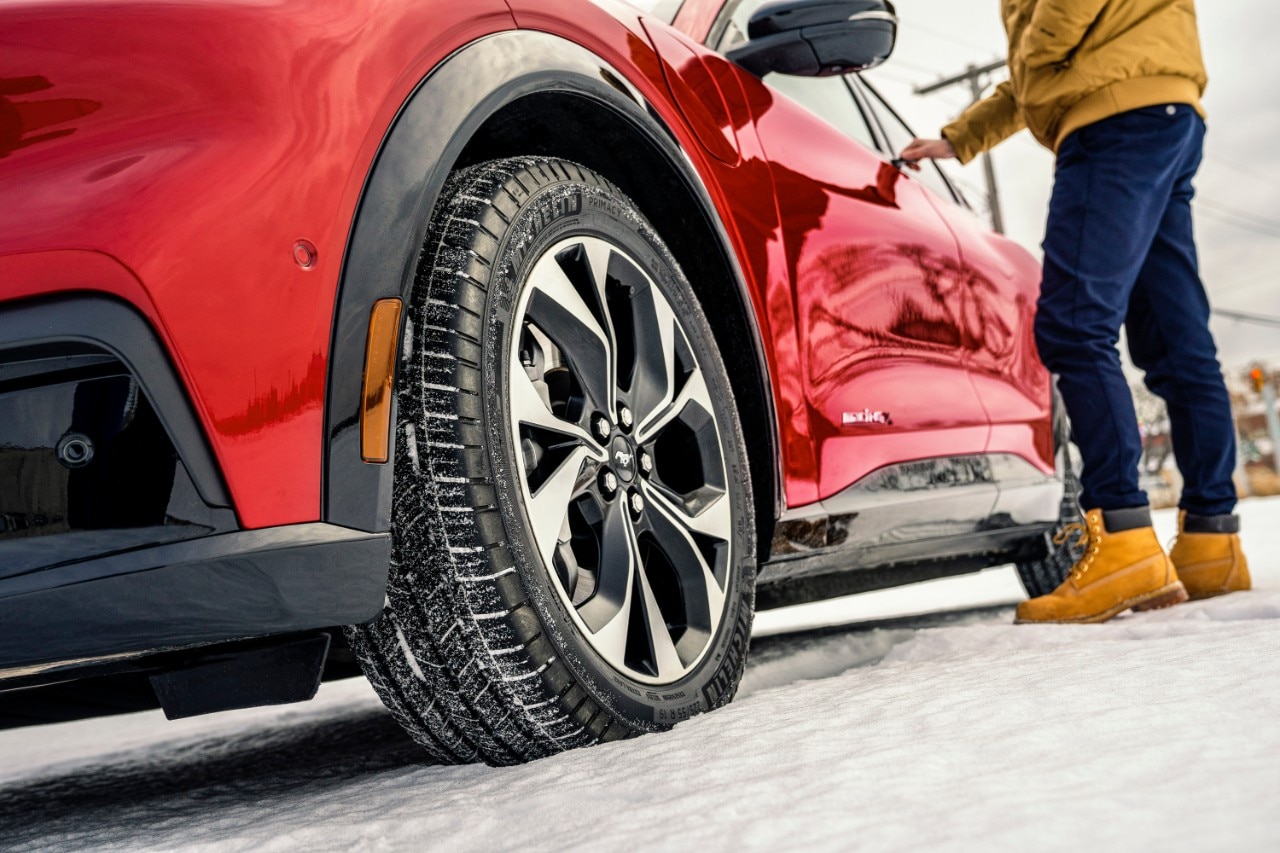
Hero image: Ford, from its winter-driving guidance. The snowy Mach-E scene illustrates winter preparation; it does not demonstrate battery heating or a Motorlinks cold-weather test.
Three Jobs That Share a Confusing Name
“Preconditioning” can describe different jobs. Separating them makes winter preparation much easier to understand.
Cabin preparation warms the passenger compartment before you get in. A remote climate command or departure schedule may handle this. Feeling warm air from the vents tells you the cabin heater is working; it does not, by itself, tell you what the battery is doing.
Departure battery preparation adjusts battery conditions before driving when the vehicle supports it. Ford’s winter guidance recommends plugged-in Departure Times for both cabin and battery preparation. Tesla’s Model Y scheduled-preconditioning instructions also describe preparing the cabin and battery by departure.
DC fast-charging preparation is another task: getting the battery ready to accept power at a charging stop. Do not assume that warming the car at home replaces the manufacturer-specified preparation for a charger later in the trip. Our battery-preconditioning explainer covers that charging-focused process.
| Function | Main job | What not to assume |
|---|---|---|
| Remote cabin heating | Prepare the passenger compartment before entry | A comfortable cabin does not prove the battery is prepared |
| Scheduled departure preparation | Have the vehicle ready at a chosen departure time; supported systems may prepare cabin and battery | Plug-in requirements and battery behavior are not identical across brands |
| DC fast-charging preparation | Prepare the battery for a charging stop using the supported procedure | Departure heating does not replace the instructions for that later stop |
Plugged In Means an Energy Source, Not Free Heat
The attraction of plugged-in preparation is straightforward: the car has an external electricity supply available before the trip. Ford recommends this approach to help preserve battery energy for driving.
That does not make the heating free. Electricity used before departure still belongs in your energy bill and ownership costs. The distinction is between energy supplied before the journey and energy taken from the battery during it—not between “uses energy” and “does not use energy.”
Nor does a connected cable justify a blanket promise that the displayed battery percentage will never fall. The cited guidance does not establish that every charging supply, vehicle or winter condition can support all preparation loads without drawing on the battery.
For a buyer with home charging, ask which supply and settings the manufacturer recommends for departure preparation. For someone comparing a household-outlet setup with a dedicated charging circuit, that is a more useful question than assuming every plugged-in arrangement behaves alike.
There is no defensible universal percentage of winter range that preheating restores. The vehicle, starting conditions and journey matter. Preheating can improve readiness; it does not turn a cold commute into an EPA or NRCan range test.
Ford and Tesla Show Why the Instructions Matter
Ford’s published winter-driving guidance recommends setting daily Departure Times while plugged in to precondition the vehicle’s battery and cabin. It describes scheduling through the vehicle’s SYNC charge settings or the app.
That recommendation is more specific than “turn the heater on.” If you want battery preparation as well as a warm cabin, find the actual departure-setting instructions for the Ford you own. Do not infer battery behavior from a Remote Start label.
Tesla’s cited Model Y manual describes Precondition as preparing the cabin and battery for a set departure time. It explicitly says unplugged preconditioning operates as long as the vehicle is not in Low Power Mode.
The contrast is useful: plugging in is not a universal prerequisite for every EV’s preconditioning function. It is also not a reason to copy one manufacturer’s behavior onto another car.
A scheduled charging session and a scheduled departure are different requests. Confirm that you selected preparation for the time you plan to leave, rather than assuming a charging schedule alone will warm the cabin.
No Home Charger? Prioritize Readiness and Trip Energy
A driver using street parking or an apartment lot may not have external power available overnight. That does not make a comfortable, clear cabin irrelevant. It means the energy budget deserves attention.
Check whether your EV supports remote climate or scheduled preparation without being plugged in, and whether a low-charge condition or power-saving mode limits it. A feature advertised in a current online manual may not be identical on an earlier model.
For a short trip, avoid running repeated long heating sessions simply because the app makes it convenient. Use the manufacturer’s instructions and the actual departure time. For a longer trip, account for preparation as well as the energy needed to reach the next reliable charger.
Neither a range target nor an efficiency preference should come at the expense of clear glass. Ford advises removing snow from the vehicle and keeping cameras and sensors clear. Cabin heat does not replace clearing the roof, lights and other exterior surfaces.
If equipped, Ford also recommends using heated seats and the heated steering wheel while lowering the cabin temperature setting to reduce HVAC consumption. Keep the cabin heating and defogging needed for visibility; personal heating is not a substitute for a clear windshield.
What to Check Before the First Cold Commute
Use the next mild day to find the controls, rather than discovering the limitations with a frosted windshield.
- The function: Does the app command only cabin climate, or does the manual explicitly describe battery preparation?
- The schedule: Is it set for the time you leave, on the right days and at the right location?
- The connection: Does your model require external power for the battery-preparation function you selected?
- The limits: Does a low battery level or power-saving mode prevent operation?
- The confirmation: What status message shows that preparation is active?
- The visibility: Are the glass, lights, cameras and exterior surfaces ready for safe driving?
Cold-weather preparation also does not guarantee full regenerative braking. Battery conditions can still limit regeneration; our cold-weather one-pedal explainer explains why energy recovery and accelerator-lift slowing are not the same thing.
The best habit is to schedule the right job, not just a warm seat. Plugged-in departure preparation is a useful advantage where supported. Without it, read the limits, budget the energy and put visibility first.
FAQ
Is warming an EV cabin the same as preconditioning its battery?
No. Cabin heating prepares the passenger compartment; battery preconditioning manages the traction battery. Some scheduled departure functions do both, but a warm cabin alone does not confirm battery preparation.
Does an EV have to be plugged in to preheat?
Not universally. Tesla’s cited Model Y manual allows scheduled preconditioning while unplugged unless the vehicle is in Low Power Mode. Ford recommends plugged-in Departure Times for cabin and battery preparation. Check your exact vehicle’s instructions.
Does plugged-in preheating eliminate winter range loss?
No. It can use external power for preparation and preserve battery energy for driving, but heating still uses electricity. It does not eliminate the effects of cold weather or guarantee a particular range gain.
Sources
Standing manufacturer guidance checked October 9, 2026, not a new feature announcement.
- Ford: Electric Vehicle Winter Driving Tips
- Tesla Model Y owner’s manual: Scheduled Precondition and Charge