208V vs 240V EV Charging: Why Your Condo Plug May Be Slower
A 208V Level 2 charger delivers less power than 240V at the same amperage. Here is the math, the overnight impact and what Canadian condo buyers should ask.
Quick Verdict
A 208-volt Level 2 connection can be perfectly useful for an EV, but it does not deliver the same power as 240 volts at the same charging current. At 30 amps, the calculation is 6.24 kW versus 7.20 kW. That is about 13.3% less power, or 15.4% more time to deliver the same AC energy if both rates stay constant.
For a commuter parking overnight, choose dependable access and enough energy for the next day over the largest charger badge. For a driver with a short shared-parking window, confirm actual voltage, available amperage and power-sharing rules before relying on the plug.
The caveat: voltage is only one limit. A car’s AC charging capability, the station’s configuration and the building’s energy-management system can matter more. Do not assume every condo has 208V or every Level 2 plug supplies its advertised maximum.
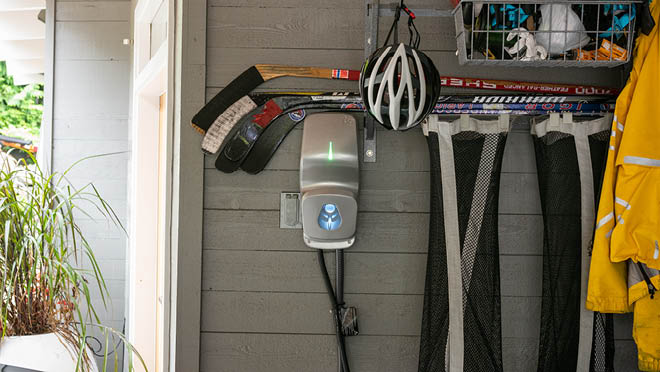
Hero photograph: BC Hydro. It illustrates home charging equipment, not a measured 208V installation or a Motorlinks equipment test.
Both Voltages Count as Level 2
Natural Resources Canada’s charging guide lists 208/240V as the input for Level 2 charging. “Level 2” describes a charging category, not one guaranteed speed.
The distinction is easy to miss when a listing, building brochure or charging app describes a unit simply as a “7-kW charger.” That might be a rounded equipment rating, not the sustained power your car will receive in that parking space.
There is also a difference between a building’s electrical supply and the charging equipment’s compatibility. As a concrete hardware example, ChargePoint’s Home Flex specification sheet lists 208/240V AC input and describes its maximum 12-kW output using 240V multiplied by 50A. Those are not interchangeable operating points.
That document is dated September 2019 and describes the listed Home Flex configurations. We use it to illustrate how a manufacturer specifies voltage and current—not as a recommendation, a current product comparison or proof that a particular condo uses this equipment. Verify the model and installation you will actually use.
The Math Behind the Missing Kilowatt
For a straightforward estimate of AC charging power:
Power in kW ≈ supply voltage × charging current in amps ÷ 1,000.
These examples assume the stated current is available continuously and the vehicle accepts it. They are calculated AC input figures, not measured battery-charging rates.
| Charging current | At 208V | At 240V |
|---|---|---|
| 24A | 4.99 kW | 5.76 kW |
| 30A | 6.24 kW | 7.20 kW |
| 32A | 6.66 kW | 7.68 kW |
| 48A | 9.98 kW | 11.52 kW |
The percentage difference is the same in every row because 208 ÷ 240 = 0.867. A charger drawing the same amperage at the lower voltage supplies roughly 86.7% as much power.
Time moves in the opposite direction. 240 ÷ 208 = 1.154, so the same AC energy takes about 15.4% longer at the lower voltage. “13% less power” does not mean exactly “13% more time.”
This also explains why seeing roughly 6.2 kW at a nominally 7.2-kW, 30A station does not automatically establish a fault. A 208V supply could explain that result. It is a possibility to confirm with the operator, not a diagnosis from the dashboard alone.
What Changes During an Overnight Session?
Suppose a session needs to deliver 30 kWh at the AC connection, with a steady 30A available throughout.
- At 240V and 7.20 kW, the ideal calculation is about 4 hours 10 minutes.
- At 208V and 6.24 kW, it is about 4 hours 48 minutes.
- The difference is approximately 38 minutes.
These figures deliberately describe energy at the AC connection. They do not promise that 30 kWh reaches the battery. Conversion losses, vehicle systems and battery conditioning can consume some of the electricity; our charging-loss explainer separates those measurement points.
For a car parked for ten hours, that voltage difference might make no practical difference to the next morning’s departure. For a shared stall with a four-hour limit, it could matter.
Start with the energy you need to replace and the time you actually have. Do not plan around refilling the entire pack every night if your routine only uses a small part of it. Equally, allow headroom for higher winter consumption and days when you arrive later or leave earlier.
Three Limits to Check Before Blaming Voltage
1. The commissioned charging current
A unit capable of high output can be installed or configured to supply less. Ask for the charging-current setting, not just the equipment’s maximum rating.
Also distinguish charging amps from breaker amps. ChargePoint’s cited datasheet calls for a breaker rated at 125% of maximum load and gives a 50A breaker for 40A output as its example. That does not turn every breaker label into a charging specification.
Have the electrical contractor confirm the approved configuration for the actual equipment and applicable local requirements. This is not a reason to change a breaker or increase an app setting yourself.
2. The vehicle’s AC charging capability
The wall unit is not the only hardware involved. During AC charging, the vehicle’s onboard charger converts incoming AC electricity for the battery. Its capability can limit the result even when the station has spare capacity.
BC Hydro’s home-charger guide explicitly makes Level 2 speed dependent on both available capacity and vehicle capability. Check the exact vehicle model year and configuration rather than borrowing the specification of a different trim.
An advertised DC fast-charging peak does not answer this question. A car capable of hundreds of kilowatts at a highway DC station will not draw that power from a Level 2 wall unit.
3. Shared or managed building power
A charger can have a fixed per-port ceiling while a building system varies the current available to it. Ask what happens when neighbouring stalls are occupied and when the building’s other electrical demand is high.
A brief session with an otherwise empty garage may not demonstrate the overnight result when many residents plug in. Conversely, a lower instantaneous reading need not mean the car will miss its target if the system can allocate more power later.
Do not confuse this AC building-management question with power sharing at a DC fast charger. The practical lesson overlaps—check the available power—but the equipment and vehicle limits differ.
What Canadian Condo Buyers Should Ask
Before paying for an installation or counting a shared plug as a purchase benefit, request:
- Supply voltage: what voltage serves this charging point?
- Charging current: what is its commissioned maximum, rather than its breaker size?
- Busy-period allocation: is power shared, scheduled or dynamically managed?
- Vehicle compatibility: does the exact car support the connector, supply and intended AC rate?
- Access window: can the car stay connected long enough, including any parking limits?
- Billing basis: are you paying per kWh, by time, through a subscription or with additional fees?
For time-based charging, a lower delivery rate can change the effective price per kWh. For energy-based billing, the voltage reduction alone does not establish a higher energy price. Read the actual tariff and parking rules before comparing costs.
Our apartment and condo charging checklist covers permissions, ownership and installation planning. If charging access affects your vehicle budget, pair that assessment with the Canadian EV incentive and affordability guide, rather than treating a purchase rebate as a solution to an unsuitable charging arrangement.
The useful question is not “Does the building have Level 2?” It is “How much energy can my car reliably receive before I need to leave?”
FAQ
Is 208V EV charging still Level 2?
Yes. NRCan lists both 208V and 240V as Level 2 inputs. The particular charging equipment and vehicle must support the supply.
How much slower is 208V than 240V EV charging?
At equal current, calculated power is about 13.3% lower. Delivering the same AC energy takes about 15.4% longer at constant power. Vehicle limits, sharing and losses can change the real result.
Does a 40A breaker mean the EV charges at 40A?
No. Breaker rating and permitted continuous charging current are different. Ask the installer for the commissioned charging amperage; do not infer it from the breaker label.
Will a higher-powered wall charger make any EV charge faster?
Not necessarily. The electrical installation, charging equipment, available shared power and vehicle’s AC capability constrain the result. A larger equipment rating cannot override the car’s limit.