EV Fast-Charger Power Sharing: Why a 350-kW Stall Can Deliver Less
Electrify Canada's Balanced chargers show why a 350-kW label is not a guaranteed charging rate. Here's how Canadians can choose a stall and diagnose a slow stop.
Quick Verdict
Choose a fast-charging stall by its power-sharing rules as well as the number on its label. A 350-kW dispenser can be the right choice for a high-power EV, but the label does not promise that much power throughout the session—or when another vehicle plugs into equipment sharing its supply.
For Canadian highway drivers, Electrify Canada’s Balanced label is a concrete example. The operator says these chargers share a power cabinet and can deliver up to 150 kW while sharing, or up to 350 kW to a capable vehicle when the adjacent charger is unused.
If your EV can accept well above 150 kW and its battery is ready, an available Balanced charger with an unused partner may offer a shorter stop. If your vehicle’s limit is below 150 kW, chasing an unshared 350-kW connection may gain nothing. The caveat: power sharing is only one possible bottleneck. A cold or nearly full battery can still charge slowly on an otherwise capable stall.
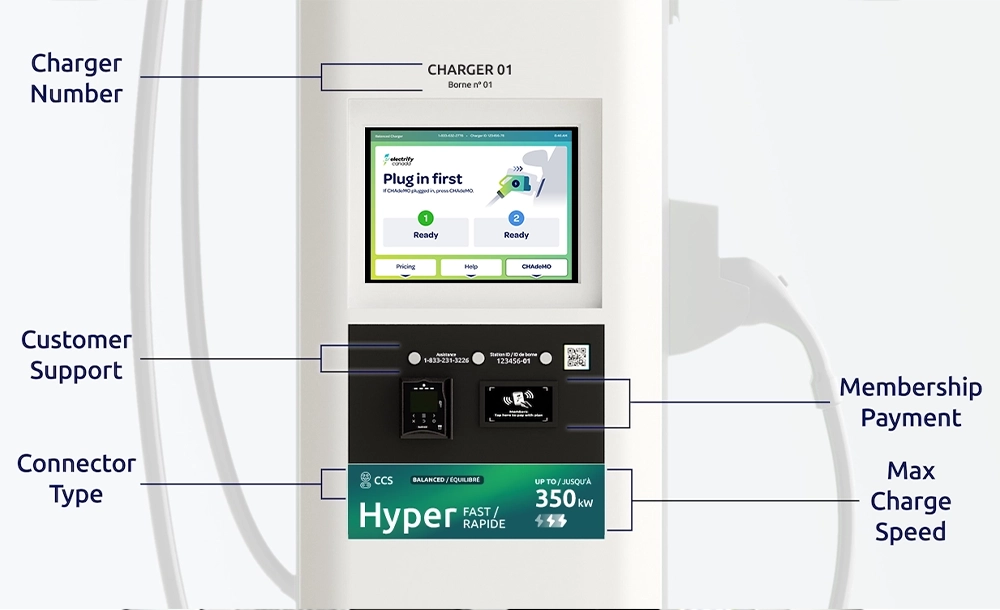
Official charger-label illustration: Electrify Canada. The maximum-power marking is a capability, not a promised session rate.
The Dispenser Is Not the Whole Charger
The unit beside your parking space is the visible part of a larger electrical system. A shared power cabinet can supply more than one dispenser, so two separate screens and cables do not necessarily mean two independent sources of maximum power.
Electrify Canada’s charging-speed guide says its Balanced chargers are typically side by side. The word “Balanced” appears on their labels or screens. That is more useful evidence than assuming every pair of adjacent stalls shares power—or that every charger with a large number is independent.
The guide distinguishes green Hyper-Fast CCS labels offering up to 350 kW from teal Ultra-Fast labels offering up to 150 kW. Balanced identifies a sharing arrangement, not a new connector standard. Check both the connector compatibility and the power information before starting.
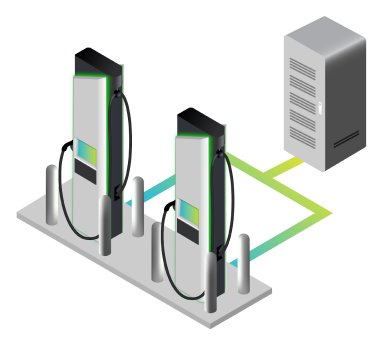
Two dispensers can share one cabinet. Official diagram: Electrify Canada.
These are Electrify Canada’s published rules, not a universal description of Canadian fast chargers. Other operators and hardware generations can allocate power differently.
Why Two Cars Do Not Automatically Get 175 kW Each
It is tempting to divide a 350-kW label by two and expect 175 kW per vehicle. That is not what Electrify Canada’s Balanced guidance promises. Its stated shared-charging figure is up to 150 kW, with up to 350 kW available to a capable vehicle when the adjacent charger is unused.
More generally, the allocation depends on the equipment and its controls. The vehicle also requests a charging rate that changes as its battery fills or its temperature changes. There is no safe universal formula based solely on the number of occupied spaces.
A drop in charging power when another vehicle arrives may be consistent with sharing, but the timing alone does not prove it. Your battery may have reached the part of its charging curve where power tapers. Read the label, watch the session and check any messages before blaming the neighbouring car.
Would a Different Stall Actually Save Time?
Consider a hypothetical EV capable of accepting 100 kW at its current battery condition. A healthy charger supplying 150 kW already has more capacity than that vehicle requests. Moving to an otherwise suitable 350-kW stall cannot make the car accept 350 kW.
Now consider a different EV capable of accepting 230 kW under the current conditions. A shared arrangement limited to 150 kW could constrain it. An available compatible stall with sufficient unshared output could help—but only while the vehicle can use that extra power.
The distinction matters because kW measures the rate of energy transfer; kWh measures the energy delivered. At a theoretical constant 150 kW, ten minutes represents 25 kWh. At a constant 100 kW, the same period represents about 16.7 kWh. Those are arithmetic examples, not battery-energy guarantees: real power varies, losses occur, and some energy may support thermal management.
Compare the expected benefit with the time needed to stop, move, reconnect and authorize another session. A brief higher peak is not automatically worth interrupting a working charge.
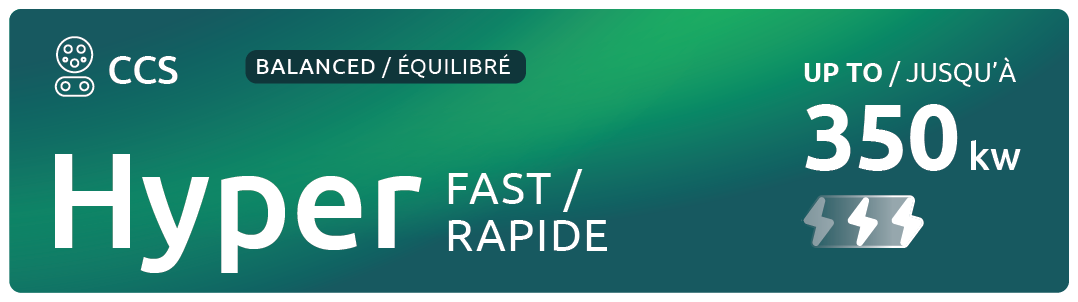
Look for “Balanced” or “Équilibré” on the equipment. The label still says up to 350 kW; the sharing guidance explains when that output is available. Official graphic: Electrify Canada.
A Five-Step Check Before You Move
- Check your EV’s DC charging capability. Use the specification for the exact model, battery and trim—not its AC home-charging rating.
- Check battery readiness. Follow the manufacturer’s preconditioning instructions where available. A cold battery may be the limiting factor even at a high-power site.
- Check the state of charge. If the battery is already well into its taper, a higher-powered stall may make little difference.
- Read the equipment labels and screen. Look for Balanced or other sharing information, the correct connector and any reduced-power or fault notices.
- Change stalls only for a plausible gain. If the vehicle can use more power and another suitable stall is available, moving may help. If the cause is unclear, the operator’s support team can help investigate.
Never unplug another driver’s vehicle to improve your own session. Sharing is a site-design issue, not a reason to treat a neighbouring driver as the problem.
What to Look for When Planning a Canadian Road Trip
For frequent highway travel, evaluate the site, not just a map pin advertising its largest power figure. Check compatible connectors, the number of stalls, available sharing information, current operating status and alternative sites along the route. A location with several working suitable connectors can be more useful than one impressive peak-power listing.
Also check the tariff. If a station bills per minute, lower average power can increase the effective cost of each kWh. With per-kWh billing, sharing mainly changes stop length, although separate parking or idle charges may still matter. Our Canadian charging-price guide explains the difference.
The practical lesson is not to avoid shared chargers. They can still provide a useful fast charge. It is to understand when sharing limits your particular EV, and when battery condition or the car’s own hardware matters more than an empty space beside you.
FAQ
What does Balanced mean on an Electrify Canada charger?
It identifies chargers that share a power cabinet. Electrify Canada says a Balanced charger can supply up to 150 kW while sharing and up to 350 kW to a capable vehicle when the adjacent charger is unused.
Does power sharing always split charging power equally?
No. Allocation depends on the charging equipment and its controls. Do not assume a 350-kW cabinet gives each of two vehicles 175 kW; follow the operator’s published rules.
Should I move stalls if my EV is charging slowly?
Only if there is a clear reason to expect an improvement. Check the vehicle’s DC charging limit, battery temperature, state of charge, charger labels and any fault messages before ending a working session.
Sources
- Electrify Canada: charging speeds, charger labels and Balanced charging
- Electrify Canada: EV charging basics