EV Roof Racks and Cargo Boxes: Load Limits and Winter Range
A roof box adds luggage space, not payload capacity. Learn how to count rack weight, secure cargo and plan winter EV charging stops without a made-up range penalty.
Quick Verdict
A roof box can make an EV a better ski-trip companion, but it does not increase the car’s payload capacity—and it can reduce range. Before buying one, confirm that your exact vehicle supports the mounting system, count the bars and box in the roof-load calculation, and leave room to adjust charging stops once you see loaded-trip consumption.
For U.S. and Canadian drivers, the best starting point is the same: keep heavy luggage low inside the vehicle, securely restrained, and reserve the roof for suitable bulky gear. If everything already fits safely inside, leaving the roof clear avoids adding exterior drag.
The key caveat is that neither a roomy box nor a rack’s impressive weight rating overrides the car’s own limits. There is also no honest one-size-fits-all percentage to subtract from every EV’s range.
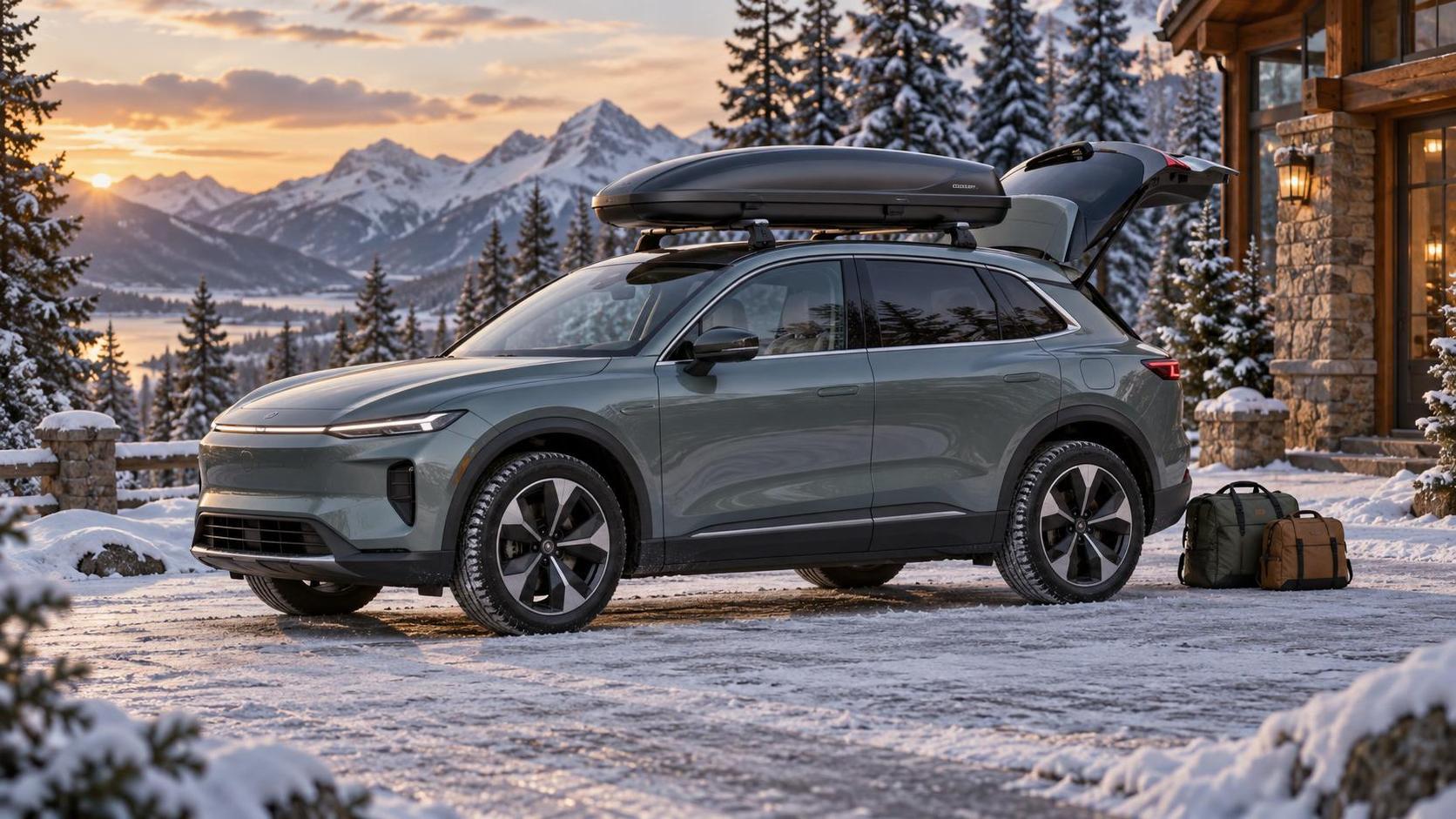
Illustration: Motorlinks, AI-generated. A crossover with a roof cargo box beside a snowy lodge. Image.
Storage Space Is Not Weight Capacity
A compact electric SUV can run out of luggage space well before it runs out of seats. A roof box helps with volume: skis, jackets and other bulky items can move out of the passenger compartment. Weight is a different calculation.
Check three separate constraints before loading:
- The vehicle’s roof-load limit. Use the manual for the exact model, model year and market.
- The rack and box limits. The carriers, attachments and box must each be suitable for the load.
- The vehicle’s overall loading limits. Moving luggage onto the roof does not take it off the vehicle’s weight budget.
Volvo’s Canadian XC60 roof-loading guidance explicitly includes load carriers and a roof box in the permitted roof load. Its current EX30 loading instructions also require compliance with the vehicle’s weight and maximum-load specifications.
Here is a hypothetical calculation, not a specification for your car: if a vehicle permits 75 kg (about 165 lb) on the roof, and the carriers plus empty box weigh 25 kg (about 55 lb), that leaves at most 50 kg (about 110 lb) for roof cargo. A lower limit on any part of the system could reduce that allowance further.
Do not confuse a roof rack’s advertised capacity with the vehicle’s permitted load. Do not assume a driving roof-load rating permits people to occupy a rooftop tent; camping equipment needs its own explicit vehicle and accessory guidance.
Why a Roof Box Changes EV Range
A roof box changes what the car has to push through the air. Volvo’s EX30 instructions state directly that exterior loads affect aerodynamics, handling and sensitivity to crosswinds, and that increased drag affects energy consumption and range.
That is especially relevant on a highway trip. The U.S. Department of Energy’s Alternative Fuels Data Center explains that higher-speed highway driving requires more energy to overcome aerodynamic drag. It also identifies heavy loads and significant climbs as factors that can reduce EV range.
Box shape, placement, speed and weather all matter. An empty box is still an exterior object; carrying less inside it does not remove the aerodynamic change. Conversely, a box full of light gear and a heavy load inside the car do not create identical effects.
Avoid turning a gasoline fuel-economy estimate into an EV range promise. Nor should you subtract a fixed percentage from an EPA or NRCan rating and treat the result as your next charging leg. Neither rating is a forecast for your loaded vehicle on a particular winter highway.
Plan the First Charging Leg Conservatively
Winter already adds variables before any luggage goes on the roof. The Department of Energy notes that extreme temperatures can reduce range because cabin heating or cooling consumes energy. A roof box adds another reason to check the trip rather than rely on yesterday’s commute.
A useful departure routine is:
- Plan the route with usable charging options. Have an earlier stop available rather than making the first leg depend on a near-empty arrival.
- Load the car before judging consumption. A previous trip with an empty roof is not a reliable baseline for today’s setup.
- Watch the navigation’s arrival estimate and actual energy use. Reassess after a representative stretch of driving, allowing for remaining hills, wind and temperature changes.
- Shorten the leg if the margin is shrinking. Do not wait until the intended charger is the only reachable option.
- Drive smoothly and keep speed appropriate to conditions. More speed adds aerodynamic demand; it is not a solution to a tight energy budget.
Preheating can make departure more comfortable, but it does not cancel exterior drag. Our winter cabin-preheating guide explains how plugged-in preparation differs from fast-charging battery conditioning.
There is no universal arrival reserve that suits every route. A busy urban corridor and a rural winter road with a single charger need different margins.
Fitment and Restraint Matter More Than Appearance
Roof rails, a panoramic roof or an accessory pictured on another version of the vehicle do not establish compatibility. Use the approved mounting locations and the instructions for both the car and the carrier.
Volvo recommends a suitable load carrier, even load distribution and careful adherence to mounting instructions. Its EX30 guidance also calls for gentle driving, avoiding rapid acceleration, hard braking and sharp cornering.
For packing, put the heaviest suitable cargo low inside the vehicle, without obstructing occupants or airbag deployment, and secure it to the appropriate load-retaining points. Volvo advises checking and re-tightening restraints during travel because cargo can move.
For the roof system, follow the accessory’s locking, fastening, loading and recheck instructions. A closed lid is not a substitute for securing the contents. Before entering a garage, parking structure or other height-restricted area, account for the installed box—not just the vehicle’s published height.
If the trip also needs winter tires, treat that as a separate decision. Carrying skis on the roof does not make the tires beneath the car suitable for snow; the EV winter-tire guide covers fitment and seasonal grip.
Take the Hardware Off When the Trip Is Over
A roof box is useful when it solves a real packing problem. Keeping it fitted for weeks after the trip preserves the extra exterior load without the benefit.
Volvo recommends removing unused load carriers to improve performance and range, and removing cargo that is no longer needed. That is a simpler efficiency habit than trying to compensate for a permanent roof setup with more charging.
Buy storage for the trips you actually take, not permission to overload the car. Get fitment and weight right first, then plan charging around the loaded vehicle’s real consumption.
FAQ
How much range does an EV lose with a roof box?
There is no universal percentage. Exterior cargo increases aerodynamic drag, and the effect varies with speed, box shape, weather and the vehicle. Use consumption from your loaded trip to revise charging stops.
Does the roof-load limit include the rack and box?
Yes. Count the load carriers, roof box and cargo together against the vehicle’s permitted roof load, and also obey the individual rack and box limits.
Does a roof box increase an EV’s payload capacity?
No. It adds storage volume, not permitted vehicle weight. Passengers, luggage and added accessories must remain within the vehicle’s loading limits.
Should unused roof bars stay on an EV?
Remove unused carriers when practical and as instructed by the manufacturer. Volvo recommends removing them to improve performance and range.
Sources
- Volvo EX30: recommendations for loading, roof cargo, restraint and range
- Volvo Canada XC60 manual: roof-load accounting, including carriers and box
- U.S. Department of Energy: all-electric vehicle range and driving conditions