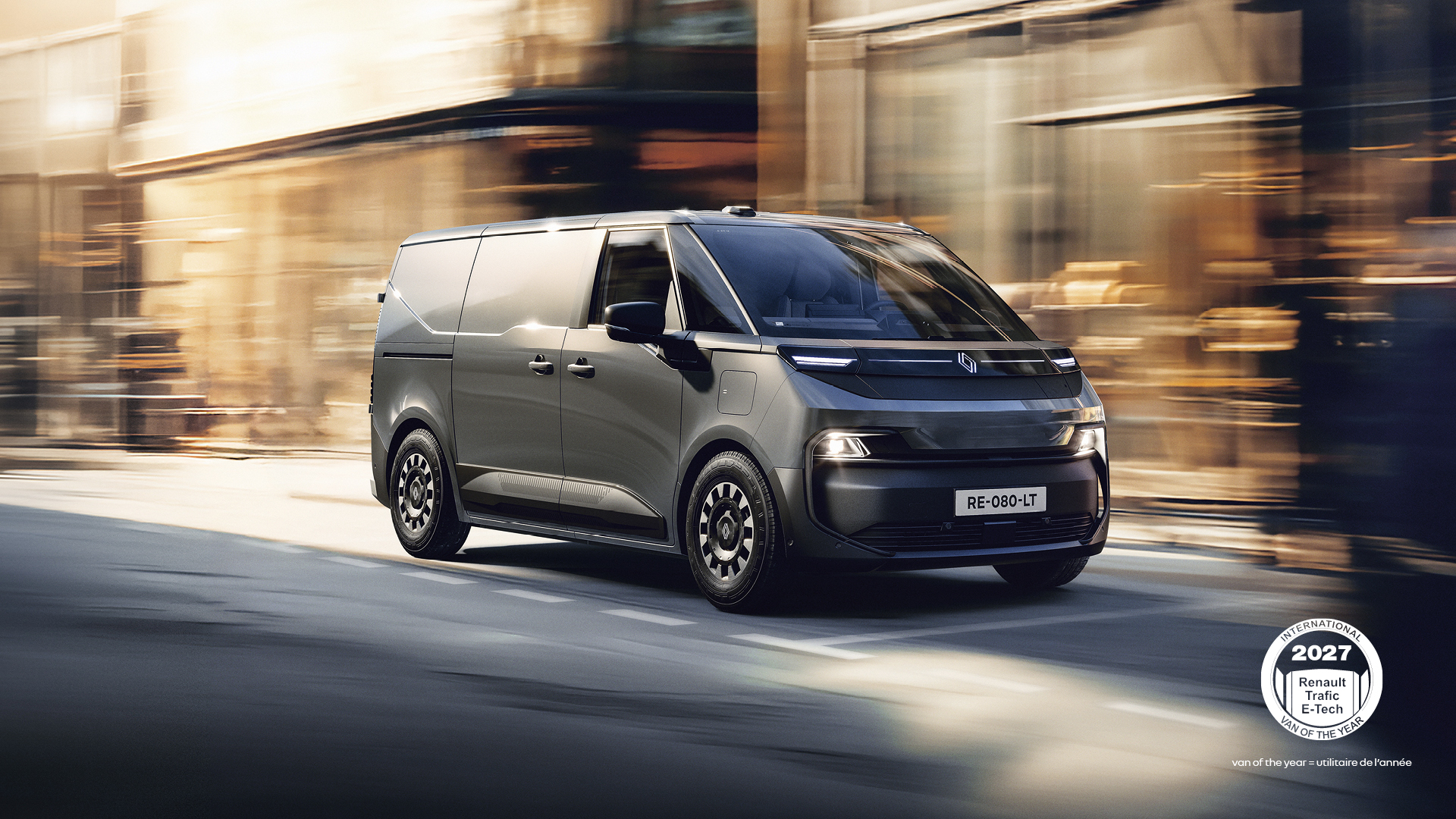
Renault Trafic E-Tech vs Kia PV7: The Electric Van Fight Is Getting Serious
Renault's new Trafic E-Tech and Kia's PV7 show how electric vans are moving beyond short urban routes, with 800V charging, bigger batteries and real fleet-use trade-offs.
Electric vans are finally getting specs that sound less like compliance projects and more like work tools. Renault’s new Trafic Van E-Tech electric and Kia’s PV7 both arrive from Europe-facing announcements with 800V charging claims, useful range targets and business-first packaging.
Neither van has been announced for Canada or the United States, so this is not a showroom comparison for a Canadian fleet manager placing an order tomorrow morning. It is still worth paying attention. These two vans show how quickly the commercial EV conversation is moving from “Can it finish a short urban route?” to “Can it replace a diesel van without disrupting the business?”
The Trafic and PV7 answer that question in different ways. Renault is leaning into compact dimensions, urban manoeuvrability, payload and quick energy recovery. Kia is stretching its Platform Beyond Vehicle strategy into a larger van with more space, more battery and more conversion potential.
Quick Verdict
The Renault Trafic Van E-Tech electric looks like the sharper tool for dense urban work. Its 1.90-metre height, 10.3-metre turning circle, 5.1 to 5.8 cubic metres of cargo volume and targeted 470 km WLTP Long Range figure make it interesting for couriers, trades and service fleets that need garage access and easy manoeuvrability more than maximum box size.
The Kia PV7 looks like the better bet for larger routes, shuttles and upfits. Kia’s preliminary figures point to a 5.35-metre Long body, up to 8.0 cubic metres of cargo space in High Roof form, up to 1,200 kg of payload in some Cargo configurations and a 96.2-kWh long-range battery. It is the more ambitious platform if the job regularly overwhelms a compact van.
For buyers watching from Canada, the practical lesson is broader: electric vans are becoming charging, payload and software decisions as much as range decisions. The best van will be the one whose size, route energy use, depot charging and payload rating match the workday.
| Item | Renault Trafic Van E-Tech electric | Kia PV7 |
|---|---|---|
| Primary role | Compact midsize electric work van for urban and regional commercial use | Larger electric PBV for cargo, passenger, shuttle and conversion use |
| Launch timing | Shown at EV Experience 2026; Renault says it is first of five electric commercial vehicles due by 2028 | Europe and Korea launch planned for the second half of 2027; more markets and derivatives to follow |
| Length | 4.87 m L1; 5.27 m L2 | 5.35 m for the Long model highlighted by Kia |
| Height | 1.90 m | Varies by body; High Roof cargo version planned |
| Cargo volume | 5.1 m³ L1; 5.8 m³ L2 | Up to 6.1 m³ Long; up to 8.0 m³ High Roof in Kia global information |
| Payload | Up to 1.3 tonnes, pending homologation | Up to 1,200 kg in some Cargo configurations, depending on body and market |
| Battery | 81-kWh NMC Long Range; LFP Urban Range due later | 71.5 or 96.2-kWh NMC packs in preliminary European information |
| Range target | 470 km WLTP Long Range; 350 km WLTP Urban Range planned | More than 460 km targeted WLTP for Cargo Long Range |
| Charging claim | 800V; up to 280 km added in 20 minutes at a suitable DC charger | 800V; about 25 minutes from 10-80% at a suitable 350-kW charger |
| Motor output | 150 kW and 345 Nm | Up to 200 kW and 420 Nm in preliminary PV7 information |
| Energy features | V2L, with V2G planned later | Fleet and connected-services focus; final market equipment to be confirmed |
| North American status | Not announced for Canada or the United States | Not announced for Canada or the United States |
Renault Trafic E-Tech and Kia PV7 official image gallery
13
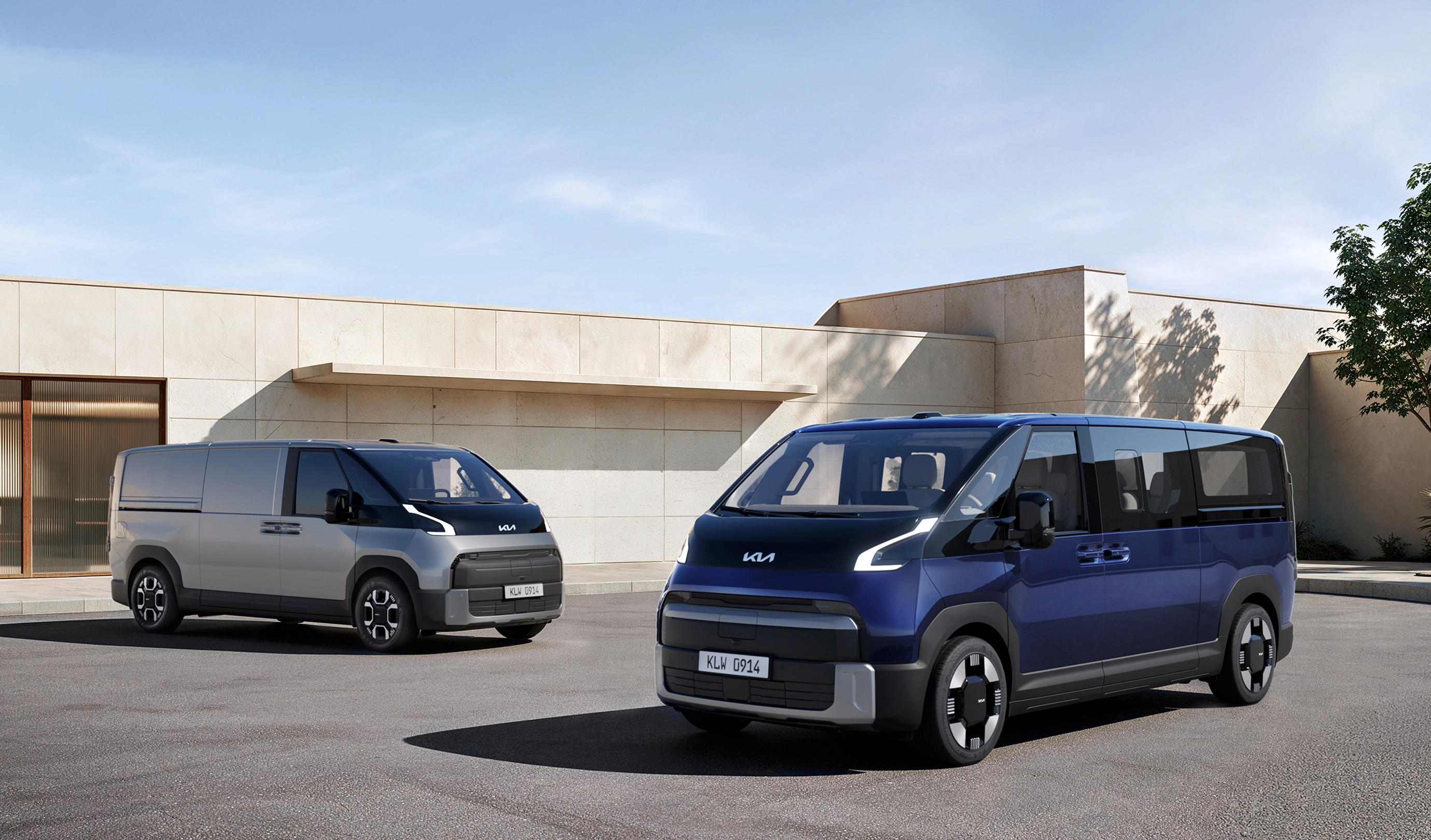
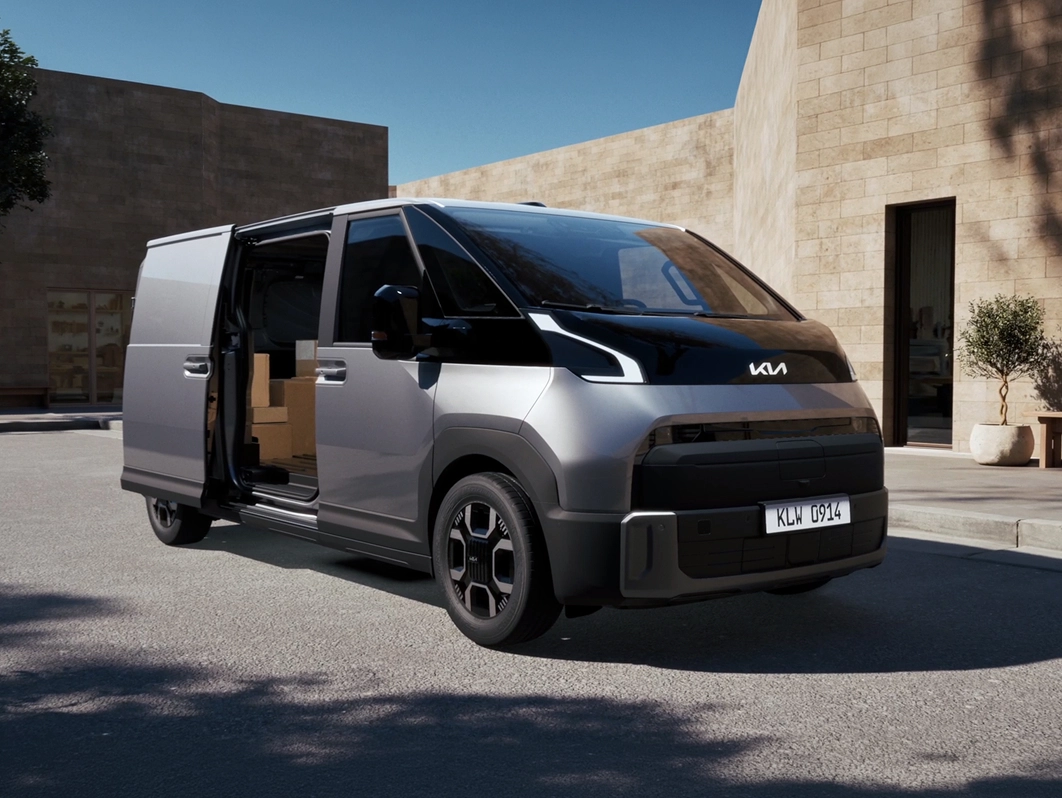
Renault is pitching the Trafic Van E-Tech electric as a compact, fast-charging work van with up to 470 km of targeted WLTP range. Image: Renault.
Size Is the First Split
Commercial vans are not bought by vibes. They are bought around routes, parking, payload, loading docks, shelving and how often the driver has to climb in and out.
That makes the size difference between these two vans important. Renault says the Trafic Van E-Tech electric will come in L1 and L2 lengths, measuring 4.87 metres and 5.27 metres. Cargo volume is 5.1 cubic metres in L1 and 5.8 cubic metres in L2, with enough space for three Europallets.
Kia’s PV7 Long is larger at 5.35 metres, and the PV7 program stretches further with a High Roof cargo body. The useful space advantage is clear: Kia talks about up to 6.1 cubic metres in Long form and 8.0 cubic metres in High Roof form.
The Renault advantage is compactness. A 1.90-metre height should help with many parking structures, and Renault quotes a 10.3-metre turning circle, which is more meaningful in daily van work than it sounds. A driver threading city alleys, underground garages and curbside stops may care more about that number than another cubic metre of cargo volume.
The PV7 is better when the route regularly fills the box. Airport hotels, regional delivery, mobile workshops, accessible transport and shuttle fleets can all make a stronger case for the bigger Kia footprint.
Payload May Matter More Than Range
Range gets the headline, but payload decides whether the van can legally do the job.
Renault says the Trafic’s platform can support up to 1.3 tonnes of payload and tow up to 2.0 tonnes, both pending homologation. That is a serious claim for a van that is also trying to stay compact and city-friendly. It is especially relevant for trades carrying tools, fixtures, parts or dense equipment rather than lightweight parcels.
Kia quotes up to 1,200 kg for some PV7 Cargo configurations in its European launch material. That is slightly lower than Renault’s headline figure, but the Kia’s larger body and conversion strategy may still make it the more useful van for bulky loads or passenger work.
Fleet buyers should not stop at the best published number. Final payload changes with battery size, body length, roof height, doors, seats, partitions, shelving, refrigeration gear and accessibility equipment. A long-range battery can be the right choice for distance and the wrong choice for payload if the route is weight-limited.
Both Vans Treat Charging as Operational Hardware
The important shift is that both Renault and Kia are treating fast charging as part of the van’s business case, not just a marketing bullet.
Renault says the Trafic Long Range uses an 81-kWh NMC battery and an 800V architecture. At a suitable DC fast charger, Renault claims it can add up to 280 km of range in 20 minutes. The company also says an Urban Range version with an LFP battery and a targeted 350 km WLTP range will follow later.
Kia’s PV7 uses the brand’s E-GMP.S platform and also moves into 800V territory. Kia’s preliminary European information points to 71.5-kWh and 96.2-kWh batteries, with the larger Cargo Long Range version targeting more than 460 km WLTP and about 25 minutes from 10 to 80 percent at a suitable 350-kW charger.
Those numbers are not directly interchangeable. Renault gives a range-added claim. Kia gives a 10-to-80-percent time. Both depend on charger power, battery temperature, state of charge, load and the actual charging curve.
For a fleet, the question is not which number looks bigger. It is whether the van can recover enough energy during the time it is actually parked. A delivery van with a 45-minute lunch window needs a different charging plan than a depot van that sits overnight for 11 hours.
Depot Charging Still Decides the Business Case
High-power DC charging can rescue a long day, but most electric vans will still live or die by depot planning.
A small business running one or two vans may be fine with overnight AC charging if routes are predictable. A larger fleet may need load management, staggered charging, dedicated DC hardware, utility upgrades or on-site battery storage. The more vans that return at the same time, the less useful a single heroic charging spec becomes.
This is where Renault’s Vehicle-to-Load support is practically interesting. V2L can power tools or devices from the traction battery, which suits trades and mobile-service users. Renault also says V2G support will come later, though real value will depend on local utility programs and compatible charging hardware.
Kia is approaching the problem with fleet software, connected services and conversion flexibility around its PBV strategy. That matters because the vehicle is only one part of electrifying a commercial route. Scheduling, energy reporting, driver behaviour, downtime and service access all decide whether the total-cost case works.
The Canadian Angle
Neither the Trafic Van E-Tech electric nor the PV7 has a confirmed Canadian launch. That limits the immediate buying advice, but it does not make the comparison academic.
Canada’s commercial EV market still has gaps. Small businesses can find electric pickups, passenger EVs and some commercial-van options, but the midsize electric work-van space remains much thinner than Europe. If vans like these eventually arrive here, the strongest candidates will be the ones that fit Canadian winters, long suburban service areas and fragmented charging access.
Canadian fleets should watch four things before getting excited about any imported spec sheet.
First, local range ratings. WLTP is useful context, but Natural Resources Canada figures and winter route data will matter more.
Second, payload by configuration. The exact Canadian body, battery and upfit can change the useful load.
Third, charging hardware. Connector choice, public charging access, depot capacity and battery preconditioning will decide real uptime.
Fourth, incentives and tax treatment. Commercial eligibility can differ from passenger-EV programs, so businesses should check current rules through the Canadian EV incentive guide instead of assuming a rebate applies.
Which Van Has the Better Idea?
The Renault Trafic E-Tech electric has the cleaner urban-work argument. It is compact, quick-charging on paper, payload-conscious and designed around the kind of daily practicality that matters when a van has to earn money block by block.
The Kia PV7 has the stronger platform-expansion argument. It is larger, more flexible and better suited to buyers that need passenger versions, high-roof cargo bodies or conversion potential beyond a standard panel van.
The more interesting conclusion is that neither company is treating electric vans as slow city appliances anymore. The new benchmark is a van that can carry real weight, charge quickly enough to stay in rotation and integrate with a business rather than merely reduce tailpipe emissions.
That is good news for buyers, even in markets still waiting for these exact models. It means the next wave of commercial EVs should be judged like work vehicles: not by the biggest battery alone, but by how well the whole package fits the job.
FAQ
Is the Renault Trafic E-Tech electric bigger than the Kia PV7?
No. The Renault is the more compact van. It measures 4.87 metres in L1 form and 5.27 metres in L2 form, while Kia says the PV7 Long is 5.35 metres and offers higher maximum cargo volume.
Which electric van has the faster charging setup?
Both make serious 800V charging claims, but they are expressed differently. Renault says the Trafic can add up to 280 km in 20 minutes. Kia targets about 25 minutes from 10 to 80 percent for the PV7 at a suitable 350-kW charger.
Are the Renault Trafic E-Tech and Kia PV7 coming to Canada?
Neither van has been confirmed for Canada or the United States as of September 27, 2026. Canadian buyers should treat both as signals of where electric commercial vans are heading, not as local-order vehicles.
Which van is better for urban delivery work?
The Renault Trafic E-Tech looks better matched to tight urban delivery because of its compact footprint, low height and 10.3-metre turning circle. The Kia PV7 makes more sense when the route needs more volume, passenger space or conversion flexibility.
Sources
- Renault Netherlands: Trafic Van E-Tech electric at EV Experience 2026
- Kia Germany: PV7 world premiere at IAA Transportation 2026
- Kia UK: PV7 premiere overview