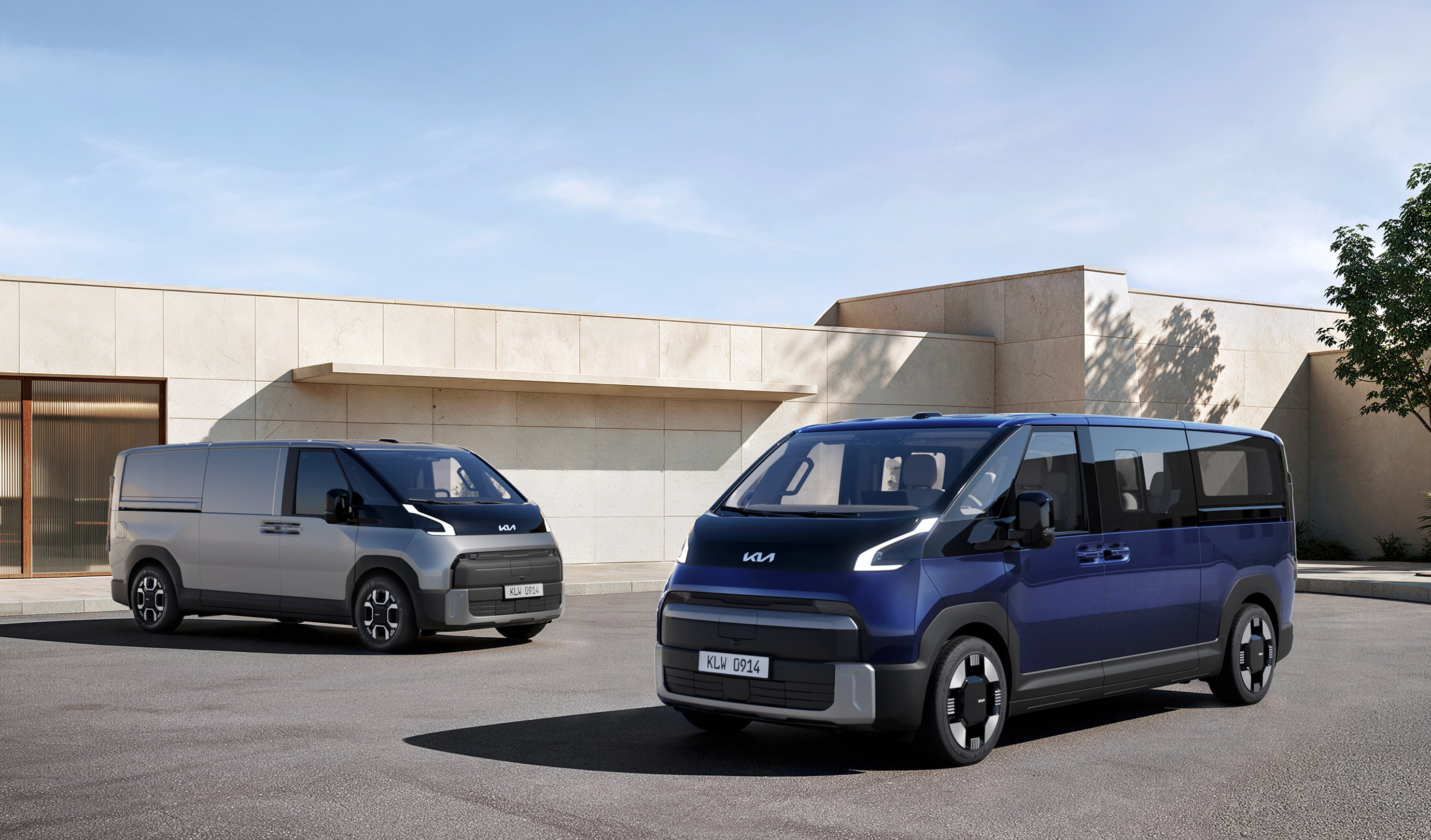
Kia PV7 vs PV5: Which Electric Van Fits the Job?
The Kia PV7 offers more cargo space, payload and faster 800-volt charging, while the smaller PV5 is better suited to urban routes. Here is how they compare.
Photo: Kia
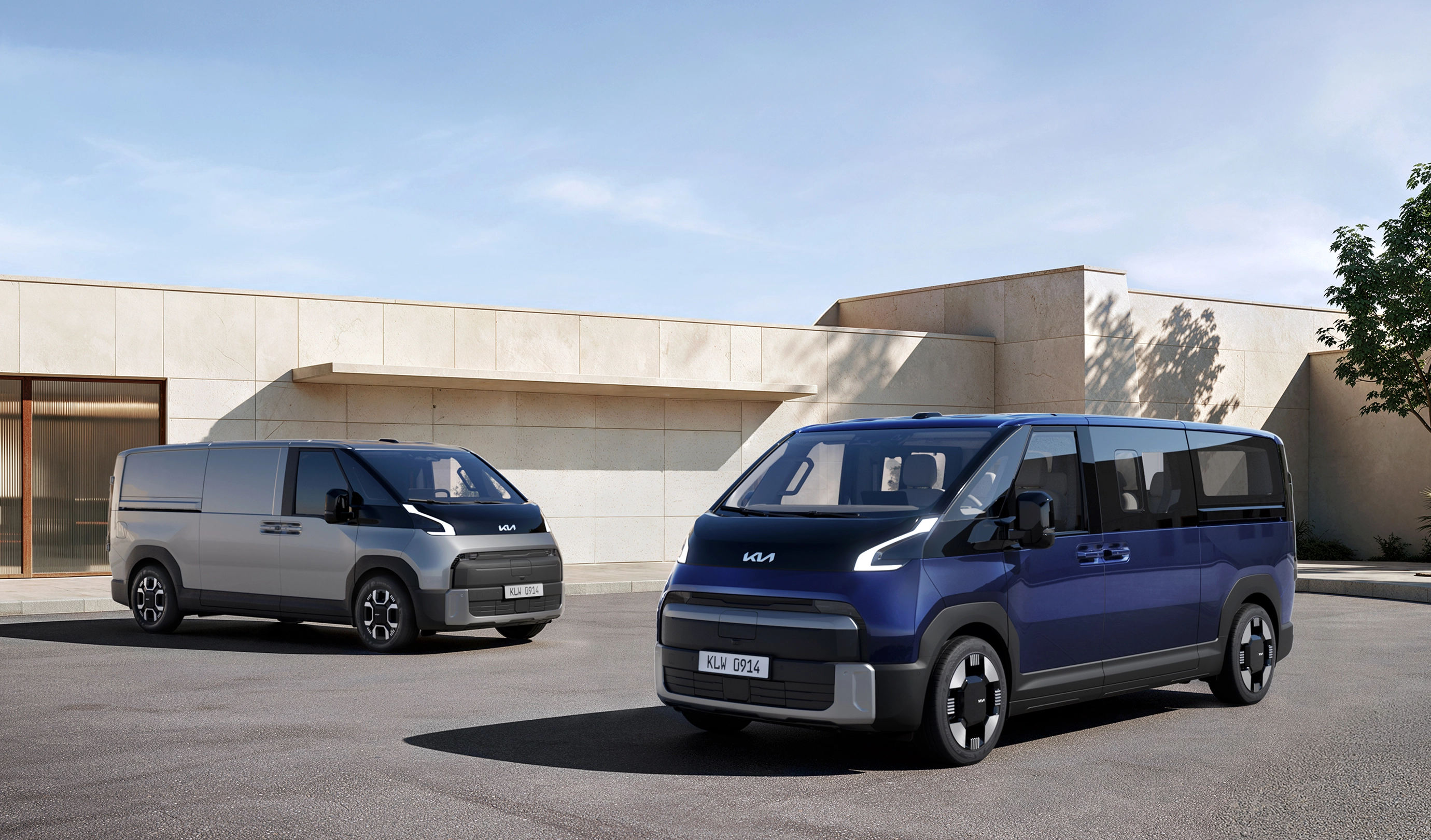
Kia now has two electric vans built from the same basic idea but aimed at substantially different jobs. The PV5 is the compact, city-friendly member of the Platform Beyond Vehicle family. The newly revealed PV7 is longer, more powerful and capable of carrying more people or cargo over a longer route.
The easy conclusion is that the PV7 is simply the better van because its numbers are bigger. That is not how commercial vehicles work. Every extra millimetre and kilowatt-hour has to earn its keep through usable space, payload or route flexibility. A smaller van can be easier to park, cheaper to charge and better matched to a technician or delivery route that rarely fills a large cargo bay.
Quick Verdict
Choose the Kia PV5 for urban delivery, mobile trades and smaller shuttle duties. Its 4.7-metre footprint is easier to manage in city traffic, its 4.4-cubic-metre cargo bay can hold two Euro pallets, and current European specifications offer up to 416 km of WLTP range. It is the more rational choice when a route is predictable and cargo volume matters more than maximum capacity.
Wait for the Kia PV7 if the job regularly overwhelms a compact van. Its Cargo Long body provides 6.1 cubic metres, the High Roof reaches 8.0 cubic metres and payload rises to as much as 1,200 kg depending on configuration. The 96.2-kWh battery and 800-volt charging system also suit longer regional work and multi-shift operation better than the PV5’s smaller battery packs.
For Canadian businesses, the decision is not immediately symmetrical. Kia Canada has a product-information page for the PV5 Cargo, while the PV7 is scheduled to launch in Europe and Korea in the second half of 2027 with no Canadian or U.S. confirmation. Local price, homologated range, charging connector and dealer support will matter more than the global specification sheet.
| Item | Kia PV5 Cargo | Kia PV7 Cargo |
|---|---|---|
| Primary role | Compact urban delivery, trades and smaller mixed-use fleets | Larger delivery routes, regional work, conversions and heavier fleet duties |
| Length | 4,695 mm | 5,350 mm for the Long model shown at launch |
| Width | 1,895 mm | 1,995 mm |
| Wheelbase | 2,995 mm | 3,500 mm |
| Cargo volume | 4.4 m³ | Up to 6.1 m³ Long; 8.0 m³ High Roof |
| Maximum payload | Up to 790 kg in current European specifications | Up to 1,200 kg Compact; up to 1,165 kg Long |
| Battery options | 51.5 or 71.2 kWh NCM; 43.3-kWh LFP offered in some markets | 71.5 or 96.2 kWh NCM |
| Maximum output | 120 kW (161 hp) | 200 kW (272 hp) |
| Maximum torque | 250 Nm (184 lb-ft) | 420 Nm (310 lb-ft) |
| Headline range | Up to 416 km WLTP for Cargo Long Range in current specifications | More than 460 km targeted WLTP for Cargo Long Range |
| DC charge time | About 30 minutes from 10-80% | About 25 minutes from 10-80% on a suitable 350-kW charger |
| Electrical architecture | Approximately 400 volts | 800 volts |
| Drive | Front-wheel drive | Front-wheel drive; all-wheel drive planned later |
| Passenger capacity | Five-seat Passenger model in major global specifications | Up to nine globally; up to 11 in Korea |
| North American status | Kia Canada has published PV5 Cargo information; confirm local launch details | Not announced for Canada or the United States |
The PV7 Is a Full Size Larger
The clearest difference is physical scale. At 5,350 mm, the PV7 Long is 655 mm longer than the PV5. It is also 100 mm wider and rides on a wheelbase extended by 505 mm.
That growth creates roughly 1.7 cubic metres of additional cargo volume when comparing PV7 Long with PV5 Cargo. The PV7 High Roof nearly doubles the advantage, reaching 8.0 cubic metres. For a fleet moving bulky parcels, catering equipment, hotel luggage or conversion hardware, that space can eliminate a second trip or let one larger van replace a less efficient assignment.
The PV5’s smaller footprint is an advantage when the van spends its day entering underground garages, squeezing into loading areas or making curbside stops. Its 419-mm rear step, straight cargo walls and room for two Euro pallets make it more useful than its exterior size suggests. A tradesperson carrying organized shelves and tools may gain little from dragging a larger body through traffic every day.
Fleet buyers should calculate utilization rather than buying the biggest box available. If the PV5 would run above its practical volume or payload limit on most shifts, the PV7 makes sense. If the PV7 would usually carry air, the compact van is likely the better operating tool.
Payload Could Decide It Before Range Does
The PV7’s strongest practical argument is payload. Kia quotes up to 1,200 kg for the Compact cargo body and up to 1,165 kg for the Long. Current PV5 European figures range from roughly 645 to 790 kg, depending on battery and door configuration.
That difference matters because electric-van range is irrelevant once the vehicle exceeds its legal weight. Dense cargo, plumbing supplies, tools, refrigeration equipment and conversion hardware can consume payload faster than they fill the body.
The largest battery is not automatically the best configuration. Battery mass can reduce legal payload, while optional shelving, partitions, passenger seats and equipment take another bite. Businesses should ask for the final market-specific curb weight and axle ratings of the exact van they intend to order, not rely on the highest payload number from a different body style.
PV7 Charging Is Built for Longer Days
Both vans can complete a useful fast charge during a break, but the PV7 has the more ambitious electrical system.
The PV5 uses an approximately 400-volt architecture and reaches 10 to 80 percent in around 30 minutes under Kia’s stated conditions. Its 71.2-kWh battery is appropriately sized for a compact van, and current specifications quote as much as 416 km WLTP.
The PV7 moves to 800 volts, offers a 96.2-kWh long-range battery and targets the same 10-to-80-percent window in about 25 minutes. Kia says that requires a compatible charger capable of up to 350 kW. The practical advantage is not merely saving five minutes: the larger van can replenish more energy during a similar stop, which is valuable on longer routes or between shifts.
Depot planning remains the constraint. Several PV7s arriving together can demand substantial site power, and a charger nameplate does not guarantee the van will hold peak output through the session. Operators need a charging plan based on overnight dwell time, route energy use, utility capacity and the number of vehicles that must recover simultaneously.
For a PV5 completing 150 urban kilometres before returning to base, expensive high-power public charging may be unnecessary. An appropriately sized overnight AC system can be cheaper and easier on the facility. The PV7’s rapid-charging advantage becomes more important as daily distance and vehicle utilization rise.
The PV5 Is the Better Urban Tool
A short wheelbase, tighter turning circle and lower energy requirement are valuable in dense service areas. The PV5’s basic shape suits couriers, electricians, telecom technicians, florists, food-service operators and municipal teams that need easy access more than a cavernous load bay.
Its lower cargo floor reduces the repeated step involved in loading parcels or equipment. Available vehicle-to-load power can run tools, while modular mounting points make the cargo area easier to organize. Those details can save more time across a workday than a small difference in advertised range.
The PV5 also has the maturity advantage. It is already represented on Kia’s European and Canadian sites, and its specifications are no longer merely concept targets. The PV7 is a promising 2027 product whose final prices, certified range figures and market-specific configurations remain unknown.
The PV7 Is Better for Shuttles and Conversions
PV7 Passenger is designed for up to nine occupants globally, with an 11-seat version planned for Korea. Removable seating, rear climate controls and power sliding doors give it an obvious role in hotel transport, airport shuttles, tourism and larger mobility fleets.
The Cargo family will include Compact, Long and High Roof bodies, followed by a chassis cab and specialist conversions. Kia says the complete PV7 program will eventually encompass 23 variants. That breadth is important for refrigerated bodies, accessible transport, mobile workshops and other jobs that cannot be served by a standard panel van.
A larger vehicle also gives converters more room to install equipment without consuming every kilogram or cubic metre available. The trade-off is cost and complexity: a specialized PV7 may require more expensive charging, tyres, parking and insurance than a PV5 doing a simpler job.
What Canadian Buyers Should Watch
Kia has not published a complete Canadian PV5 ordering guide with all final prices and certified specifications on the information page cited here, and it has not announced the PV7 for North America. That makes this a planning comparison rather than a current showroom choice between two equally available vans.
Canadian operators should watch five items:
- Final local range ratings: Natural Resources Canada figures will not match WLTP directly, and winter routes need an operating reserve.
- Charging connector and access: Depot hardware, public fast-charging compatibility and payment arrangements must fit the duty cycle.
- Payload by configuration: Battery, doors, seats and conversion equipment all change the usable number.
- Dealer and upfitter support: Commercial downtime is expensive, so parts, body repairs and conversion warranties matter.
- Total acquisition cost: Electricity savings cannot rescue a van that is oversized, underused or too expensive for the route.
Businesses considering an electric fleet should also check the current Canadian EV incentive guide rather than assuming a passenger-vehicle rebate applies to a commercial van. Program eligibility, vehicle class and provincial support can change.
Which Kia Van Fits Which Job?
Choose the PV5 if:
- daily work is mainly urban or suburban
- 4.4 cubic metres and two Euro pallets cover the normal load
- payload stays comfortably below the chosen configuration’s rating
- parking access and manoeuvrability are recurring constraints
- the van returns to a depot for overnight charging
- Canadian availability matters sooner than the PV7’s 2027 European launch
Wait for or evaluate the PV7 if:
- cargo regularly exceeds the PV5’s space or payload
- regional routes need a larger battery and quick mid-day energy recovery
- a High Roof, chassis cab or specialist conversion is required
- the business needs a larger passenger shuttle
- 800-volt charging can be supported at the depot or along the route
- the purchase timeline can wait for final pricing and local-market confirmation
Bottom Line
The Kia PV5 is the efficiency choice: compact enough for cities, large enough for two Euro pallets and capable of covering many return-to-base routes without carrying unnecessary van around all day.
The Kia PV7 is the capacity choice: more cargo room, substantially more payload, larger batteries and faster 800-volt charging for operators whose work genuinely requires them.
Kia’s smartest move may be offering both. Electric commercial vehicles are not a one-size-fits-all market, and the best van is the smallest one that can complete its hardest regular route with a safe payload and charging margin.
What is the difference between the Kia PV5 and PV7?
The PV5 is a compact electric van aimed at urban delivery, trades and smaller passenger duties. The PV7 is 655 mm longer in the Long configuration and offers more cargo volume, payload, power and charging capability.
Does the Kia PV7 have more range than the PV5?
Kia targets more than 460 km WLTP for the PV7 Cargo Long Range. Current PV5 Cargo Long Range specifications reach up to 416 km WLTP in some markets. The figures are not final North American ratings.
Which Kia electric van charges faster?
The PV7 has the stronger specification: about 25 minutes from 10 to 80 percent using an 800-volt system and suitable high-power charger. Kia quotes roughly 30 minutes for the PV5.
Are the Kia PV5 and PV7 coming to Canada?
Kia Canada has published information for the PV5 Cargo, although buyers should confirm final local pricing, timing and specifications. Kia has not announced Canadian or U.S. availability for the PV7.
Sources
- Kia: PV7 world-premiere specifications and launch plan
- Kia Europe: PV5 Cargo specifications
- Kia Canada: PV5 Cargo product information
Related Articles
- Kia PV7 Debuts With 460-KM Range and 800-Volt Charging
- Kia PV5 Makes Electric Vans Look Like the Next Real EV Battleground
- Morris JE Electric Van Sets Out Its Production Roadmap
Update, October 2026: Some PV7 size, battery, payload and charging figures are preliminary. PV5 WLTP and payload figures are European, not Canadian.