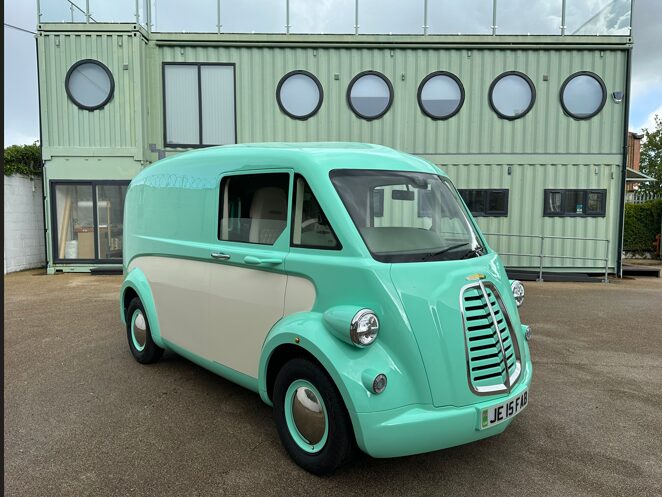
Morris JE Electric Van Gets a Production Roadmap After Its Latest Reveal
Morris Commercial has shown the latest pre-production JE electric van and outlined a path toward pilot production in 2027 and commercial-scale manufacturing in Wales in 2028.
The Morris JE is still a long way from becoming a common sight on North American streets, but the retro electric van just became a little less theoretical.
Morris Commercial has shown the latest pre-production version of its JE electric van at the Everything Electric West show in Cheltenham, while outlining a production path that now points to pilot manufacturing in 2027 and commercial-scale production in 2028. For a project first previewed years ago, that matters. The JE has always had the easy part figured out: it looks fantastic. The harder question has been whether a small revived brand could turn a nostalgic design into a real electric commercial vehicle.
The latest update suggests Morris Commercial is still chasing exactly that, with a distinctive pitch: an all-electric van inspired by the postwar Morris J-Type, wrapped around a lightweight recycled carbon-fiber body and aimed as much at brand-conscious businesses as conventional fleet buyers.
What Morris Is Building
The JE is not a restored classic with batteries squeezed underneath. Morris Commercial describes it as a clean-sheet electric van that reinterprets the original J-Type’s rounded shape, upright stance, and friendly face with modern EV hardware underneath.
On its official product page, the company says the JE uses an ultra-light fully recycled carbon monocoque body and a lightweight aluminum skateboard chassis. Morris claims the setup makes the van one of the lightest commercial vehicles in the world, which is the key to its range and payload argument.
The working numbers are unusual for something this characterful. Morris lists a 1,000-kg payload, about 6 cubic metres of load volume, room for two Euro pallets or 8-by-4-foot sheets, and a 250-mile range on its own product page. Its FAQ says the final range will depend on battery size, with more detail due closer to launch.
Recent industry coverage of the pre-production reveal has cited an even higher up-to-300-mile target and 20-to-80-percent charging in about 30 minutes, with a faster option also mentioned. That is worth treating as a target rather than a locked production spec. Until Morris publishes final homologated numbers, the sober read is that the JE is being positioned as a high-range, lightweight electric van, not that every version is guaranteed to deliver the headline figure.
The New Production Timeline
The most important part of this reveal is not the styling. It is the manufacturing plan.
Business Motoring reports that Morris Commercial plans to begin pilot production in 2027 at its composite manufacturing facility in Milton Keynes, then move to commercial-scale production in 2028 at St Athan in South Wales. The company has also acquired Prodrive Composites, which should give it more direct control over one of the JE’s most important technologies: the carbon-fiber body structure.
That is a meaningful shift because low-volume EV startups often stumble exactly here. Making a handsome prototype is one job. Certifying it, sourcing it, building it repeatedly, supporting it, and doing all that at a price commercial customers can justify is a completely different job.
The Welsh connection has been building for a while. In November 2025, the Welsh Government said Morris Commercial would establish a Bro Tathan production facility for the JE, creating around 150 skilled jobs and giving Wales what it described as its first electric-vehicle manufacturing facility. That announcement framed the JE as a late-2026 launch project. The latest 2027/2028 roadmap makes the timeline look more measured, and frankly more believable.
Why This Van Is Different From a Normal Fleet EV
Most electric commercial vans are sold on practicality first: route predictability, depot charging, lower maintenance, and urban clean-air access. The JE has to do all of that, but it is clearly being pitched with another job in mind.
Morris Commercial talks about the van as a rolling identity tool for premium retailers, hospitality brands, artisans, and specialty operators. That sounds fluffy until you picture the actual use case. A bakery, hotel, florist, coffee roaster, or boutique delivery business may care that its van turns heads in a way a generic white box never will.
That does not make the business case automatic. A distinctive body and carbon construction could make the JE expensive compared with more conventional electric vans from Ford, Stellantis, Volkswagen, or Kia. Morris’ own FAQ still lists a starting price of £61,000 when the van goes on sale, though final specifications and costs are expected closer to launch.
The counterargument is that some buyers are not shopping purely on lowest monthly cost. If the van doubles as advertising, customer theatre, and a sustainability signal, the math can look different for small brands that live on visibility.
The North America Question
Morris says international demand is part of the plan. Its FAQ says deliveries outside the UK are intended after the domestic launch, including Europe, Australia, New Zealand, North America, and other markets. Industry coverage of the latest reveal also points to more than 7,000 expressions of interest worldwide.
That does not mean Canadians or Americans should expect a local launch soon. North American certification, service support, parts availability, charging standards, warranty coverage, pricing, and commercial dealer relationships all matter. A niche British electric van can attract attention here without becoming a practical purchase.
Still, the JE fits a segment that deserves more variety. MotorLinks recently argued that Kia’s PV5 could make compact electric vans feel far more serious, especially for cities where a full-size van is overkill. The Morris JE is coming from a very different angle, but the underlying idea is similar: electric vans do not all have to be anonymous fleet appliances.
The Takeaway
The Morris JE remains a promise, not a finished production vehicle. Final range, pricing, market availability, service support, and delivery timing still need confirmation. That caution matters because EV history is full of charming concepts that never survived the industrial grind.
But this is also exactly the kind of project that makes the electric-vehicle shift more interesting. The JE is not another crossover chasing the same spec-sheet race. It is a small commercial vehicle with real personality, a lightweight material story, and a production plan that now extends beyond show-stand optimism.
If Morris Commercial can turn the latest pre-production van into repeatable 2028 manufacturing, the JE could become one of the rare EVs that makes commercial buyers think about more than payload, range, and charging speed. It could make a delivery van feel like part of the brand again.