
Tesla Semi vs Mercedes eActros 600: Which Electric Truck Is Ready for Europe?
Tesla's European Semi promises 550 km of range and 800 kW charging, while the Mercedes eActros 600 is already hauling freight. Here is how their specs and readiness compare.
AI-generated illustration
Tesla has finally given European fleets enough Semi specifications to make a serious comparison. The numbers are compelling: 550 km of estimated range, energy use of 1.0 kWh per kilometre, charging at up to 800 kW and a tractor curb weight of about 9.1 tonnes.
The obvious rival is the Mercedes-Benz eActros 600. It carries a familiar 500-km headline range, a 621-kWh LFP battery, up to 400-kW CCS charging and an eventual megawatt-charging path. More importantly, it is not waiting for a European launch. Series production began at the end of 2024, customer trucks are already operating and Mercedes is delivering large fleet orders.
That creates a comparison with two different answers. The Tesla looks highly competitive on its published efficiency and charging targets. The Mercedes is the truck a fleet can procure, support and put to work today.
Quick Verdict
Choose the Mercedes eActros 600 for a fleet deployment that has to start now. Its 500-km standard range is enough for many depot-to-depot and middle-mile routes, the truck has accumulated real customer use, and Mercedes offers a broad family of cab, battery, wheelbase and axle configurations. Existing 400-kW charging is slower than the Semi’s maximum claim, but it is a known operating path.
Put the Tesla Semi on the 2027 evaluation list if route efficiency and fast turnaround matter more than immediate availability. Tesla’s 1.0-kWh/km estimate and 800-kW charging capability could make it a strong regional and medium-distance tractor. Fleets should not sign off on the business case until Tesla discloses European pricing, launch markets, service coverage and the practical availability of Semi Chargers.
The most important difference is not the nominal 50-km gap between their standard range claims. Mercedes now says an economy-focused eActros 600 configuration can reach up to 560 km, while real range for either truck will depend heavily on trailer aerodynamics, speed, weather, elevation and payload. The real gap is readiness: eActros is operating now; Semi is due in 2027.
| Item | Tesla Semi Europe | Mercedes-Benz eActros 600 |
|---|---|---|
| European availability | Customer deliveries scheduled to begin in 2027 | Series production since late 2024; in customer operation |
| Headline range | Approximately 550 km estimated | 500 km standard claim; up to 560 km in an economy-focused configuration |
| Published range basis | 40 tonnes, 80 km/h, 20°C, flat terrain, specified aerodynamic equipment and dry-van trailer | 40 tonnes, 20°C, preconditioned 4x2 tractor in long-haul operation; route and configuration dependent |
| Battery | Capacity and chemistry not published for Europe | Three 207-kWh LFP packs; 621 kWh installed |
| Energy consumption | 1.0 kWh/km estimated | No directly comparable single figure published |
| Current published fast charging | Up to 800 kW; up to 60% of range in 30 minutes | Up to 400 kW CCS; about 10-80% in 70 minutes under Mercedes’ stated 400-kW conditions |
| Megawatt charging | MCS 3.2 listed as charge type | MCS test program up to 1,000 kW; about 20-80% in 30 minutes simulated |
| Gross combination weight | 40 tonnes | Technically up to 44 tonnes |
| Tractor or payload figure | About 9,100 kg tractor curb weight | Around 22 tonnes payload with a standard semitrailer in the EU |
| Drive system | Three independent rear-axle motors; up to 800 kW drive power | Two-motor electric axle; 400 kW continuous and 600 kW peak output |
| Configuration strategy | Standard-range European tractor specification announced | Multiple cabs, battery counts, wheelbases and axle configurations |
| Best fit today | 2027 trial candidate for fleets willing to validate infrastructure and support | Near-term fleet procurement with established production and customer use |
Tesla Semi and Mercedes eActros 600 official gallery
13

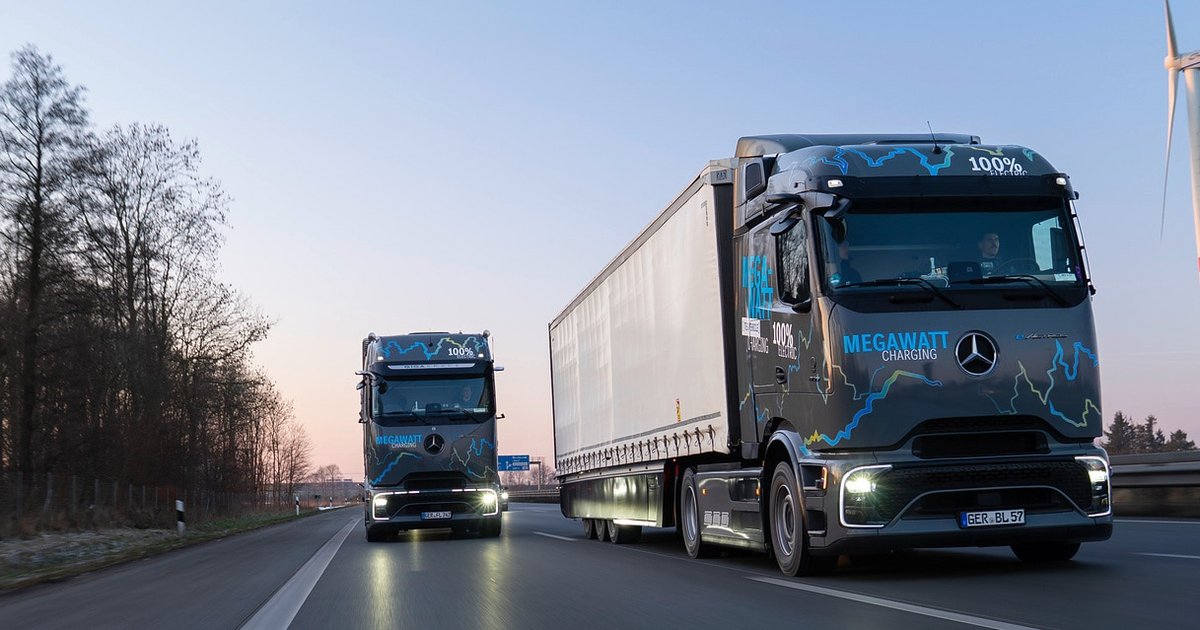
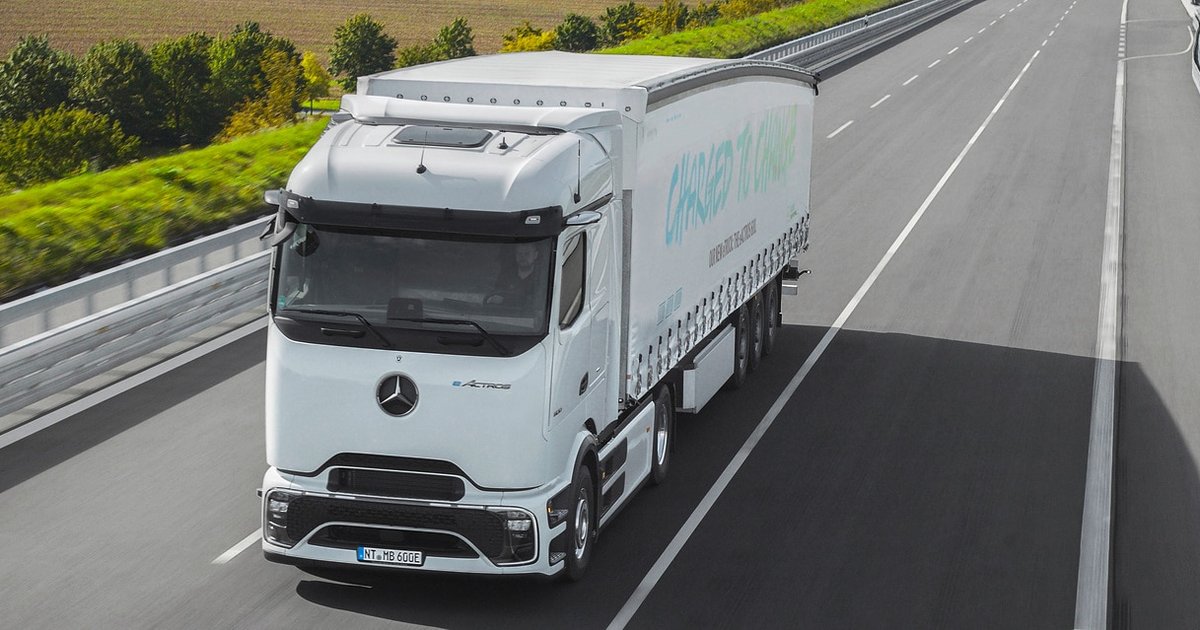
Tesla’s European Semi specification targets 550 km of estimated range at a 40-tonne gross combination weight, with deliveries scheduled to begin in 2027.
The Range Numbers Are Closer Than They Look
Tesla’s 550-km estimate initially appears to beat the eActros 600 by 50 km. It is a useful number, but not a clean victory.
Tesla bases its estimate on a 40-tonne gross combination weight, 80 km/h, 20°C, flat terrain and a defined aerodynamic tractor-and-trailer setup. That is a transparent test description, yet it is still an internal estimate built around favourable repeatable conditions. Headwinds, winter temperatures, wet roads, hills and a less aerodynamic trailer will all change the result.
Mercedes’ long-standing eActros 600 claim is 500 km at 40 tonnes under practical long-haul conditions. In its September 2026 fleet announcement, Mercedes added that the most economical three-battery configuration can achieve up to 560 km at the same gross train weight. That does not make the eActros universally longer-legged; it shows how much configuration and duty cycle matter.
The fleet-planning lesson is simple: neither truck should be purchased from the headline range alone. Operators need route simulations using actual trailer types, average road speeds, seasonal temperatures, elevation, driver breaks and reserve requirements.
A 500-km truck that reliably returns to a depot with a planned buffer can be more useful than a nominally longer-range truck that depends on a public charger that has not been built yet.
Tesla Has the More Aggressive Efficiency Claim
The most intriguing Tesla number is 1.0 kWh/km, not 550 km.
If that figure survives real European fleet use, it would give the Semi a strong operating-cost foundation. Energy efficiency affects electricity expense, battery mass, charging time and how much useful range can be added during a fixed break. Saving a tenth of a kilowatt-hour on every kilometre becomes meaningful when a tractor runs six figures of kilometres per year.
Tesla has not published the European truck’s battery capacity or chemistry, so the complete battery-to-range calculation remains unavailable. It also lists up to 800 kW of drive power, which is a peak capability rather than evidence that the truck consumes that much energy in normal motion.
Mercedes provides more battery detail. The eActros 600 uses three 207-kWh LFP packs for 621 kWh installed, and the company says more than 95% of that capacity can be used. LFP chemistry is well suited to commercial service because durability and cycle life matter more than chasing the highest possible energy density.
Mercedes has not supplied one energy-consumption figure that is directly comparable with Tesla’s stated test. Dividing battery capacity by range would be misleading because installed capacity, usable energy, reserve strategy and test conditions differ. Proper fleet trials matter more than an improvised spreadsheet number.
Charging Is Where the Strategies Separate
Tesla says the European Semi can accept up to 800 kW and recover up to 60% of its range in 30 minutes. On the 550-km estimate, that represents roughly 330 km of added rated range during a half-hour stop.
The company lists MCS 3.2 as the charge type and refers to an expanding Semi Charger network. What it has not yet provided is a detailed European map, opening schedule, access model or pricing structure. Those details will determine whether 800-kW capability is an everyday tool or a depot-only advantage during the early rollout.
The eActros 600 currently supports CCS charging at up to 400 kW. Mercedes says the 400-kW setup being installed for a major customer can charge the truck from 10% to 80% in around 70 minutes under its stated standard conditions. That is slower than a normal 45-minute driver break, but it can work at depots, fulfilment centres and routes with longer loading windows.
Mercedes is also advancing MCS. Two test trucks completed a 2,400-km charging exercise between Germany and Sweden in January 2026, using public and private truck infrastructure. Mercedes says up to 1,000 kW could reduce a 20-to-80% session to about 30 minutes, but it also notes that only a few public MCS sites are currently available and the uniform standard remains in development.
In other words, Tesla presents the more aggressive peak-power specification, while Mercedes has both a slower charging system in commercial use and a faster one under real-world development. Neither manufacturer can solve the broader infrastructure problem alone.
Availability Changes the Buying Decision
The eActros 600 has a two-year head start over Tesla’s planned European customer deliveries.
Mercedes began series production at Wörth at the end of 2024. The truck has since entered regular customer operation, including large orders from logistics fleets. In September 2026, Mercedes handed over the first 27 German eActros 600 trucks from a broader order of more than 200 for Amazon’s European network, with more than 50 scheduled to operate in Germany by year-end.
That operating base gives procurement teams information that a specification sheet cannot: delivery timing, workshop processes, parts support, driver training, charging integration and route performance. A fleet can also choose from a growing eActros family with two cab variants, two or three battery packs, multiple wheelbases and new axle layouts.
Tesla says European deliveries begin in 2027, but pricing and the first countries have not been announced. It has presented one clear standard-range tractor specification with a central seating position, three-motor rear drive, a 40-tonne gross combination rating and up to 25 kW of electric power take-off.
For a fleet writing a 2026 purchase order, this is not yet an equal contest. For a fleet planning a 2027 pilot, the Semi’s efficiency and charging claims justify attention.
Payload Needs a Vehicle-by-Vehicle Check
Tesla’s published European curb weight is about 9,100 kg for the tractor. Mercedes instead emphasizes a complete operating result: the eActros 600 is technically designed for up to 44 tonnes gross combination weight and provides around 22 tonnes of payload with a standard semitrailer under EU rules.
Tractor equipment, axle specification, trailer mass, national allowances and the chosen body all affect legal payload. Tesla’s listed 40-tonne gross combination limit is also lower than Mercedes’ technical 44-tonne ceiling, although many European operations are planned around 40 tonnes.
A fleet should ask both manufacturers for homologated axle loads, fifth-wheel position, exact tractor mass, trailer assumptions and legal payload in each operating country. The decisive number is not the lightest brochure tractor. It is how much revenue-generating freight the complete combination can carry on the intended route.
Cab and Fleet Integration May Matter More Than Acceleration
Tesla’s central driving position is the most visible philosophical difference. It provides a symmetrical forward view and allows the same basic cab concept to work in left- and right-hand-drive markets. The trade-off is a less conventional cabin layout for fleets accustomed to established European tractors.
Mercedes takes the familiar route. The eActros 600 is integrated into a broad commercial-vehicle operation with conventional fleet configurations, workshop processes and cab choices. That can reduce retraining and procurement friction, especially for mixed diesel and electric fleets.
Tesla’s three motors and up to 800 kW of drive power sound dramatic, but heavy-truck productivity is rarely decided by maximum acceleration. Uptime, tyre wear, energy use, driver comfort, brake blending, service response and charger reliability are more important over a million-kilometre life.
The Semi may prove excellent in those areas. European operators need evidence from local trucks before assuming North American demonstrations transfer directly to their routes.
Which Truck Fits Which Fleet?
Choose the Mercedes-Benz eActros 600 if:
- trucks need to enter service in 2026 or early 2027
- established European production and support reduce procurement risk
- 500 km of standard range covers the core route plan
- depot or destination charging at up to 400 kW is workable
- multiple cabs, axle layouts or battery configurations are required
- legal payload and body flexibility matter more than the highest peak charging claim
Evaluate the Tesla Semi if:
- a 2027 pilot fits the replacement cycle
- the route can benefit from a published 1.0-kWh/km efficiency target
- a 30-minute charging stop is central to utilization
- Tesla can provide dependable depot or corridor charging for the contract
- a central-seat cab and new service model are acceptable
- the purchase decision can wait for firm European pricing, country availability and support terms
For many fleets, the right answer will be both: deploy proven eActros 600 trucks on suitable routes now, then test the Semi against actual operating data when European customer vehicles become available.
Bottom Line
The Tesla Semi has arrived in the European conversation, not yet in European fleet service. Its 550-km range estimate, 1.0-kWh/km efficiency target and 800-kW charging specification are strong enough to make it a credible eActros 600 competitor on paper.
The Mercedes-Benz eActros 600 remains the more immediately available operational choice. Its standard range is close, its best configuration can overlap Tesla’s estimate, and its greatest advantage is tangible: production trucks, customer kilometres, established support and configurable hardware.
Tesla can close that gap, but range alone will not do it. European fleets need competitive pricing, reliable service and a charging network that turns the Semi’s 800-kW capability into repeatable daily uptime.
Is the Tesla Semi available in Europe?
Not yet for normal customer delivery. Tesla says European Semi deliveries will begin in 2027. Pricing, first delivery markets and a detailed European Semi Charger rollout remain unannounced.
Does the Tesla Semi have more range than the eActros 600?
Tesla estimates 550 km. Mercedes quotes 500 km for the standard eActros 600 test case and up to 560 km for its most economical three-battery configuration. The figures use different manufacturer methods, so route-specific testing is more useful than declaring a universal winner.
Which electric truck charges faster?
Tesla publishes a higher peak-power figure in the retained account: up to 800 kW and up to 60% of range in 30 minutes. The eActros 600 supports up to 400-kW CCS charging in customer operation. Mercedes is testing MCS at up to 1,000 kW, with a simulated 20-to-80% time of about 30 minutes.
Which truck should a fleet buy today?
For immediate deployment, the eActros 600 is the lower-risk choice because it is already in production and customer use. The Tesla Semi is a promising 2027 trial candidate once pricing, service coverage and charging access are clear.
Sources
- Tesla: European Semi specifications and delivery timing
- Daimler Truck: eActros 600 specifications and September 2026 fleet deliveries
- Daimler Truck: eActros 600 megawatt-charging endurance test
- Daimler Truck: eActros 600 technical launch information
Related Articles
- Tesla Semi’s European Specs Are Official: 550 km Range and 800 kW Charging
- Electric Truck Charging Reservations Are Coming to North America
- Scania’s Wibax Order Shows Where Heavy Electric Trucks Work Today
Update, October 2026: Tesla’s European figures are from its September 2026 announcement. Tesla quotes range recovered while Mercedes quotes a percentage charge window, so the charging numbers are not directly comparable.