EV Brake Rust in Canada: Why Low-Wear Brakes Still Need Service
Regenerative braking reduces pad wear, but Canadian road salt can leave EV rotors and calipers corroded. Here is what owners should inspect and service.
Electric vehicles are famous for going easy on brake pads. Regenerative braking uses the drive motor to slow the car and sends some of that recovered energy back to the battery, leaving the conventional friction brakes with less work to do.
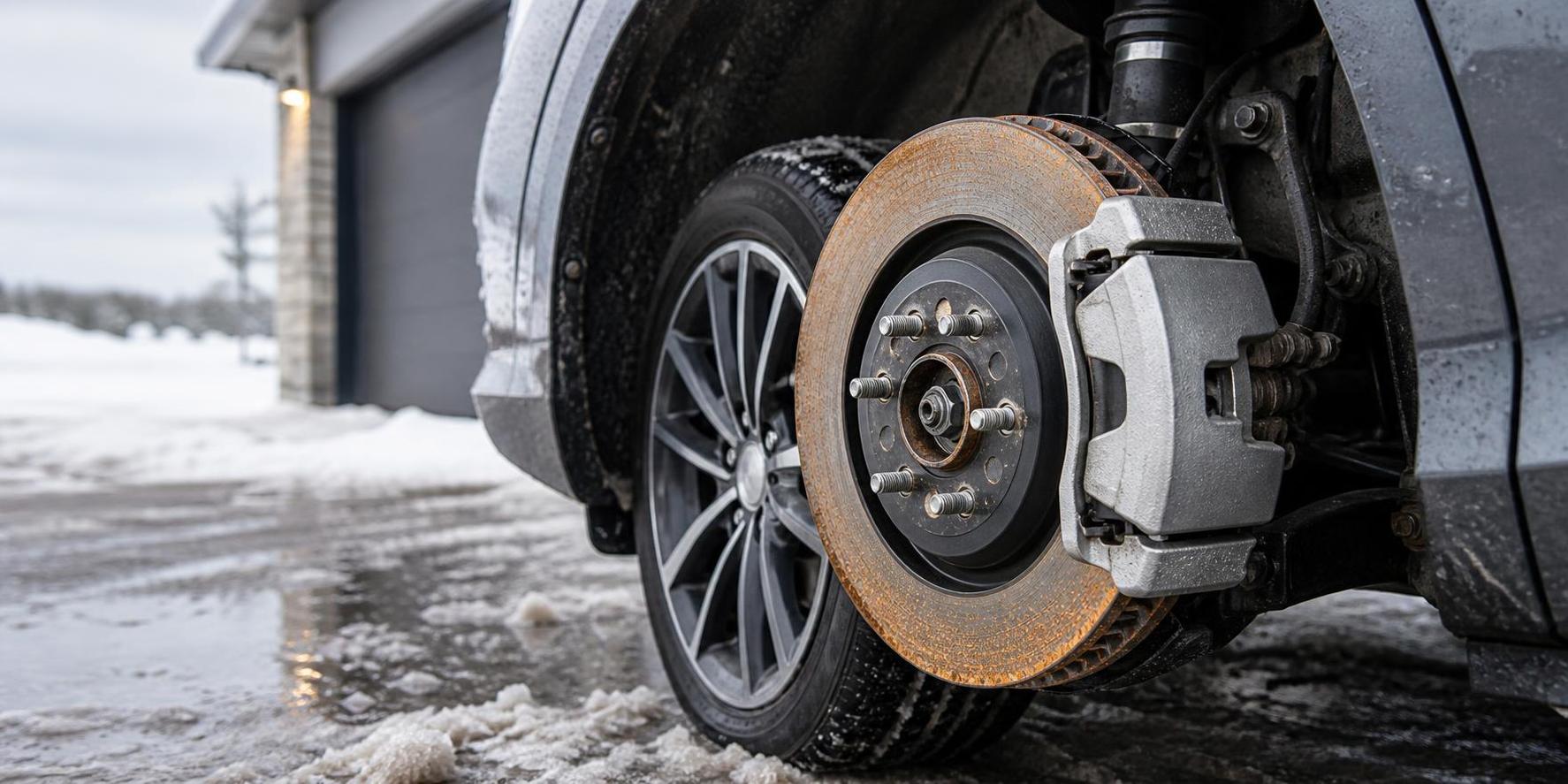
That is an efficiency win, but it creates a Canadian maintenance paradox: brake pads may wear slowly while rotors, calipers and sliding hardware still face water, grit and road salt. A brake system that is rarely used hard enough to dry and clean its friction surfaces can develop corrosion long before the pads are worn out.
The answer is not to fear regenerative braking or start making unnecessary hard stops. It is to understand how the two braking systems share the job, follow the vehicle’s own brake-cleaning instructions, and make inspection part of routine ownership.
This is a general ownership guide, not a repair procedure. Brake controls, service intervals and disc-cleaning functions vary by model. Safety-critical brake work should be performed by a qualified technician. Manufacturer information was checked on August 31, 2026.
Quick Verdict
EV brakes can last longer, but they are not maintenance-free. Regeneration reduces pad and rotor wear during normal deceleration. It does not protect caliper pins, pad contact points, rotor edges or other exposed hardware from corrosion.
Canadian owners should prioritize condition over pad thickness alone. A shop should look for free pad movement, even rotor contact, corrosion, pitting, damaged boots, seized hardware, fluid condition and any manufacturer-required cleaning or lubrication.
Use a built-in brake-disc-cleaning mode when the manual provides one. Hyundai and Kia manuals describe systems that temporarily reduce regeneration for a series of brake applications. Do not assume that the same button sequence or procedure applies to another vehicle.
Persistent symptoms need inspection. Grinding, pulling, pedal changes, vibration, warning lights, a wheel that runs unusually hot, deep pitting or rust that does not clear are not problems to solve with an improvised braking exercise.
| System or condition | What happens | Maintenance implication | Owner action |
|---|---|---|---|
| Regenerative braking | The drive motor slows the vehicle and recovers energy | Pads and rotors may be used less often | Use normal regen; follow the manual for brake-cleaning guidance |
| Friction braking | Pads clamp the rotors and convert motion into heat | Contact can dry and clean light contamination, but components still wear | Have noise, pulling, vibration or reduced performance inspected |
| Road salt and moisture | Corrosive residue reaches exposed rotors and caliper hardware | Rust and seized movement can develop even with thick pads | Follow severe-climate service guidance and rinse the vehicle appropriately |
| Long parking after wet use | Moisture can leave a light film on exposed iron rotors | Brief surface rust can be normal; persistent corrosion is not | Check whether it clears in normal, safe use and seek inspection if it does not |
Why Regeneration Changes Brake Wear
The U.S. Department of Energy explains regenerative braking simply: the electric motor operates in reverse during deceleration, using the rotating wheels to generate electricity and slow the vehicle. Conventional wheel brakes remain available, but they do not have to turn all of the car’s kinetic energy into waste heat.
Modern EVs often blend the two systems. Depending on speed, battery state of charge, temperature, requested stopping force and stability-control needs, the car can use regeneration, friction braking or both. Pressing the brake pedal therefore does not always mean the pads are doing all the work.
Less friction use generally means less brake dust and slower pad wear. The trade-off is inactivity. Polestar’s Canadian manual explicitly recommends regular use of the friction brakes to avoid rotor problems caused by rust or accumulated dirt. Tesla likewise notes that regenerative braking lets pads see less use and tells owners to apply the mechanical brakes often enough to help dry pads and rotors.
That advice must stay inside the manufacturer’s procedure and normal road safety. A driver should never make a hard stop in traffic merely to clean rotors. Some vehicles blend the brakes automatically or provide a dedicated cleaning function; others give model-specific instructions in the manual.
Why Canadian Winters Are Hard on EV Brakes
Most brake rotors are exposed cast iron. They can develop a thin orange film after rain, a car wash or a damp night. That light surface oxidation may disappear after the friction brakes make proper contact. It is not automatically evidence that a rotor needs replacement.
Road salt raises the stakes. Salty moisture can reach the rotor faces and edges, caliper brackets, pad contact points, fasteners and sliding hardware. Repeated wet-dry cycles leave residue behind, while infrequent friction-brake use gives corrosion more time to establish itself.
Tesla’s current maintenance guidance recognizes that climate penalty directly. For applicable vehicles operated where roads are salted in winter, it recommends cleaning and lubricating brake calipers every year or 20,000 kilometres, whichever comes first. That is a Tesla interval, not a universal schedule, but it shows why an EV’s low pad wear should not be confused with no brake service.
Corrosion can cause several different problems:
- pads that do not move freely in their carriers
- caliper pins or mechanisms that bind instead of releasing smoothly
- uneven contact that cleans only part of the rotor face
- rotor scaling or pitting that normal braking cannot remove
- noise, vibration or pulling under braking
- unwanted drag that creates heat and wastes energy
- accelerated wear on one pad, rotor or corner of the vehicle
An inspection has to look at the complete assembly. Reporting that the pads still have plenty of material does not answer whether the pads move freely or the rotor surface remains serviceable.
Surface Rust or a Real Brake Problem?
A uniform, light-coloured film after the car sits wet is different from a rotor with deep pits, flaky scaling or only a narrow polished band where the pad makes partial contact. Owners do not need to diagnose rotor service limits from the driveway, but they should know when to stop assuming rust is harmless.
Arrange an inspection when any of these symptoms persists:
- grinding, scraping or a harsh metallic sound
- pulsing or vibration through the pedal or steering wheel
- the vehicle pulling left or right during braking
- a material change in pedal feel or stopping response
- a brake, stability-control or hydraulic-system warning
- one wheel producing unusual heat or a burning smell
- heavy corrosion, deep grooves or an uneven rotor contact pattern
- rust or noise that remains after the manual’s approved cleaning procedure
A brief squeak after rain can have a simple cause. A continuous high-pitched wear warning, grinding or reduced braking should never be dismissed as an EV quirk. Kia’s manual warns owners not to ignore the audible indicator from worn brake pads, and the same common-sense rule applies across brands.
How Built-In Brake Disc Cleaning Works
Some Hyundai and Kia vehicles include a Brake Disc Cleaning function. Their current manuals say it temporarily limits regenerative braking so the friction brakes can work during roughly 10 brake applications, helping reduce surface rust and squeal. The function then switches off automatically.
This is a clever solution because the car coordinates the process. The driver receives a dashboard confirmation, the control system changes the brake blend, and the vehicle returns to normal operation when the cycle is finished.
It is not a universal EV feature. Even within one brand, availability and activation can vary by model, market and model year. Owners should search the current manual for terms such as “brake disc cleaning,” “brake cleaning,” “rotor rust” or “regenerative braking,” then use only the documented procedure.
Do not copy a button sequence from a different vehicle. Do not disable safety systems, shift to neutral on the road, repeatedly brake hard, or use the parking brake as a substitute for the service brakes unless the manual specifically describes an emergency procedure.
What a Proper Brake Inspection Should Cover
The useful question at a service visit is not simply, “How much pad is left?” Ask for the brake system to be assessed for the environment in which the EV operates.
A condition-based inspection can include:
- Pad thickness and wear pattern: Inner and outer pads should be checked, because a seized component can make them wear differently.
- Rotor condition: The technician should assess both faces where possible, not only the visible outer surface, and compare corrosion, thickness and runout against manufacturer limits.
- Caliper and pad movement: Pins, boots, brackets and contact points need to move and seal as designed.
- Brake fluid: The vehicle’s schedule or onboard health check determines when testing and replacement are required. Regeneration does not eliminate the hydraulic circuit.
- Electronic parking brake operation: The mechanism still needs to apply and release properly, even if the driver rarely handles a conventional lever.
- Leaks, hoses and warning history: Brake fluid loss, damaged lines or stored faults require diagnosis, not cleaning.
Brake service is safety-critical. Tesla’s own salt-removal service document warns that lubricant must not contact the rotor, pad friction surface or rubber brake components. That is a strong reason to leave caliper disassembly and lubrication to someone using the correct procedure and materials.
A Sensible Canadian Owner Routine
Start with the exact maintenance schedule for the model and climate. If it lists an interval for salted roads or severe conditions, treat that as part of the cost of ownership rather than an optional upsell.
Between services:
- pay attention to new noise, pulling, vibration, warnings or pedal changes
- look through the wheel openings for obvious heavy corrosion or an uneven swept area
- use the vehicle’s documented disc-cleaning mode when appropriate
- avoid leaving road-salt buildup on the vehicle for long periods; follow the manual’s washing guidance, especially around high-pressure spray and electrical components
- expect a light film after wet parking, but check whether it clears during normal approved use
- keep invoices that record brake inspection, caliper service and brake-fluid checks
Spring tire changeover is a convenient time to ask for a brake inspection because the wheels are already coming off. That does not automatically mean the brakes need annual replacement. It simply gives the shop a clear view of components that may otherwise stay hidden behind aerodynamic wheel covers.
Drivers shopping for a used EV should request the same evidence. A car with original pads at high mileage may demonstrate effective regenerative braking—or it may have neglected, corroded hardware. Service records and an inspection separate the two.
MotorLinks’ used-EV battery health guide covers the high-voltage checks, but the ordinary mechanical systems still deserve equal attention before purchase.
Bottom Line
Regenerative braking is one of an EV’s most satisfying engineering advantages. It recovers energy, makes one-pedal driving possible in many models and can stretch the useful life of pads and rotors.
It does not repeal winter chemistry.
Water and road salt still attack exposed brake hardware, and a rotor that sees less friction can have fewer opportunities to clean itself. The smart Canadian approach is not more aggressive driving; it is model-specific brake-cleaning use, regular condition checks and climate-appropriate caliper service.
Long pad life should be a benefit, not an excuse to stop looking at the brakes.
FAQ
Do EV brakes last longer than brakes on gasoline cars?
Regenerative braking can reduce friction-brake use and pad wear. Actual life depends on the vehicle, climate and driving, while corrosion or seized hardware can require service before the pads are worn out.
Is rust on an EV brake rotor normal?
A light film after rain, washing or damp parking can be normal and may clear with appropriate brake use. Persistent heavy rust, deep pitting, vibration, pulling, grinding or reduced braking needs professional inspection.
How often should EV brakes be serviced in Canada?
There is no universal interval. Follow the exact model’s schedule and severe-climate guidance. Tesla, for example, recommends annual or 20,000-kilometre caliper cleaning and lubrication for applicable vehicles in salted-road regions.
Can regenerative braking clean rusty brake rotors?
No. Regeneration slows the vehicle through the electric motor rather than pad-to-rotor friction. Some EVs provide a disc-cleaning mode that temporarily limits regeneration and uses the friction brakes.
Sources
- U.S. Department of Energy: Regenerative braking overview
- Tesla Model 3 maintenance service intervals
- Tesla technical note: Cleaning road salt from brake calipers
- Hyundai owner manual: Brake Disc Cleaning
- Kia owner manual: Brake disc cleaning
- Polestar Canada owner manual: Regenerative braking