EV 12-Volt Batteries Explained: Why a Full EV Can Still Be Stranded
An EV's small low-voltage battery powers the computers, locks and startup sequence. Here is what Canadian owners should know before it fails.
An electric vehicle can show plenty of range and still refuse to unlock, wake up or move. The apparent contradiction comes from the fact that most EVs carry two electrical systems: a large high-voltage battery for propulsion and a much smaller low-voltage battery for the electronics that bring the vehicle to life.
Owners still commonly call it the 12-volt battery, although manufacturers increasingly use the broader term low-voltage battery and the exact voltage or chemistry can vary by vehicle. Whatever the label, its job matters. It powers items such as control modules, locks, displays and lighting, and it supports the startup sequence that allows the high-voltage pack to connect to the rest of the car.
That makes a weak low-voltage battery more than an inconvenience. The car may have hundreds of kilometres of energy stored underneath the floor but lack the small amount of power required to make that energy accessible.
This is a general ownership guide, not a repair procedure. Low-voltage layouts and recovery instructions vary significantly, so use the current manual for the exact vehicle. Sources were checked on August 29, 2026.
Quick Verdict
Treat the low-voltage battery as a separate maintenance item from the traction battery. A healthy high-voltage state of charge does not prove that the smaller battery is healthy.
Act on low-voltage warnings promptly. Intermittent screen resets, unusual electrical messages, unreliable app wake-ups or a vehicle that struggles to enter its ready state deserve diagnosis. Those symptoms can have other causes, but waiting for the car to become completely unresponsive removes the easy options.
Save the vehicle-specific recovery instructions before an emergency. Some EVs need an external low-voltage supply merely to open the hood or unlock access to the proper jump points. A manual stored only inside a locked, powerless car is not very helpful.
Do not improvise with jumper cables. Tesla, Hyundai and Polestar manuals illustrate how different the rules can be. Use only the specified voltage, connection points and sequence, and call roadside assistance when the procedure or battery type is uncertain.
| System | Main job | How it is replenished | What failure can look like |
|---|---|---|---|
| High-voltage traction battery | Stores energy for propulsion and high-power vehicle systems | External AC or DC charging, plus regenerative braking | Reduced or no driving range; charging or propulsion warnings |
| Low-voltage battery | Powers computers, locks, lights, displays and the startup control sequence | Normally supported through a DC-to-DC converter from the high-voltage system | No unlock or wake-up, blank displays, electrical warnings, or failure to enter ready mode |
| Portable external power source | Temporarily supports the low-voltage system during an approved recovery procedure | Charged separately before use | Can damage the vehicle if voltage, polarity, connection points or procedure are wrong |
What the Small Battery Actually Does
The traction battery is designed to move the vehicle. The low-voltage system runs much of the familiar automotive hardware around it.
Polestar’s current owner information offers a useful plain-language distinction: the traction battery powers propulsion and indirectly supports the rest of the car by keeping the smaller battery charged, while the 12-volt battery powers the vehicle’s primary electrical system. Depending on the model, that can include computers, door locks, alarms, lighting, screens, communication hardware and control circuits.
The low-voltage system also has a critical startup role. The high-voltage pack is not meant to remain directly connected to every part of the car while it is parked. When the driver unlocks the vehicle and asks it to become ready, control modules perform checks and command high-voltage contactors to close. If the smaller battery cannot support that process, the energy in the large pack remains effectively behind an electrical gate.
Once the EV is operating normally, a DC-to-DC converter generally steps high-voltage energy down to support the low-voltage loads and recharge the smaller battery. This replaces the belt-driven alternator used by a conventional gasoline vehicle, but it does not make the auxiliary battery immortal.
Why a Charged EV Can Become Unresponsive
A traction-battery percentage and low-voltage battery condition answer different questions. The main display estimates how much propulsion energy remains. It does not necessarily show how much reserve the smaller battery can deliver after the vehicle sits, experiences cold weather or wakes repeatedly to run connected features.
Tesla’s Model 3 manual says that a parked vehicle periodically uses high-voltage energy for system checks and to recharge its low-voltage battery. It also warns that if the traction pack reaches zero, it can stop supporting the onboard electronics and auxiliary battery. That is a model-specific explanation, but it illustrates the relationship: one battery can normally help the other, yet the system still depends on software logic, usable high-voltage charge and a low-voltage battery capable of accepting and delivering energy.
Common contributors to a low-voltage problem can include:
- ordinary battery aging or an internal battery fault
- a vehicle or charging-system fault that prevents normal replenishment
- long storage that does not follow the manufacturer’s instructions
- repeated short wake cycles and connected-feature activity while parked
- an accessory, dash camera or aftermarket device that continues drawing power
- very low temperatures reducing available battery performance
- leaving the traction battery at or near zero long enough that it cannot support the smaller battery
That list is diagnostic context, not permission to guess. A failed battery, excessive parasitic draw, software issue and DC-to-DC converter problem can produce overlapping symptoms. If a replacement battery becomes weak again quickly, the vehicle needs a proper diagnosis rather than another blind swap.
Warning Signs Worth Taking Seriously
Some failures arrive without much notice, but many vehicles can identify degrading low-voltage performance before complete shutdown.
Tesla’s troubleshooting guidance, for example, describes alerts for reduced electrical-system power and for low-voltage battery replacement. It warns that a vehicle may shut down unexpectedly or fail to restart if the condition continues. Other brands use different messages, so search the exact wording in the owner’s manual rather than assuming every battery icon means the same thing.
Possible clues include:
- a direct low-voltage, auxiliary-battery or electrical-system warning
- intermittent blank screens, rebooting modules or unusual fault messages
- doors, windows, lights or power accessories behaving inconsistently
- the vehicle failing to wake reliably through the key, handle or app
- clicking from control hardware without the vehicle entering ready mode
- repeated need for external low-voltage support
A mobile app that cannot reach the car is not proof of battery failure; cellular coverage, server status and sleep behaviour can also interfere. Several electrical symptoms appearing together make the low-voltage system more suspicious, but fault-code and voltage testing should decide the repair.
Jump-Starting an EV Is Model-Specific
For a gasoline car, “jump start” usually means supplying enough current to crank an engine. An EV recovery procedure often has a narrower purpose: provide low-voltage power so the vehicle can wake up, operate locks or releases, close its high-voltage contactors, or accept charging.
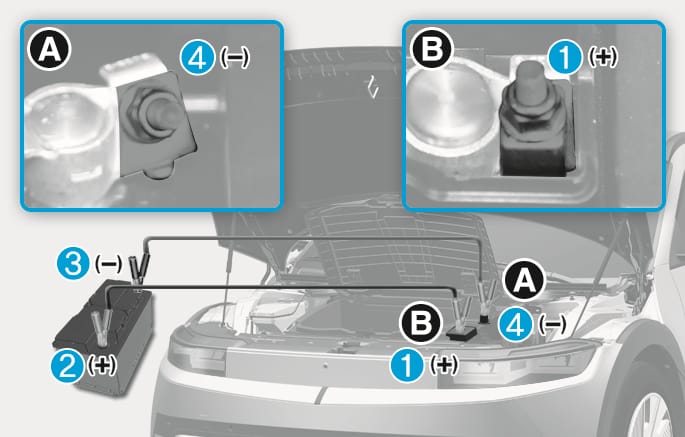
The details are not universal. Hyundai’s IONIQ 5 manual specifies a 12-volt power source and dedicated underhood connection points. Tesla says its Model 3 procedure changes depending on whether the vehicle has a lead-acid or lithium-ion low-voltage battery, and it warns that the Model 3 must not be used to jump-start another vehicle. Polestar’s newer manuals can restrict an externally accessible terminal to short service use with specific current limits.
Before connecting anything:
- Identify the exact model, model year and low-voltage system.
- Open the current owner’s manual outside the vehicle, on a phone or another device.
- Confirm whether owner jump-starting is permitted and what the external source must provide.
- Use the designated positive point and grounding location in the stated order.
- Keep clear of orange high-voltage cables and components.
- Stop if the manual, terminals or battery type do not match what is in front of you.
- Arrange diagnosis after recovery; external power does not explain why the battery became depleted.
Never connect a generic charger, booster or donor vehicle merely because the clamps fit. Reverse polarity, excessive voltage or the wrong connection point can damage control modules and create a safety hazard. The safest response to uncertainty is roadside assistance with the make, model, location and symptoms clearly stated.
Storage Needs a Vehicle-Specific Plan
Long parking periods expose the difference between the two batteries. The traction pack may lose energy slowly while the low-voltage system continues supporting alarms, connectivity and periodic wake-ups.
Ford of Canada advises owners to consult the vehicle’s storage section for periods longer than 30 days. Its published electrified-vehicle guidance also notes that the smaller battery can drain much faster than a sufficiently charged traction pack. Tesla recommends leaving a Model 3 plugged in when it is not being used, particularly for an extended period, so the vehicle can manage its batteries according to its software.
Do not turn those examples into a universal rule. Recommended traction-battery percentage, plug-in status, sleep settings and low-voltage maintenance differ by manufacturer. Before leaving an EV for weeks:
- read the exact long-term-storage instructions
- leave the traction pack within the manufacturer’s recommended window
- make sure the charging location and equipment are appropriate for unattended use
- disable unnecessary third-party accessories or app polling when advised
- keep the physical key and roadside information accessible outside the car
- arrange periodic checks if the manual calls for them
Disconnecting the low-voltage battery or attaching a maintainer may be appropriate for some vehicles and wrong for others. Both actions can affect locks, alarms, learned settings or system initialization, so they belong under model-specific guidance.
What to Check When Buying a Used EV
Used-EV shoppers naturally focus on traction-battery health, but the smaller battery belongs on the inspection sheet too.
Ask when it was last replaced and whether the invoice identifies the correct specification. Check the service history for repeated no-start complaints, electrical-system warnings, DC-to-DC repairs or unexplained battery replacements. A technician familiar with the model can test battery condition and charging support, scan stored faults and confirm that aftermarket accessories are not creating an abnormal draw.
Chemistry and replacement requirements matter. Tesla’s documentation distinguishes between lead-acid and lithium-ion low-voltage batteries in different Model 3 production periods. Polestar specifies the correct type, capacity and cold-cranking rating for applicable models. “Any 12-volt battery that fits” is therefore not a safe buying or repair standard.
MotorLinks’ used-EV battery health guide covers the larger traction pack and the rest of an EV-specific pre-purchase inspection. The two checks complement each other: one estimates whether the vehicle retains useful driving energy, while the other helps establish whether its control system can reliably wake and manage the car.
A Practical Owner Checklist
- Download the owner’s manual and bookmark the low-voltage recovery page.
- Learn where the physical key and manual door release are located.
- Confirm how the hood, trunk or charge port opens if electrical power is lost.
- Note the approved external power source, connection points and sequence.
- Keep roadside-assistance details somewhere other than the locked vehicle.
- Do not ignore a low-voltage or electrical-system warning.
- Have recurring battery depletion diagnosed, including charging support and parasitic draw.
- Follow the exact storage instructions before leaving the EV unused for weeks.
- Never touch or open high-voltage components; orange cables are not part of an owner recovery procedure.
Bottom Line
The small battery in an EV does not propel the car, but it can decide whether the car goes anywhere. It wakes computers, supports locks and displays, and helps complete the sequence that makes high-voltage energy available. When it becomes too weak, a charged traction pack may be unable to rescue the situation on its own.
Canadian owners do not need to become electrical technicians. They do need to recognize the two-battery architecture, act on warnings and keep the correct recovery instructions accessible. A little preparation turns an apparently baffling “full battery, dead car” event into a known roadside problem—and helps prevent unsafe improvisation.
FAQ
Why does an EV need a 12-volt battery?
The low-voltage battery powers computers, locks, displays, lights and startup controls. It also supports the process that connects the high-voltage traction battery when the vehicle is made ready to drive.
Can an EV have a full traction battery and still not start?
Yes. If the low-voltage system cannot wake the control modules and complete the startup sequence, the vehicle can remain unresponsive even when substantial propulsion energy is stored in the main battery.
Can every EV be jump-started like a gasoline car?
No. Battery chemistry, system voltage, connection points and recovery steps vary. Use the instructions for the exact model and year or contact roadside assistance.
Can an EV jump-start another vehicle?
Do not assume it can. Some manufacturers explicitly prohibit using their EV as a donor vehicle. Check the owner’s manual before connecting cables or an external power source.
Sources
- Polestar: Car electrics and batteries
- Polestar 2 manual: 12 V battery
- Tesla Model 3 manual: High Voltage Battery Information
- Tesla Model 3 manual: Troubleshooting Alerts
- Tesla Model 3 manual: Jump Starting
- Hyundai IONIQ 5 manual: Jump starting the 12 V battery
- Ford of Canada: Storing an electrified vehicle