BMW M Concept Neue Klasse Explained: Why Electric M Is Getting Serious
BMW's M Concept Neue Klasse previews the design, four-motor drive system, 800V battery hardware, and performance priorities that could define the first true electric M cars.
BMW just gave its electric performance future a much sharper shape.
The BMW M Concept Neue Klasse is making its world premiere at the 24 Hours of Le Mans, and BMW is framing it as a preview of the new design language for high-performance M cars. That alone would make it interesting. The bigger story is underneath: four electric motors, M-specific drive control, 800V hardware, and a battery with more than 100 kWh of energy content.
This is not a production electric M3 announcement. BMW has not given a price, output figure, range rating, or showroom date. But it is still a useful signal because it shows how BMW wants to make a future electric M car feel distinct from a normal long-range EV.
Quick Verdict
The BMW M Concept Neue Klasse matters because it moves electric M from a vague promise into a more believable engineering direction.
BMW is not just adding bigger motors to a Neue Klasse platform. It is talking about a dedicated BMW M eDrive setup with four electric motors, a high-performance computer called Heart of Joy, wheel-specific drive and braking control, an 800V electrical system, and a high-voltage battery with more than 100 kWh of energy content.
For buyers, the practical advice is simple: do not delay a 2026 purchase just because this concept exists. Treat it as a preview of where BMW M is going, not as a car you can order. The production iX3 and future Neue Klasse models are the real near-term buying story. The M Concept is the more emotional one.
What BMW Actually Revealed
| Item | BMW M Concept Neue Klasse | Why it matters |
|---|---|---|
| Vehicle type | All-electric BMW M concept | A preview of future M design and EV performance thinking, not a confirmed showroom model |
| Drive system | BMW M eDrive with four electric motors | Gives BMW a path to precise torque control rather than simply chasing headline horsepower |
| Control hardware | Heart of Joy high-performance computer with BMW M Dynamic Performance Control | Centralizes drivetrain and braking control for faster, wheel-specific response |
| Electrical architecture | 800V technology | Supports high power delivery and faster charging hardware, depending on the production application |
| Battery signal | High-voltage battery with more than 100 kWh of energy content | Suggests BMW is balancing performance demand with long-range capability |
| Design focus | Motorsport-influenced aero, yellow M lights, ducktail spoiler, natural-fiber elements | Makes the M version visually and materially different from standard Neue Klasse models |
The reveal is heavy on design language, but the technical pieces are what make it more than a show-car exercise.
BMW says the concept uses BMW M eDrive, a performance version of the Neue Klasse Gen6 electric hardware developed specifically for all-electric M vehicles. The setup combines four electric motors with BMW M Dynamic Performance Control, running through the Heart of Joy computer. That system manages drive and braking forces at the wheel level.
That last point is important. Performance EVs already have instant torque. The hard part is making that torque feel exploitable, repeatable, and genuinely fun near the limit. Four motors give engineers more control authority because each wheel can be managed independently. In theory, that means better traction, sharper yaw control, stronger recuperation, and a car that can rotate or stabilize itself with far more precision than a conventional two-motor layout.
BMW also says the battery housing is structurally integrated with both the front and rear axle, contributing to driving dynamics. That sounds dry, but it points to a key EV performance challenge: the battery is heavy, so the vehicle structure has to use that mass intelligently instead of merely carrying it.
Why Four Motors Matter
Most mainstream dual-motor EVs use one motor at the front axle and one at the rear. That gives all-wheel drive and plenty of power, but it does not allow each wheel to be controlled with the same precision as a four-motor setup.
In an electric M car, four motors could let BMW shape the car’s behavior corner by corner. The system can send more drive to the outside rear wheel, pull power from an inside wheel, blend regenerative and friction braking more precisely, or prioritize stability on a wet road without making the car feel numb.
That is the right target for BMW M. The brand cannot rely only on acceleration numbers because many EVs are already absurdly quick in a straight line. The challenge is character. An electric M car has to feel like more than a very fast battery pack.
The risk is complexity. Four motors, high-output cells, sophisticated braking integration, track-capable cooling, and M-specific software will not be cheap. They also have to work repeatedly, not just for one launch-control run or one lap in perfect conditions.
The Battery And Charging Story
BMW says the concept uses 800V technology and a high-voltage battery with more than 100 kWh of energy content. It also says the M-specific version of its sixth-generation cylindrical cells is optimized for high output during both energy delivery and charging.
That fits the broader Neue Klasse direction. BMW has already said Gen6 eDrive technology brings 800V hardware, cylindrical cells, structural battery integration, bidirectional charging capability in the wider platform strategy, and a claimed step forward in charging speed and range versus its previous EV hardware.
For a future M car, the battery has a harder job than it does in a normal commuter EV. It has to deliver high current repeatedly, accept fast charging without excessive heat, support strong regenerative braking, and avoid turning the vehicle into something too heavy to enjoy. That is the balance BMW is trying to preview here.
The concept does not answer the production questions yet. We still do not know peak charging power, usable battery capacity, curb weight, range, thermal limits, or how long a future electric M car could sustain track-level output. Those are the numbers that will matter when BMW moves from concept language to a model buyers can compare.
The Design Is Doing Real Work
The concept’s styling is not subtle, but the details are mostly tied to performance themes.
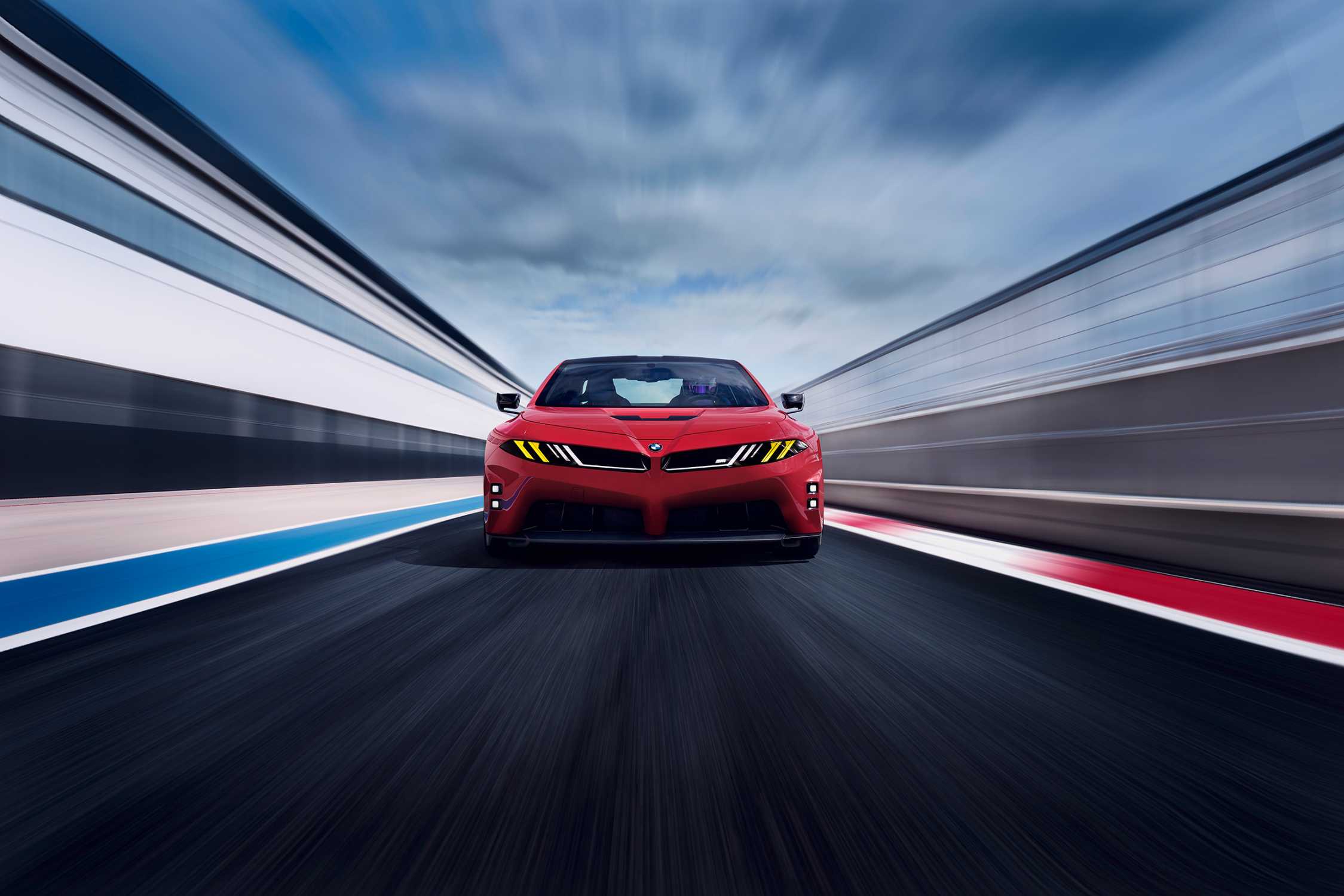
BMW points to a V-shaped bonnet outlet for electric drivetrain cooling, M-specific aerodynamic mirrors, a front splitter supported by a trimaran-style front apron, three-dimensional Track Lights, a floating rear diffuser, and a ducktail spoiler designed to increase rear-axle downforce. The red-and-blue center-lock wheels and Monza Red metallic paint are there to make the motorsport link impossible to miss.
There is also a sustainability angle, but BMW is keeping it tied to material use rather than vague virtue signalling. Natural-fiber elements appear in the front splitter, bonnet air outlet, diffuser, roof graphic, and parts of the cabin structure. That matters because performance cars need light, strong materials, and BMW will want lower-impact alternatives to some traditional composites where they make engineering sense.
Inside, the concept is intentionally focused. BMW describes four newly developed bucket seats, five-point belts, black nubuck leather, M-specific backlighting, and red accents on the selector, steering-wheel paddles, and displays. That is concept-car theater, yes. But the driver-focused layout also hints that BMW understands the electric M problem: a future M EV cannot feel like an isolated luxury lounge with huge acceleration. It needs a cockpit with purpose.
What It Means For The Electric M3 Question
BMW does not call this an electric M3. That restraint is useful.
The company already has the first production Neue Klasse SUV, the iX3, moving toward North American sales with real pricing, range, NACS charging, and launch timing. MotorLinks has covered why BMW iX3 pricing makes Neue Klasse feel real, and that vehicle is the practical foundation for BMW’s next EV phase.
The M Concept is different. It previews the emotional and performance side of the same broader reset. If the iX3 is meant to prove that Neue Klasse can deliver range, charging, software, and premium-SUV usability, the M Concept is meant to prove that BMW still knows how to make EV performance feel like BMW M.
That is not guaranteed. EV performance cars can become too heavy, too quiet, too software-filtered, or too focused on launch times. BMW’s job is to make the first true electric M cars feel interactive at normal and high speeds, not merely devastating from 0 to 60 mph.
The four-motor architecture is the right clue. So is the focus on wheel-specific control and structural battery integration. The specs are not the full answer, but they point at the right problem.
Should Buyers Wait?
Most shoppers should not wait for this concept specifically.
If you need a premium EV in 2026 or early 2027, compare real products with real prices, range figures, charging access, incentives, lease terms, and service coverage. The iX3, Porsche Macan Electric, Audi Q6 e-tron, Mercedes electric crossovers, Tesla Model Y Performance, and other premium EVs are actual buying decisions.
If you are an M buyer who can wait, this concept is worth watching for a different reason. It suggests BMW is not treating electric M as a badge-and-power upgrade. The company appears to be building a dedicated performance-control layer around the Neue Klasse hardware. That is exactly what it has to do.
Still, the production car needs proof. Weight, cooling, braking feel, steering, battery degradation under hard use, software calibration, charging curve, tire wear, and price will decide whether electric M works for enthusiasts.
Bottom Line
The BMW M Concept Neue Klasse is not important because it guarantees the next M3 will be electric, four-motor, and showroom-ready tomorrow. It is important because it shows BMW M has a clearer plan for making EV performance feel distinct.
The design is dramatic, but the real story is the control system: four motors, wheel-specific drive and braking management, 800V hardware, a high-output battery, and a chassis strategy built around the battery instead of pretending it is not there.
That is the kind of thinking electric M needs. Now BMW has to turn the concept into a production car that delivers more than numbers.
FAQ
Is the BMW M Concept Neue Klasse a production car?
No. BMW describes it as a concept that previews the future BMW M design language and all-electric M technology direction. It is not a confirmed production model with pricing, output, range, or a launch date.
What makes the BMW M Concept Neue Klasse important?
It combines BMW’s Neue Klasse Gen6 EV hardware with BMW M-specific performance ideas, including four electric motors, wheel-specific drive and braking control, 800V architecture, and a battery with more than 100 kWh of energy content.
Should BMW M buyers wait for an electric M car?
Not if they need a car soon. The M Concept is a technology preview. Buyers shopping now should compare real production EVs and hybrids, while enthusiasts who can wait should watch how BMW turns the concept’s four-motor control strategy into a showroom model.