
Ramcharger vs Silverado EV: Which Electric Truck Strategy Makes More Sense for Towing?
Ram and Chevrolet are taking two very different paths to electric-truck towing. The Ramcharger brings a gas generator; the Silverado EV leans on a huge battery and fast charging.
Photo: Stellantis
That page still says projected availability in 2026 and labels the vehicles preproduction. Its 690-mile range, 14,000-lb towing and 2,625-lb payload headlines are manufacturer targets, not a MotorLinks loaded-towing test or proof of deliveries. The detailed 2026 Chevrolet table below still requires its dated launch and fleet documents to be re-established; it must not be treated as a cleared specification sheet.
Electric trucks have a towing problem that cannot be solved with one heroic range number.
A big battery can look fantastic on a spec sheet, then burn through energy quickly when the truck is pulling a camper, running into a headwind, or climbing a grade in cold weather. A gas truck also loses efficiency while towing, of course, but it can recover range in five minutes at almost any highway exit. That convenience gap is why the next phase of electric pickups is splitting into two very different strategies.
The Ram 1500 Ramcharger uses electric drive, but it also carries a gasoline engine and generator. Ram’s current range-extended truck page lists a 92-kWh battery, 130-kW generator, 3.6-liter Pentastar V6, 647 horsepower, 610 lb-ft of torque, a targeted 690-mile total range, and up to 14,000 lb of towing when properly equipped.
The 2026 Chevrolet Silverado EV stays fully electric. Chevrolet’s latest lineup includes Work Truck, LT, and Trail Boss trims, with range as high as 493 miles EPA-estimated on the WT Max battery configuration. It can also tow seriously: Chevrolet lists up to 12,500 lb for the Trail Boss Extended Range and Silverado EV WT 5WT configurations, while the WT Max trades some tow rating for the longest official range.
That sets up a useful question for truck shoppers: is the smarter tow rig the one with a generator, or the one with the bigger battery?
Quick Verdict
Neither a 690-mile total-range target nor an unloaded EPA range establishes towing distance. Ram’s generator strategy may interest buyers with sparse charging access, but the source still describes preproduction vehicles; it does not prove customer availability or sustained loaded performance. For an available truck, compare the exact vehicle’s towing documentation and payload label with the planned trailer and route. There is no measured MotorLinks winner here.
Ramcharger and Silverado EV towing strategy gallery
12
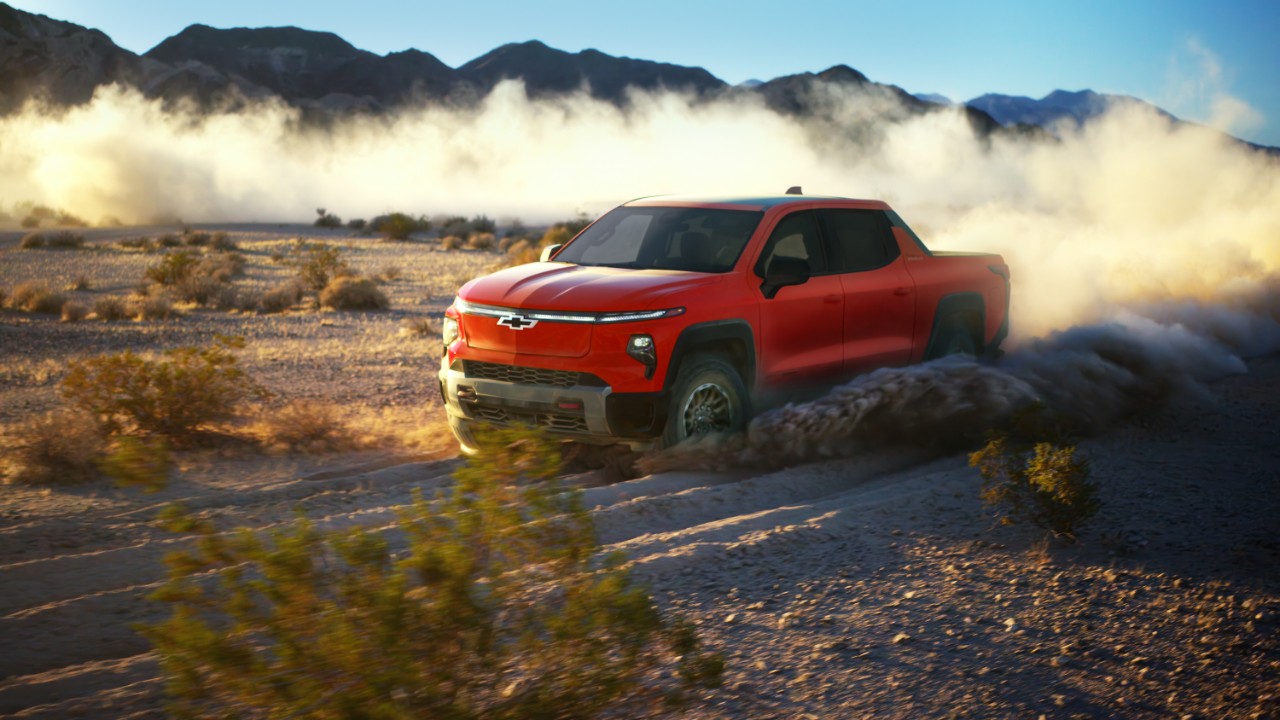

Ram is betting that electric drive plus an onboard generator is the easier sell for truck buyers who tow far from reliable chargers.
The Spec-Sheet Split
| Question | Ram 1500 Ramcharger | 2026 Chevrolet Silverado EV |
|---|---|---|
| Basic strategy | Range-extended electric truck with battery-electric drive and onboard gas generator | Pure battery-electric full-size pickup |
| Availability signal | Ram lists projected availability in 2026 | Chevrolet says the 2026 lineup includes WT, LT, and Trail Boss trims |
| Range headline | Manufacturer-estimated up to 690 miles total with battery and generator support | Up to 493 miles EPA-estimated on Silverado EV WT Max |
| Battery / generator setup | 92-kWh battery with 130-kW generator and 3.6L Pentastar V6 | Standard, Extended, and Max battery packs depending on trim |
| Tow rating headline | Up to 14,000 lb when properly equipped | Up to 12,500 lb on Trail Boss Extended Range and WT 5WT configurations |
| Payload headline | Up to 2,625 lb when properly equipped | Chevrolet lists up to 2,100 lb for Trail Boss Extended Range and up to 1,800 lb for WT 5WT |
| Charging headline | 400V DC fast charging up to 145 kW; Ram says up to 50 miles of electric range in 10 minutes | Available DC fast charging up to 350 kW; Chevrolet lists GM-estimated 100 miles in 10 minutes |
| Best fit | Proposed generator strategy; loaded capability and availability require verification | Predictable routes, depot/home charging, pure-EV ownership, and fleet duty |
Why the Ramcharger Exists
The Ramcharger is not trying to win an EV purity contest. It is trying to answer the specific complaints truck buyers have about battery-electric pickups.
Towing range is the big one. A truck that can travel nearly 500 miles empty can still become a planning exercise with a trailer attached. Add winter weather, remote campsites, rural job sites, or a charging station that is already occupied, and the theoretical convenience of an electric pickup can disappear quickly.
Ram’s answer is to keep the electric-driving feel but bring liquid fuel along as backup. The gasoline engine is not there to drive the wheels directly in the traditional truck sense. It powers a generator that can send electricity to the vehicle when the battery needs help. That means the truck can still behave like an EV around town, while giving long-distance users a familiar refueling safety net.
The trade-off is complexity. The Ramcharger carries a battery, motors, a V6 engine, a generator, a fuel system, emissions hardware, and charging hardware. That is more to package, maintain, certify, and eventually repair. It also means buyers should not think of it as a zero-emissions pickup just because the wheels are electrically driven.
But for the buyer who actually tows, that compromise may be easier to live with than a pure EV that is brilliant unloaded and frustrating with a trailer.
Why the Silverado EV Still Has a Strong Case
The Silverado EV’s argument is cleaner: big battery, electric truck platform, real range, fast charging, no gasoline engine.
Chevrolet’s 2026 lineup is also broader than it was at launch. The Work Truck starts at $54,895 including destination, while the WT Max reaches 493 miles EPA-estimated. The LT and Trail Boss trims bring more lifestyle and retail appeal, with the Trail Boss adding a lift, all-terrain tires, off-road tuning, and 410 miles EPA-estimated with the Extended Range battery or 478 miles GM-estimated with the Max battery.
That range matters because many truck owners do not tow long-distance every week. A contractor running local routes, a fleet with depot charging, or a homeowner using a truck for commuting, hardware-store runs, and occasional hauling may be better served by skipping the engine entirely. The fewer-fuel-systems argument gets stronger when charging is predictable.
The Silverado EV also has serious charging hardware. Chevrolet lists available DC fast charging up to 350 kW and a GM-estimated 100 miles in 10 minutes under suitable conditions. That will not make towing stops disappear, but it gives the truck a better road-trip case than early EV pickups that leaned too hard on range and not enough on charge rate.
The catch is configuration. The longest-range WT Max is not the same as the strongest tow setup. Chevrolet’s fleet material lists the 5WT Extended Range at 424 miles and up to 12,500 lb of towing, while the 8WT Max stretches to 493 miles but lists 10,500 lb of towing. Shoppers need to compare the exact trim, battery, payload sticker, and trailer weight rather than assuming one headline number carries across the lineup.
Towing Is Where the Philosophies Split
For unloaded driving, both approaches can make sense. For towing, the decision gets sharper.
The Ramcharger’s advantage is refueling confidence. A long towing day can include gas stops instead of only charger stops, which matters if the destination is a lake, job site, rural highway, or winter route where charging coverage is still thin. It may also be less stressful for owners who tow just often enough that they cannot ignore the edge case.
The Silverado EV’s advantage is electric simplicity when the work is planned. If a fleet can charge overnight, run known routes, and keep trailers within a predictable duty cycle, the pure EV architecture has a cleaner operating story. There is no oil-change schedule for a generator engine and no tailpipe fuel burn during normal battery-electric use.
Neither truck makes towing physics vanish. Trailer shape, speed, wind, temperature, terrain, tire choice, payload, and accessory load all matter. The difference is how each brand gives buyers back their margin when the day does not go perfectly.
The MotorLinks Take
A generator and a larger traction battery answer different planning questions, but neither eliminates towing constraints. Do not buy against a preproduction maximum or combine the longest-range Chevrolet configuration with another trim’s tow rating. Obtain exact vehicle documentation, an itemized quote and a route plan for the loaded combination before choosing.
Is the Ramcharger the same as a plug-in hybrid truck?
Ram describes a range-extended electric truck: the engine powers a generator, while the wheels are driven electrically.
Does the Silverado EV tow as much as the Ramcharger?
Ram advertises a preproduction target of up to 14,000 lb; check Chevrolet’s current figures for the exact Silverado EV configuration. No loaded towing winner is established.
Which truck is cheaper?
Neither truck had a matched retail quote at publication, so compare current offers. Obtain current itemized offers before comparing.