Range-Extender Off-Roaders: Why Gas Generators Are Back in the EV Conversation
Ineos, Scout, and Ram are all pointing at the same compromise: electric drive for daily use, with a gasoline generator for the messy truck and off-road jobs where pure EVs still make buyers nervous.
Photo: Ram
The electric off-roader has always sounded easy in theory. Instant torque, precise low-speed control, quiet trail driving, and no tailpipe emissions at the campsite all make sense.
The hard part is everything truck and 4x4 buyers actually do: tow, climb, crawl, haul, sit in bad weather, head into rural places, and expect the vehicle to get home without turning the route into a charging puzzle.
That is why range extenders are suddenly back in the conversation. The latest nudge came from Ineos, where Car and Driver reported that the smaller Ineos Fusilier is now expected around 2028 and appears to be moving toward a range-extender setup rather than a straight battery-electric launch. That follows Ineos’ own original Fusilier announcement, which described a small gasoline engine powering a generator when external charging is not available.
Ineos is not alone. Scout says its Harvester range extender is planned to give Traveler and Terra buyers about 150 miles of electric range and more than 500 miles total on manufacturer estimates. Ram’s current range-extended truck page lists a 92-kWh battery, a 130-kW generator, a 3.6-liter Pentastar V6, a targeted 690 miles of total range, and a targeted 14,000-pound towing capacity.
That does not mean every big adventure vehicle should give up on pure EVs. It does mean automakers are admitting something obvious: the heavier and more remote the job gets, the harder it is to sell buyers on battery-only purity.
| Vehicle/program | Range-extender idea | Why it matters |
|---|---|---|
| Ineos Fusilier | Small gasoline engine acting as a generator for an electric 4x4; latest reporting points to a likely 2028 arrival and a stronger range-extender focus | Shows how even a purpose-built off-road brand is backing away from a simple BEV-only answer for smaller 4x4s |
| Scout Traveler and Terra Harvester | Scout projects about 150 miles of all-electric range and more than 500 miles total with the generator system | A direct play for adventure buyers who like EV torque but still want gasoline-road-trip flexibility |
| Ram range-extended 1500 program | 92-kWh battery, 130-kW generator, 3.6-liter V6, targeted 690-mile total range, 14,000-lb towing, and 2,625-lb payload | The strongest truck-use-case argument: towing and payload without depending entirely on public fast charging |
What a Range Extender Actually Does
A range-extended EV is easiest to understand if you separate the wheels from the fuel source.
In the clean version of the concept, the wheels are driven by electric motors. The gasoline engine is not the main propulsion device in the way it is in a conventional hybrid. Instead, it works as a generator, feeding electricity back into the battery or electrical system when the battery gets low or the vehicle needs sustained power away from a charger.
That is the pitch behind these truck and off-road programs. You plug in at home, drive on electricity for normal use, and keep the generator as backup for the jobs where charging access is poor or the load is ugly.
The language can get messy. Some automakers prefer “extended-range EV” because the vehicle feels EV-like from behind the wheel. Critics will point out that it still burns gasoline, which makes it a plug-in hybrid by a broader definition. Both points can be true. The important thing is whether the vehicle delivers meaningful electric driving first, not whether the badge makes everyone feel better.
Why Off-Roaders Are a Perfect Test Case
Off-roaders expose the weak spots in big battery EVs faster than almost anything else.
Range ratings are built around standardized driving, not a snowy forest road with roof gear, oversized tires, a loaded cargo area, and long stretches away from fast chargers. Add towing or a camping trailer and the calculation gets even less friendly. A large battery can solve some of that, but it adds cost and weight, and weight is not free when the vehicle also needs suspension travel, payload capacity, ground clearance, and durability.
This is where a range extender starts to look less like a retreat and more like a tool. Electric motors still give the good stuff: instant torque, smooth crawling, fine throttle control, and quiet low-speed driving. The generator gives the owner a fallback when a weekend route, worksite, or rural trip does not line up neatly with charging infrastructure.
That is especially relevant for brands like Ineos and Scout. These are not aero-first commuter crossovers. They are selling durability, utility, and the emotional promise that the vehicle will not make the owner turn around early.
Range-extended truck and off-road programs
11
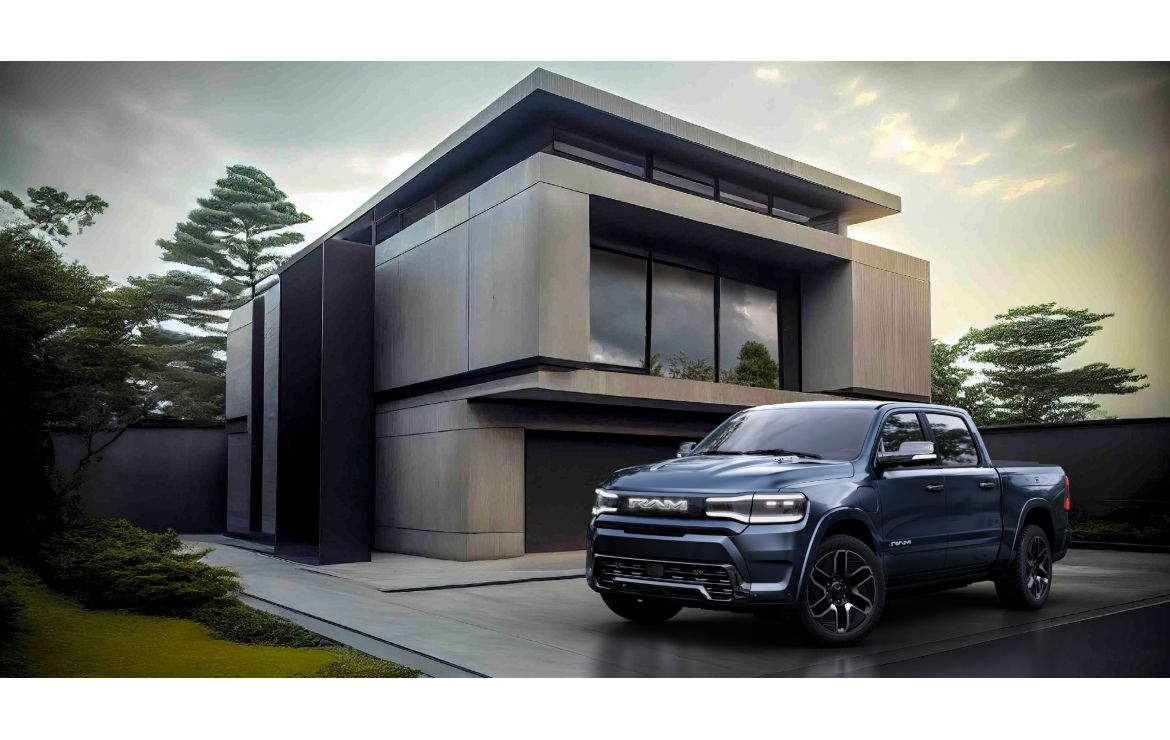
Ram is using range-extender hardware to chase truck-grade towing, payload, and long-distance confidence. Image: Ram/Stellantis.
Scout Is Selling Freedom From the Charger Map
Scout’s Harvester system is the clearest lifestyle pitch.
Scout says buyers will be able to choose an all-electric system or a gas-powered range extender. In Harvester-equipped vehicles, the generator is packaged into the vehicle platform and recharges the high-voltage battery. Scout projects about 150 miles of electric driving before relying on the generator, with more than 500 miles of total range.
That 150-mile electric figure is important. It is enough to cover most daily driving if the owner plugs in regularly. It is not enough to satisfy someone who wants a pure EV road-trip machine. But that is exactly the point: Scout is not only trying to win over EV early adopters. It is trying to convince truck and SUV buyers who like the EV experience but are not ready to let a charger map define every trip.
For a vehicle with a removable-roof, trail-capable, body-on-frame personality, that compromise may be easier to explain than a huge battery pack with a big price and a still-awkward towing story.
Ram Is the Work-Truck Argument
Ram’s range-extended pickup is the numbers-heavy version of the same idea.
On the current Stellantis Fleet page, Ram describes the truck as using a 92-kWh liquid-cooled battery paired with a 130-kW generator. The 3.6-liter V6 makes mechanical power, which is converted into electricity by the onboard generator. Ram targets 690 total miles of range, 2,625 pounds of payload, 14,000 pounds of towing, 663 hp, 615 lb-ft, and a 4.4-second 0-60 mph run.
Those are not small claims. They are also exactly the kind of claims full-size truck buyers understand. Range matters, but so do payload and towing. A pure EV pickup can be excellent when used inside its comfort zone, but towing can hammer real-world range. A generator does not make physics disappear, but it gives the truck another energy source when the job gets heavy.
That is why range extenders may have more credibility in trucks than in small cars. In a compact commuter, the added engine, exhaust hardware, fuel tank, and complexity can feel like overkill. In a full-size pickup, the extra hardware is easier to justify if it preserves capability.
Ineos Shows the Purist Problem
Ineos is the interesting one because the brand has a purist streak.
The Grenadier exists because some buyers wanted an old-school, work-first 4x4 after the Land Rover Defender went modern. The Fusilier was meant to move that idea into a smaller electrified package, developed with Magna and built around a bespoke skateboard platform with steel structure and aluminum closures.
But off-road purism and EV purism are not the same thing. An Ineos buyer may love mechanical honesty and remote capability more than they love a zero-tailpipe-emissions spec sheet. If the Fusilier arrives with a range extender as the main path, that would be a practical admission that the customer use case matters more than the cleanest marketing line.
The risk is complexity. A range-extended 4x4 needs to feel cohesive, not like two powertrains awkwardly stitched together. It needs enough battery range for daily electric use, enough generator output for long climbs and sustained loads, and software smart enough to manage energy without annoying the driver.
If Ineos gets that wrong, the Fusilier could feel like a compromise in the bad sense. If it gets it right, it could be the sort of compromise off-road buyers actually respect.
The Catch: More Parts, More Honesty Required
Range extenders are not magic. They add an engine, fuel system, emissions hardware, maintenance needs, noise, vibration questions, and more software complexity. They also weaken the simple appeal of a pure EV: fewer moving parts, no gasoline stops, and cleaner local operation.
That is why automakers need to be honest. A range-extended truck or off-roader should not be marketed as if it were the same thing as a battery-only EV. It is a bridge technology for buyers whose use cases still do not fit neatly inside today’s battery-and-charging reality.
The best version is straightforward: plug in every day, drive electric most of the time, use gasoline when the trip or job demands it. The worst version is marketing fog, where the vehicle burns fuel often but gets sold with EV language because that sounds better.
The Motorlinks Take
Range extenders are back because they solve a real product problem, not because automakers suddenly forgot how to build EVs.
For regular crossovers, the battery-only answer keeps getting stronger. Charging is improving, ranges are better, and prices are slowly becoming less absurd. But trucks and off-roaders sit in a tougher corner of the market. Their buyers want capability first, and they often use vehicles in ways that punish efficiency.
That makes Ineos, Scout, and Ram worth watching. They are all circling the same idea: electric drive is desirable, but gasoline backup still has a role when the vehicle is heavy, remote, or expected to tow.
EV purists will hate that answer. Some of them will be right to worry about emissions and complexity. But from a buyer’s point of view, the range extender may be the thing that gets more people into electric-drive trucks and 4x4s sooner.
The key is honesty. Call these vehicles what they are: electric-first, gasoline-backed machines for the messy jobs. That is not as clean as a pure EV. For off-roaders and trucks, it may be a lot more realistic.