Tesla FSD v13 Review: The Most Capable ADAS System in the Real World
We spent a month living with Tesla Full Self-Driving (Supervised) v13. After 3,000 miles, here's the definitive assessment of where FSD excels and where it still struggles.
After a month of living with Tesla Full Self-Driving (Supervised) version 13, including 3,000 miles of driving in a variety of conditions, here is the definitive real-world assessment of where FSD v13 excels, where it struggles, and how it compares to the competition.
The System
FSD (Supervised) v13 is Tesla’s latest and most capable advanced driver assistance system. It uses camera-only perception (no LiDAR, no radar) to navigate city streets and highways simultaneously. It is a SAE Level 2 system — meaning it requires active driver supervision at all times.
The system handles lane keeping, lane changes, traffic light and stop sign recognition, intersection navigation, and object detection. It does not make the vehicle fully autonomous.
What It Does Well
Highway driving: On divided highways, FSD v13 is genuinely excellent. It handles lane changes proactively, responds smoothly to traffic flow, and maintains appropriate following distances. The experience is close to the hands-free luxury of GM Super Cruise on roads where it is mapped.
City street navigation: FSD v13 handles most urban driving situations competently. It navigates traffic lights, stop signs, yield signs, and roundabout entrances. Left turns across oncoming traffic are handled safely, though conservatively — the system will wait for gaps that a human driver would take.
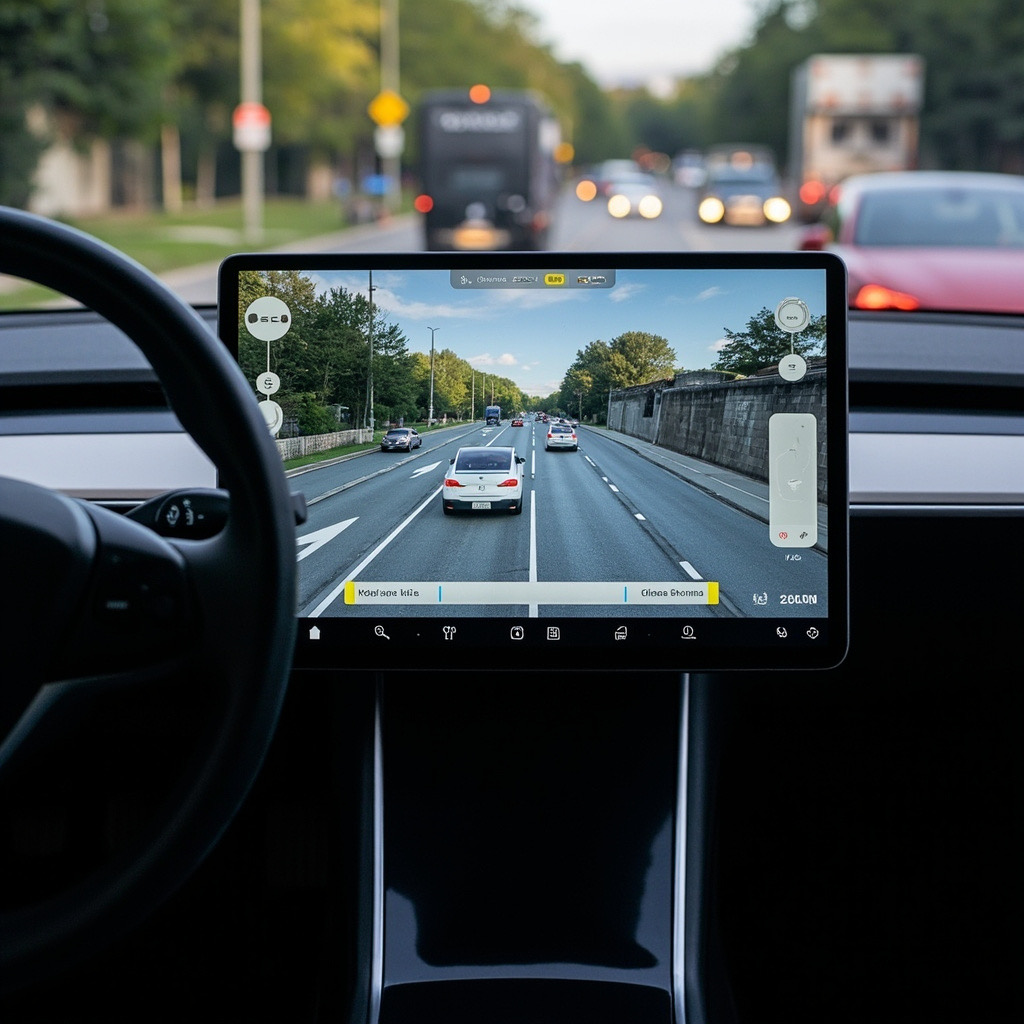
System transparency: Tesla’s visualization of what the car “sees” — the lane lines, vehicles, pedestrians, and traffic signals displayed on screen — is the best in the industry. It gives the driver genuine confidence in what the system is doing and why.
What It Struggles With
Construction zones: FSD v13 is consistently confused by construction zones. Orange cones and temporary lane markings cause the system to either disengage or make inappropriate lane selections. In one instance, the system followed a detour sign into a parking lot rather than the main road.
Narrow streets: On streets with parked cars and narrow lanes, FSD v13 tends to slow dramatically or disengage. A human driver would inch forward; FSD waits for more space that never comes.
Darkness and rain: Performance degrades noticeably in heavy rain and in darkness on unlit roads. The camera-only approach has genuine limitations in conditions where depth perception is challenged.
Overly cautious behavior: FSD will sometimes wait at an intersection for longer than necessary, causing honking from behind. The system is calibrated conservatively — which is the right call for safety, but can be frustrating in daily use.
The Real-World Numbers
Over 3,000 miles of FSD v13 driving:
- Disengagements: 14 (one per 214 miles on average)
- Near-disengagements (driver intervention without full disengagement): approximately 40
- Incidents requiring immediate driver override: 2 (both in construction zones)
The $8,000 Question
At $8,000 for the one-time purchase (or $199/month subscription), FSD is expensive. Ford BlueCruise ($2,400 one-time) and GM Super Cruise (included on higher trims, $25/month thereafter) offer 90 percent of FSD’s highway capability at a fraction of the cost. The additional capability that justifies FSD’s premium is city street navigation — if you primarily drive on highways, FSD is hard to justify.
For drivers who want the most capable overall system and are willing to pay for it, FSD v13 is worth considering. For everyone else, the highway-only systems from Ford and GM offer better value.
For a comparison of FSD vs. the competition, see our FSD vs. Competition feature.