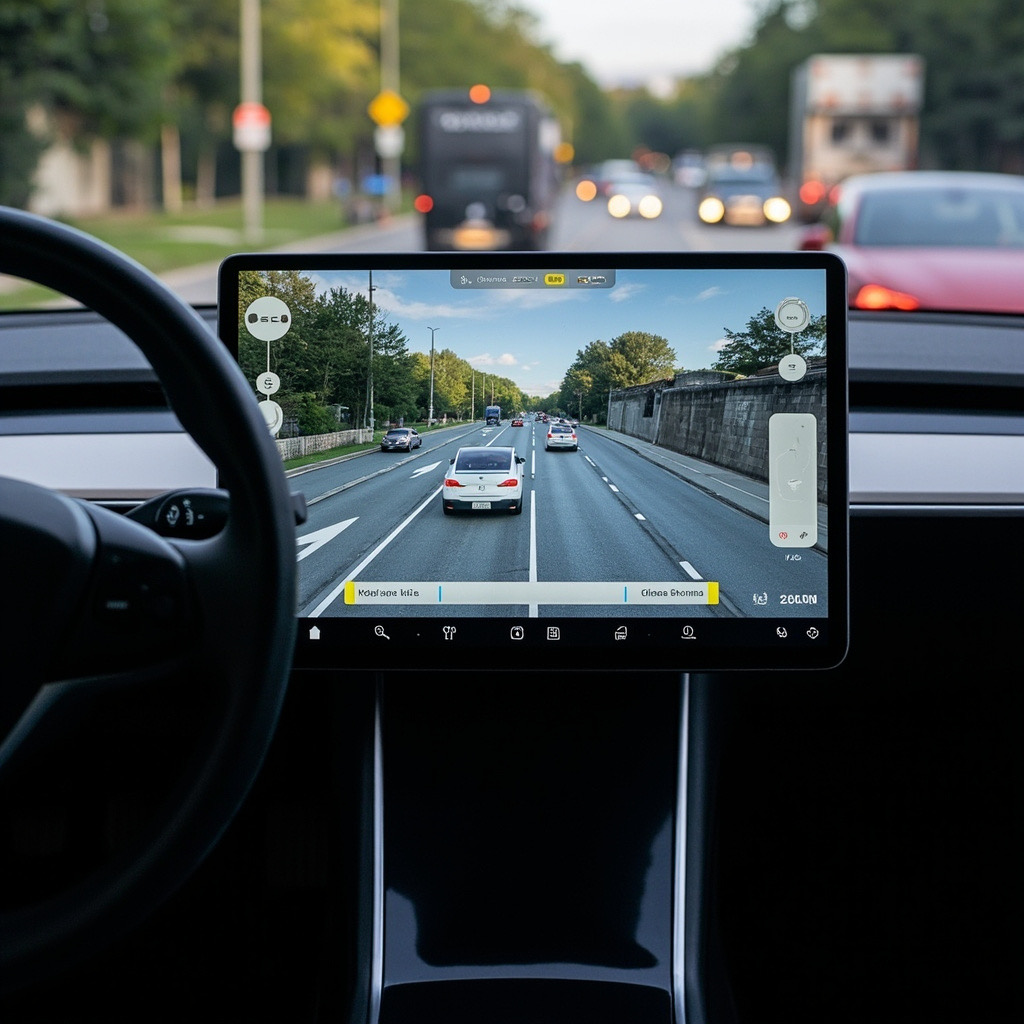
Tesla FSD vs. The Competition: A 2026 Reality Check
Tesla's Full Self-Driving system has been the most talked-about advanced driver assistance system in the industry. But how does it compare to Ford BlueCruise, GM Super Cruise, and Mercedes Drive Pilot in 2026?
Tesla’s Full Self-Driving (Supervised) system remains the most capable advanced driver assistance system available in the United States — and also the most controversial. Five years after the first FSD beta releases, the gap between Tesla’s system and the competition has narrowed, while the regulatory scrutiny has intensified. Here’s where the technology stands in 2026.
The Systems Compared
Tesla FSD (Supervised) — Available on all Tesla vehicles. Uses cameras only (no LiDAR, no radar). SAE Level 2, requiring active driver supervision. City street driving now included in the supervised release. Monthly subscription: $199/month; one-time purchase: $8,000.
Ford BlueCruise — Hands-free driving on pre-mapped divided highways. Requires藍牙 driver monitoring camera. Available on Ford Mustang Mach-E, F-150 Lightning, and Explorer. No city street capability. Included with Ford+ subscription or $2,400 one-time.
GM Super Cruise — Hands-free on mapped divided highways with LiDAR mapping. Genuinely excellent highway performance. Driver attention monitoring via infrared camera. Available on Cadillac, GMC, and Chevrolet vehicles. Three-year subscription included, then $25/month or $250/year.
Mercedes-Benz Drive Pilot — The only SAE Level 3 system commercially available in the U.S. (in Nevada and California), Drive Pilot allows hands-free, eyes-off driving at up to 40 mph on mapped highways. Requires LiDAR and extensive sensor suite. Available on S-Class and EQS. $2,500/year for the first year, then $1,200/year.
Where Tesla FSD Excels
Tesla’s camera-only approach, while controversial from a safety engineering standpoint, has produced a system that handles city streets and complex intersections in ways that highway-focused systems like BlueCruise cannot match. FSD’s ability to navigate traffic lights, stop signs, unprotected left turns, and roundabouts makes it genuinely useful for drivers who want ADAS capability across their entire commute rather than just on highway segments.
The latest FSD v13 release, deployed in late 2025, showed meaningful improvements in smoothness and reduced the frequency of “phantom braking” incidents that had plagued earlier versions. The system’s neural network continues to improve through Tesla’s fleet data — billions of miles of real-world driving inform the model.
For drivers who want the most capable system for mixed driving (highway plus city streets), Tesla FSD remains the benchmark.
Where Tesla FSD Falls Short
Despite the improvements, FSD still requires active driver supervision and intervention far more frequently than the highway-only systems. Drivers cannot check out entirely — the car requires regular “nudges” to confirm attention, and disengagements are common in construction zones, adverse weather, and unusual road configurations.
The camera-only approach also has theoretical safety limitations. LiDAR provides precise depth information that cameras must infer, and in conditions of heavy rain, snow, fog, or direct sun glare, the system’s perception capability degrades more than systems with redundant sensor suites.
Tesla’s approach to driver monitoring — capacitive touch sensors on the steering wheel — is also less robust than the infrared camera-based monitoring used by GM Super Cruise and Mercedes Drive Pilot. Drivers have been documented attempting to defeat the monitoring system with weights on the steering wheel.
The Regulatory Wild Card
NHTSA’s ongoing investigation into Tesla Autopilot and FSD-related crashes means that the regulatory environment for Tesla’s systems remains uncertain. A recall covering FSD — the petition for which was rejected by NHTSA in March 2026 — remains possible if future data shows elevated crash rates.
Mercedes Drive Pilot, by contrast, operates under a type approval framework in Nevada and California that explicitly defines its operational domain. When Drive Pilot disengages, the liability transition to the driver is clear. Tesla’s more expansive approach — allowing FSD in situations its engineers haven’t explicitly validated — creates more grey area.
The Bottom Line
For most drivers, Ford BlueCruise or GM Super Cruise offer a better value proposition: genuinely hands-free highway driving at a fraction of the cost, with more predictable behavior and less need for active supervision.
For drivers who want the most capable overall system and are willing to pay $8,000 (or $199/month) and accept more frequent engagement requirements, Tesla FSD remains the most comprehensive option available today.
The promise of full self-driving — where you genuinely don’t need to pay attention — remains just that: a promise. None of the commercially available systems are there yet.
Motorlinks covers vehicle technology and safety. For more on Tesla’s brand challenges, see our Tesla brand reputation analysis.