Tesla Adds Model 3 and Model Y Home Backup With Powerwall 3 in the U.S.
Tesla expands Powershare home backup to eligible U.S. Model 3 and Model Y vehicles with Powerwall 3. Canadian eligibility was not announced.
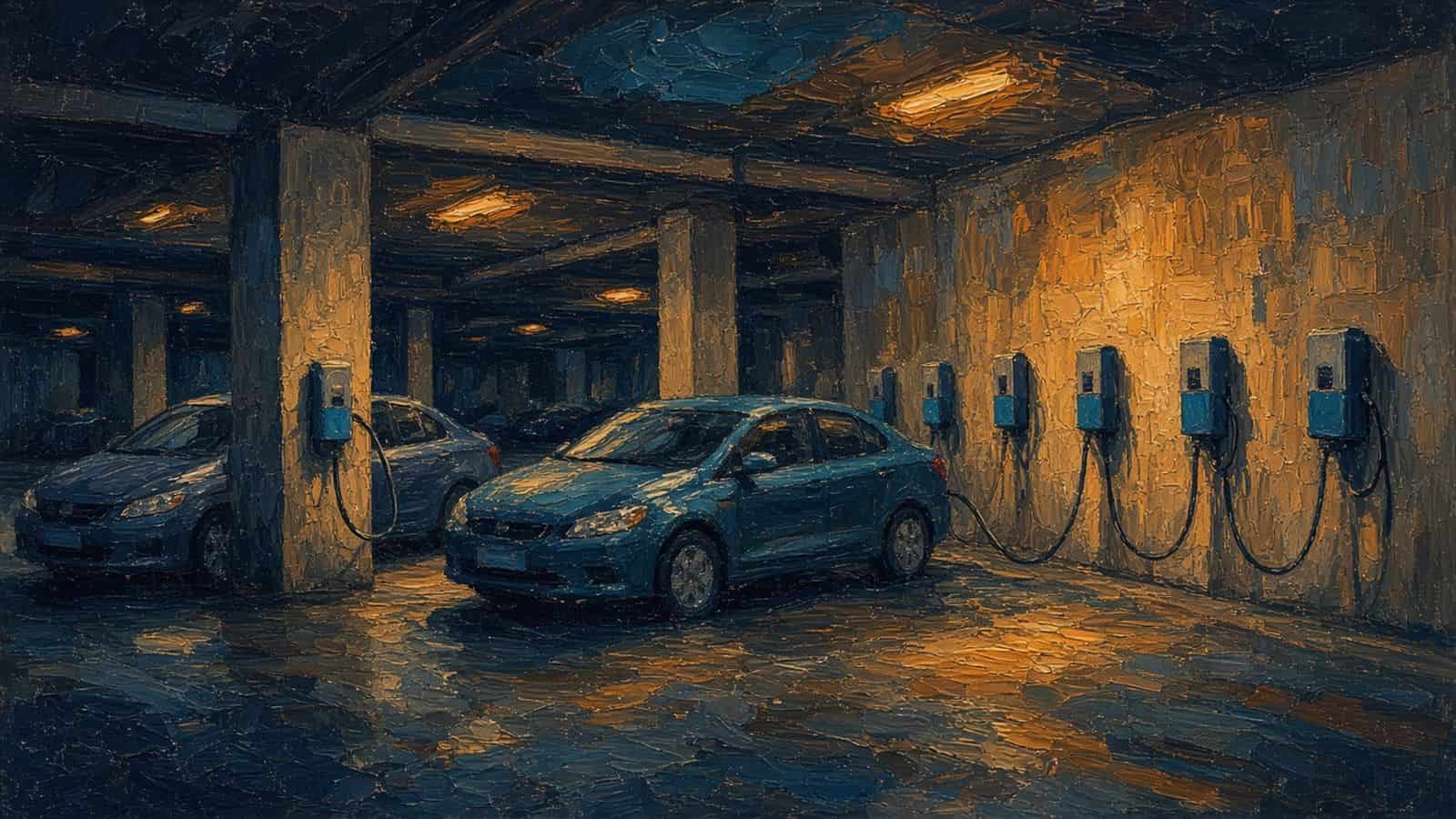
AI-generated illustration
Tesla is expanding Powershare home backup beyond Cybertruck to eligible Model 3 and Model Y vehicles in the United States and Puerto Rico. With a compatible Powerwall 3 system and Tesla wall charger, the car’s traction battery can supply energy to the home during an outage. The October 6 announcement gives Tesla’s mainstream sedan and crossover a useful role beyond transportation—but it is not a promise that every existing car, or every Canadian-market Tesla, now supports the feature.
Tesla’s official Powerwall configuration guide says all Model 3 and Model Y vehicles ordered in the U.S. and Puerto Rico after October 1, 2026 are Powershare-capable when paired with a Powerwall system. It lists home backup with Powerwall 3 as available now. The wording concerns an order date, not a blanket model-year rule.
What the Home Needs
Tesla lists a Universal Wall Connector or Gen 3 Wall Connector alongside the Powerwall system and a Powershare-compatible vehicle. Its installation note says an existing Powerwall system with the appropriate Wall Connector does not require additional equipment for this functionality; Powershare is enabled during device setup.
That is a specific supported configuration, not a claim that an ordinary charging outlet can feed a home’s circuits. A household without Powerwall still needs to plan and price a compatible installed system. Tesla also explicitly says Powerwall is not compatible with Powershare Gateway and instructs installers not to combine them.
For Powerwall 2 and Powerwall+, the guide says equipment can be installed now, but the Powershare feature is “coming soon.” That is not an available-today feature or a dated rollout commitment.
The distinctions matter: a large car battery is only useful as home backup if the vehicle, charger, stationary storage and home electrical installation work together. Buyers should confirm the exact configuration with Tesla or their qualified installer rather than treating the badge on the trunk as sufficient.
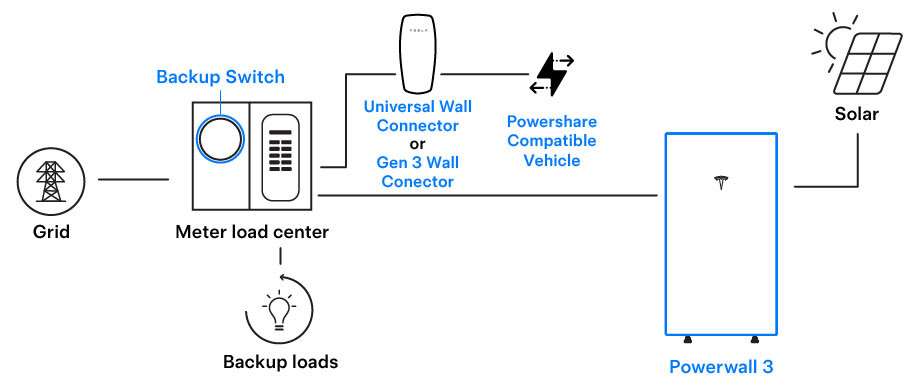
Tesla’s published whole-home example uses Powerwall 3 and a Backup Switch. Diagram: Tesla, from its Powershare configuration guide.
Existing Cars Need an Eligibility Check
Some vehicles from before the new order cutoff may also qualify, according to Drive Tesla’s October 6 report. The report directs owners to Controls → Software → Additional Vehicle Information, where compatible cars display Powershare Support as enabled. Tesla’s installation guide likewise refers owners of other Model 3 and Model Y vehicles to its support page for confirmation.
That makes the car’s actual support status more useful than assuming an older vehicle gains the function through a software update. Owners should verify that status before paying for home-energy equipment.
Tesla’s announcement, reproduced in the report, describes extending home backup by more than two days with the vehicle. Treat that as a company claim, not guaranteed runtime: the energy remaining in the vehicle and the household’s electricity demand determine how long backup lasts. Running a few essential loads is a different proposition from supplying every appliance in the house.
Appliance Power Is a Separate Expansion
Drive Tesla also reports an expansion of vehicle-to-load, or V2L, across the U.S. Model 3 and Model Y lineup. It says Tesla’s Outlet Adapter supplies up to 2.4 kW at 120 volts and 20 amps for compatible plugged-in devices.
V2L and Powershare home backup solve different problems. V2L powers individual suitable appliances or tools directly; the Powerwall arrangement integrates vehicle energy into the home’s supported backup system. An outlet adapter alone is not a home-backup installation, and should not be used to feed household wiring through a wall receptacle.
The adapter’s power rating is also not the output rating of the Powerwall-based home-backup system. This announcement should not be read as a 2.4-kW limit on every Powershare configuration.
What Canadian Readers Can—and Cannot—Assume
The official new-vehicle eligibility footnote explicitly names the U.S. and Puerto Rico. It doesn’t confirm equivalent Canadian Model 3 or Model Y eligibility, and Drive Tesla reports that no matching Canadian change was announced.
Canadian buyers should therefore seek confirmation for their specific vehicle and address before making a purchase decision around the new capability. U.S. availability is not proof of Canadian installation support or accessory availability.
A complete installed package price in USD or CAD is not provided. A vehicle MSRP or a currency conversion would not answer what the home-backup project actually costs.
For eligible U.S. owners who already have Powerwall 3, the expansion is meaningful: the car can become additional outage storage without being replaced by a Cybertruck. For everyone else, the useful next step is a compatibility check and an installed quote—not an assumption that every Tesla is now a plug-and-play generator.
Photo: Tesla. Model 3.