Can an EV Power Your Home in Canada? V2L vs. V2H Explained
An EV's appliance outlet is not the same as whole-home backup. Here's what Canadian buyers should check before paying for vehicle-to-load or vehicle-to-home capability.
A big EV battery can look like an obvious answer to a power outage. But “can power an appliance” and “can power a house” are different product claims. The distinction matters before you pay for a particular trim, a bidirectional charger or electrical work.
GM and PG&E’s new California home-charger offer is a useful reminder: even when charger hardware is included, home-backup capability can require more equipment and a separate installation. That offer is not a Canadian program. For a Canadian buyer, the practical question is which loads you want to keep running, for how long, and whether the vehicle and home can be connected safely and legally.
Quick Verdict
Choose V2L if you need to run a few compatible devices directly from the car. Budget for a complete V2H system if you want household circuits to keep working through an outage. Neither feature should be assumed from battery size, charge-port shape or an ordinary Level 2 charger.
For occasional appliance backup, a vehicle with a suitable V2L outlet may be enough. For an automatic or panel-connected setup, confirm the specific Canadian-market vehicle and model year, compatible home hardware, installer availability and local electrical requirements before ordering. If backup power is a must-have, get an installed quote and a written compatibility answer, not just a vehicle brochure.
V2L: An Outlet, Not a Home Electrical System
Vehicle-to-load (V2L) supplies electricity to devices plugged into an outlet or approved adapter on the vehicle. Hyundai Canada says the IONIQ 5 and IONIQ 6 can use V2L to run individual home appliances and smaller devices during an outage. That could be useful for charging phones or running a suitable appliance, subject to the outlet’s rated load and the instructions for the exact car.
It does not mean you can feed the home’s wiring by running a cord to a wall receptacle. That would bypass the protections required for a properly connected backup source and could energize circuits unexpectedly. Keep V2L use within the manufacturer’s outlet and accessory ratings; check the exact trim and whether an exterior adapter is included or sold separately.
A second limit is logistical: the car must be present, charged and available. If someone drives it to work during the outage, your backup source leaves with them.
V2H: Vehicle, Charger and Home Must Work Together
Vehicle-to-home (V2H) is a designed connection that lets a compatible EV supply selected household circuits or, where the system supports it, a whole-home configuration. It is not a feature an electrician can simply switch on in any EV.
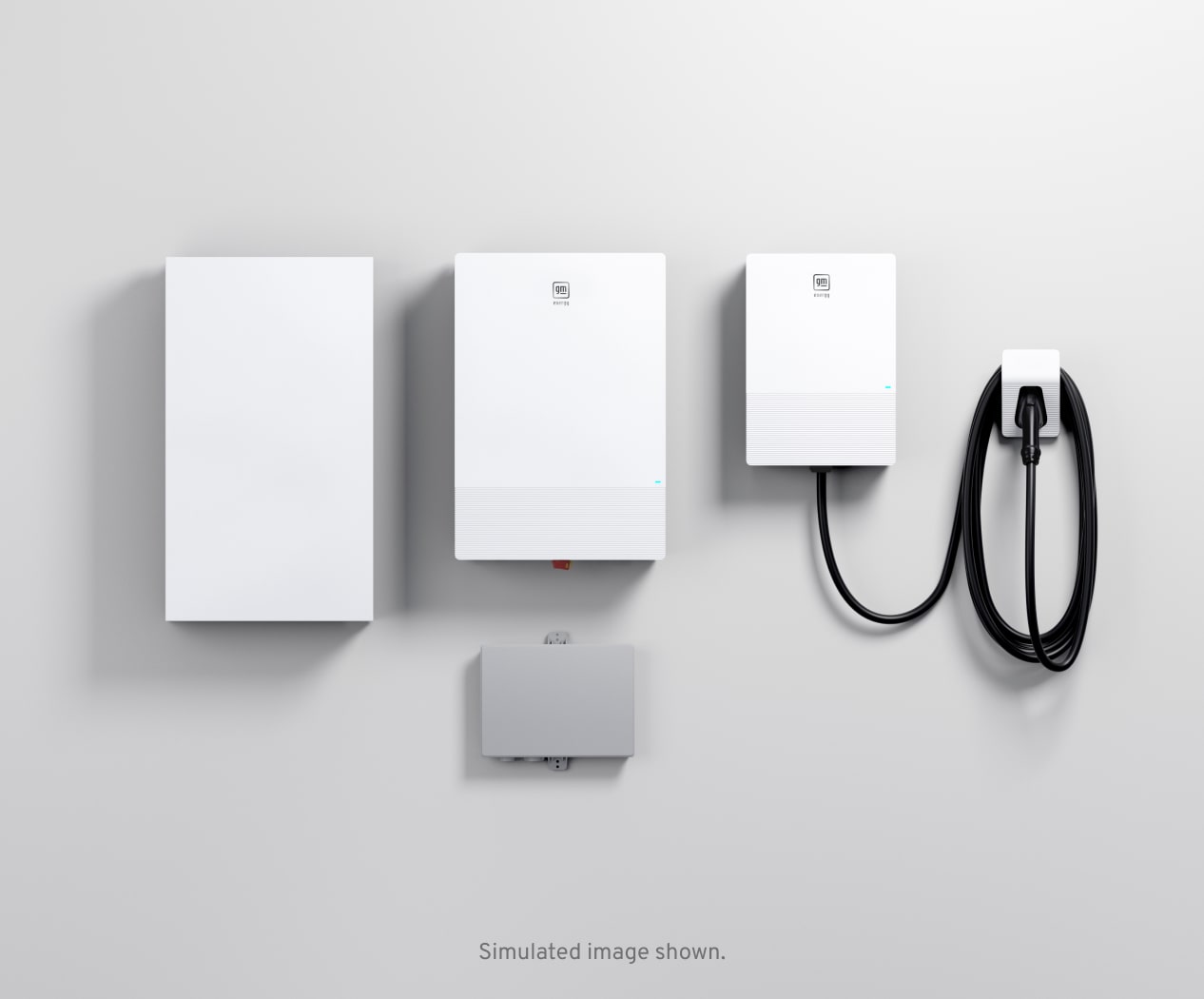
For example, GM Energy’s V2H bundle pairs the PowerShift Charger with a V2H Enablement Kit containing a home hub, inverter and dark-start battery. GM lists 9.6 kW of backup output for the inverter and supports whole- or partial-home configurations. Those specifications describe GM’s system, not every V2H product or the power every household can draw continuously. GM says the vehicle must also be V2H-capable and the home properly equipped.
GM’s compatibility list spans particular Chevrolet, GMC and Cadillac model years, with some 2024 vehicles needing a software update. A nameplate appearing on that list is not proof that the equipment can currently be ordered, installed or supported at your Canadian address. Confirm Canadian availability with the automaker and an installer before using a U.S. storefront or promotion as your budget.
The difference also clarifies the morning GM–PG&E offer: a PowerShift charger can be the starting point for a future GM Energy V2H installation, but the charger on its own is not the complete home-backup system.
What Will It Run, and for How Long?
There are two separate numbers to ask about. Power, in kilowatts (kW), limits what can run at once. Usable energy, in kilowatt-hours (kWh), determines how long the car can supply those loads. A large battery does not override the backup equipment’s output limit. A heavy load, such as electric heating or several major appliances starting together, may exceed the system’s capability even if plenty of energy remains.
As a calculation example, not a vehicle claim, imagine 60 kWh of energy available at the start of an outage, a 20% reserve for driving, and an average 3 kW household load. The simple upper-bound arithmetic is 60 × 0.8 ÷ 3 = 16 hours. Conversion losses, changing loads, battery limits and the vehicle’s own consumption shorten that figure. Lower essential loads could last longer; an electric furnace, heat pump or cooking load could shorten it sharply.
Ask an installer to identify the circuits you actually need—perhaps refrigeration, lights, communications and a heating-system control circuit—and calculate both running and startup loads. Decide how much battery you must leave for an emergency drive. Do not buy on a generic “days of backup” claim without the load assumptions behind it.
The Canadian Installation Check
A home-connected EV is an electrical power source, not just a charging appliance. Ontario’s Electrical Safety Authority guidance on bidirectional EV equipment says the relevant power-source and interconnection rules apply, and that the utility needs to know about potential grid backfeed. Its backup-generator safety guidance explains why a permanently connected backup source needs a transfer device to prevent power flowing into utility lines.
Those are Ontario examples, not a single Canada-wide approval process. Rules, permits and utility interconnection procedures vary by province and service area. Have a qualified local electrical contractor specify the approved isolation or transfer equipment, permits, inspections, panel changes and utility steps for your address. Never improvise a connection from a V2L outlet into household wiring.
Before signing, ask for a quote that separates the bidirectional charger, home hub/inverter or equivalent equipment, electrical work, permits and any panel or service changes. Also ask what happens during an outage if the car is unplugged, its battery reaches your reserve limit, the system loses connectivity or the vehicle needs a software update.
Five Questions to Ask Before Paying for Backup Capability
- Which job? A few plug-in devices, essential household circuits, or a larger share of the house?
- Which exact car? Is this Canadian-market model year and trim supported, with any required software installed?
- Which complete system? What equipment beyond the charger is required, and is it sold and supported locally?
- Which approval? Who handles the electrical permit, inspection, transfer or isolation device and utility requirements?
- Which real budget? What is the installed price, expected backup output and load-based runtime with a driving reserve?
If you mostly need occasional outage power for a refrigerator and phones, V2L may be the simpler purchase—provided the appliance loads fit. If you need the home’s circuits to stay energized, treat V2H like a home-electrical project with an EV attached. The vehicle purchase is only one line of that project.
FAQ
Can I plug my house into an EV’s V2L outlet?
No. V2L is for suitable individual appliances or devices within the vehicle’s outlet rating. Supplying household wiring requires an approved, professionally installed backup-power system.
Does a bidirectional EV automatically provide home backup power?
No. Check the exact vehicle, model year and software, compatible bidirectional charger and home equipment, installation, electrical approvals and utility requirements.
Is GM’s PowerShift charger alone enough for vehicle-to-home backup?
No. GM says its V2H setup pairs the PowerShift Charger with its V2H Enablement Kit and a compatible EV in a properly equipped home.