Tesla Update 2026.20.6.11 Brings FSD v14 Lite to Older HW3 Cars
Tesla's 2026.20.6.11 update brings FSD v14 Lite to older Hardware 3 cars, adding smoother driving, parking tools and newer navigation behaviour.
Tesla’s 2026.20.6.11 software update is reaching regular customer cars with FSD (Supervised) v14 Lite, moving the older Hardware 3 fleet beyond the small early-access test group.
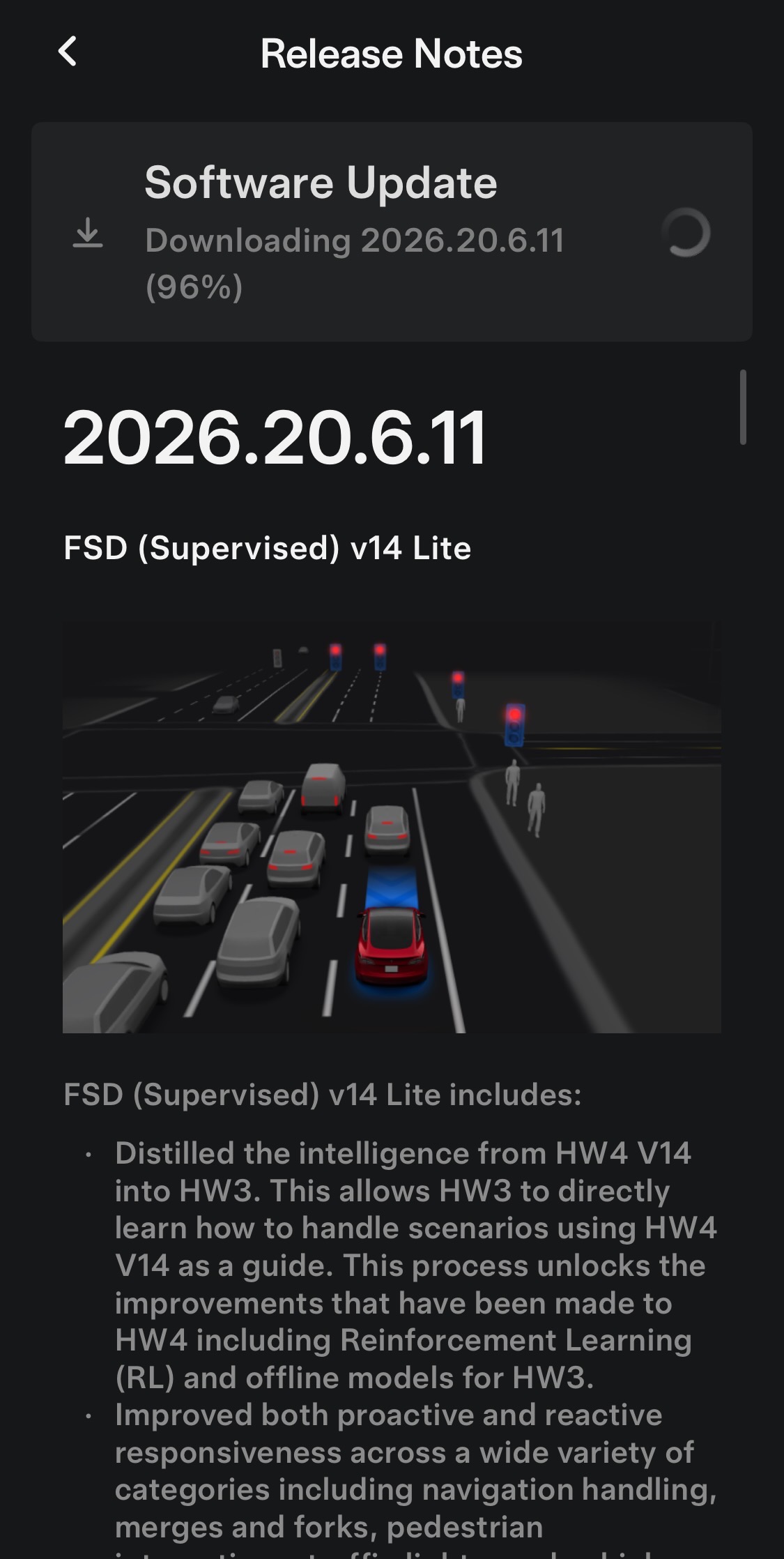
This is the wider-release step that mattered after MotorLinks reported on July 21 that an earlier build was likely to expand beyond testers. Owner-supplied in-car release notes show 2026.20.6.11 downloading with the full v14 Lite feature list, while the independent Not a Tesla App update tracker recorded hundreds of installations beginning July 21.
For an HW3 owner, the immediate story is useful new behaviour: better handling around navigation decisions and other road users, fewer unnecessary slowdowns, smoother steering, parking and reversing, more control over where a trip ends, and Speed Profiles that remain available throughout the drive.
The longer-term story is just as important. Tesla is still engineering substantial driver-assistance updates for a computer platform it said was already in production in April 2019. That is unusually long-lived software support by modern-car standards. It is not, however, full parity with newer HW4 vehicles—and it does not make an older Tesla autonomous.
What HW3 Owners Get in FSD v14 Lite
Tesla says it “distilled the intelligence from HW4 v14 into HW3,” using the newer system as a guide so the smaller HW3 model can learn from improvements developed with reinforcement learning and offline models. Distillation is a common machine-learning technique for transferring useful behaviour from a larger model to one that can run within tighter computing limits.
The owner-facing changes listed in Tesla’s release notes are broad:
- Navigation and traffic handling: improved proactive and reactive responses when following the route, taking merges and forks, interacting with pedestrians, responding to traffic lights and dealing with vehicles cutting in.
- More natural control: fewer false slowdowns in normal driving, smoother steering inputs and more consistent lane centering.
- Low-speed manoeuvres: new parking, unparking and reversing capabilities.
- Arrival Options: the driver can tell FSD where to finish the trip, including a parking lot, street or driveway.
- Always-available Speed Profiles: driving-style preferences remain selectable at all times instead of being limited to certain conditions.
Those changes target exactly the moments that determine whether an assistance system feels helpful or tiring. A false slowdown erodes confidence. An indecisive fork or awkward cut-in response creates work for the person supervising. Better lane centering and steering are less dramatic than a new headline feature, but they are the kind of refinement an owner can notice on every trip.
Parking and Arrival Options also extend v14 Lite beyond point-to-point lane following. The car can now handle more of the transition into and out of a trip, while the driver chooses the type of arrival that fits the destination. Tesla’s current FSD support documentation separately describes Speed Profiles ranging from the conservative Sloth setting through Chill, Standard, Hurry and Mad Max.
The current release-note mirror identifies HW3 Model 3 and Model Y under the v14 Lite section. As with any Tesla rollout, availability can vary by vehicle configuration, software branch and region; an update appearing on some customer cars does not guarantee that every eligible HW3 vehicle will receive it immediately.
Why a 2019 Computer Still Getting New Features Matters
Tesla publicly said its proprietary FSD computer was already in production on April 3, 2019. In other words, the HW3 platform behind this release dates back more than seven years, even though individual vehicles and later retrofits may be newer.
Tesla’s current AI computer support page also says qualifying owners who bought FSD and still have older computer 2.0 or 2.5 hardware can receive an upgrade to computer 3.0. That means the potential HW3 population includes not only cars built with the computer from 2019 onward, but some older Teslas that received it later.
The significance is not that software can erase aging hardware. It cannot. The signal is that Tesla still considers this installed base worth optimizing for instead of treating it as a frozen legacy branch.
That distinction has practical value for owners. A vehicle does not need to match the newest model to benefit from better route handling, more comfortable steering or new parking logic. Continuing to ship those functions can extend the useful life of the technology already on the road and make an older car feel less abandoned.
It is also an inference about Tesla’s support strategy, not a promise about every future release. Version 14 Lite shows that the company can adapt some newer behaviour to HW3. It does not prove that all future HW4 functions will be portable, nor does it establish how long Tesla will keep the older branch current.
“Lite” Means This Is Not Full HW4 Parity
The name is doing important work. The same 2026.20.6.11 package carries FSD v14.3.6 for HW4 vehicles and v14 Lite for HW3 vehicles, according to the release tracker. Tesla’s own HW3 notes describe intelligence being distilled from HW4 rather than the identical model running on both computers.
That makes v14 Lite a hardware-aware adaptation, not evidence that HW3 and HW4 are now interchangeable. Newer cars have a different compute and camera platform, and feature availability can still vary by hardware, model, model year, configuration and market.
Owners should judge v14 Lite by what it improves on their cars now. The release notes make specific claims about behaviour and comfort, but they are not independent safety testing, and early impressions cannot establish fleet-wide performance. The rollout needs time in ordinary traffic before anyone can responsibly measure how consistently those changes hold up.
Supervision Is Still Mandatory
FSD v14 Lite remains an advanced driver-assistance system. Tesla says FSD (Supervised) requires an attentive driver, does not make the vehicle autonomous and can behave differently depending on hardware, software, configuration and region.
The driver must watch the road, be prepared to intervene and remain responsible for speed and control at all times. Parking, reversing and smoother traffic-light handling do not change that obligation.
That is the right frame for 2026.20.6.11: a meaningful usability upgrade for an aging hardware generation, not an autonomy breakthrough. Tesla deserves credit for continuing to improve HW3 cars this far into the platform’s life. HW3 owners should also keep expectations grounded—the “Lite” branch is a compromise built around older limits, and active supervision remains non-negotiable.