Tesla’s FSD v14 Lite Could Go Wide on HW3. Audi and VW Show Why That Matters
Tesla is testing a wider FSD v14 Lite release for older HW3 cars. The real story is long-tail software support—and where Audi and Volkswagen still lag.
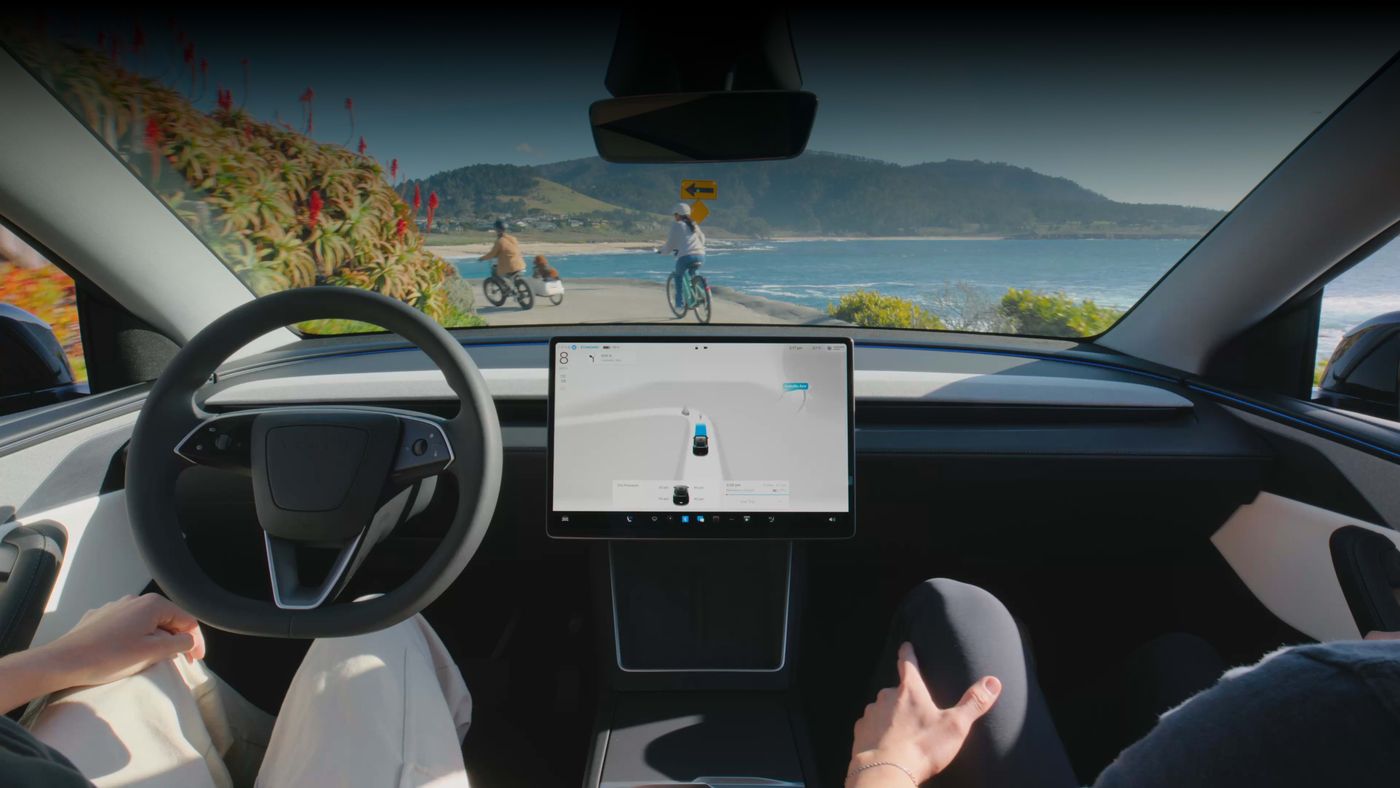
Tesla appears to be getting closer to a wider release of FSD v14 Lite, a reduced version of its newest Full Self-Driving (Supervised) software built for older cars with the company’s Hardware 3 computer.
The key word is appears. Tesla has not announced a firm public-release date or promised that every HW3-equipped car in every market will receive the same features. On July 20, Tesla AI lead Ashok Elluswamy said the new 2026.20.6.10 build is the version “likely” to go to wide release. As of July 21, specialist outlet Not a Tesla App reports that the build is still reaching U.S. early-access testers rather than the entire eligible fleet.
That makes this a release candidate, not a finished broad rollout. It is still significant.
Millions of Teslas equipped with HW3 are now several years old. Giving even part of that fleet a meaningful driver-assistance update is the kind of post-sale improvement buyers were promised when cars started becoming connected computers on wheels. Tesla’s execution has been imperfect, especially for HW3 owners, but this is still the standard legacy automakers such as Audi and Volkswagen have struggled to match consistently.
What FSD v14 Lite Actually Brings to HW3
Tesla began a limited FSD v14 Lite rollout in late June. According to Tesla release notes reported by Electrek, the company used the HW4 version of v14 as a guide to distill newer behaviour into a model that can run on HW3’s more constrained computer.
The latest test build reportedly adds several pieces that newer HW4 vehicles already have: the dedicated Self-Driving app, destination-arrival and parking options, mobile-app FSD status, and interface refinements around starting a drive. Tesla’s release notes also claim better handling of navigation, merges, forks, pedestrians, traffic lights and vehicle cut-ins.
Those are Tesla’s claims, not independent proof of safer operation. Early testers have posted positive impressions, but a hand-picked test group is not a substitute for fleet-scale data. We will know more only after the build reaches a much larger and more representative group of owners.
There is another important limit: FSD v14 Lite does not make an HW3 Tesla autonomous. Tesla’s own FSD support page says the system requires active driver supervision and does not make the vehicle autonomous. The driver remains responsible at all times.
Tesla CEO Elon Musk also acknowledged during the company’s first-quarter 2026 earnings call that HW3 cannot achieve unsupervised FSD in its current form. FSD v14 Lite is therefore a better supervised driver-assistance package for old hardware, not a back door to robotaxi capability.
Tesla Deserves Credit, but HW3 Owners Also Deserved Better
There is a temptation to turn this into a simple Tesla victory lap. The record does not support that either.
HW3 owners spent roughly 14 months on the older v12.6.4 branch while Tesla’s main FSD development moved to newer hardware. The company had previously marketed cars with HW3 as having the hardware needed for future self-driving capability, then later conceded that the computer could not deliver unsupervised operation. A future hardware-upgrade path has been discussed, but it is not the same thing as a defined retrofit program available to every affected owner today.
FSD v14 Lite does not erase that history. What it does show is that Tesla is still putting engineering effort into improving cars sold years ago rather than reserving every meaningful software advance for the next model year.
That distinction matters. A 2019 or 2020 Model 3 receiving new driving logic, parking behaviour and a revised interface in 2026 is more useful than a new icon pack or updated map database. It changes what the car can do, even if the result remains supervised and hardware-limited.
Volkswagen Has OTA Updates—Just Not Tesla’s Consistency or Scope
Volkswagen cannot fairly be accused of having no OTA capability. The company introduced over-the-air updates for its ID family in 2021, and its current owner documentation lists OTA-delivered ID. software 3.7 with optimizations, driving-behaviour changes and bidirectional-charging support for eligible vehicles.
But Volkswagen’s own documentation also makes the limitation plain: some updates arrive over the air, while others must be installed by a retailer. Eligibility depends on vehicle software, connected-service enrollment, consent, market and the particular update. If an OTA installation fails, Volkswagen’s U.S. support page directs owners to a dealer when an in-car retry is no longer available.
The real-world path has therefore been uneven. One ID.3 owner reported in 2025 that moving an older car from software 2.4 to 3.2 required three days at a dealer; only after that foundation update did the car receive version 3.7 over the air. That is one owner’s experience, not fleet-wide evidence, but it neatly illustrates the difference between technical OTA capability and effortless delivery.
Volkswagen’s newer vehicles are substantially better positioned than the first ID models. Still, the company’s software history includes delayed architectures, reorganizations at Cariad and a major new software partnership with Rivian. The scale of that investment is evidence that Volkswagen itself sees substantial room to improve its existing approach.
Audi’s New Platforms Are Better Prepared Than Its Older Cars
Audi’s situation is similarly nuanced. The new Q6 e-tron and other vehicles on the PPE/PPC electronics architecture are designed for broader OTA software updates. Audi says the Q6 e-tron can download software over the air, and the company has publicly described regular OTA updates, bug fixes and new features as a core lifecycle goal.
That is real progress. It is also not the experience every Audi owner has today.
When Audi released software 3.2 for early Q4 e-trons in 2023, the company said owners of cars without the newer software would be contacted by dealers about how to proceed. Installing 3.2 was what enabled those older Q4s to receive future updates through a wireless interface. In other words, some cars needed a workshop bridge before they could become OTA-ready.
Audi owners continue to describe basic MMI and app faults that require resets, technical service bulletins or dealership visits. Consumer Reports’ Q4 e-tron reliability reporting includes owner accounts of repeated warning and navigation problems followed by dealer-installed software updates. Audi forums and owner groups carry similar reports, though those anecdotes cannot establish how common a fault is across the fleet.
Audi is now talking about software-defined vehicles, lifetime feature additions and regular wireless updates. That is the right direction. The test is whether owners of today’s cars actually receive useful fixes and new functions on a predictable cadence—not whether the architecture can support them on a presentation slide.
The Real Advantage Is the Post-Sale Delivery Record
Tesla is not the only automaker with OTA updates, and it should not get a free pass for missed promises. The FSD name remains far more ambitious than the supervised system owners can use, and HW3 is proof that software cannot overcome every hardware limit.
But the latest v14 Lite work reinforces one of Tesla’s most durable product advantages: it treats a car already in a customer’s driveway as a current software target.
Audi and Volkswagen are closing the technical gap. Their newest platforms can update more control units, add connected features and reduce service visits. What they have not yet matched is Tesla’s habit of shipping conspicuous, customer-facing improvements across a large installed fleet—even when that fleet includes vehicles from an older hardware generation.
If FSD v14 Lite moves from early access to a genuinely broad HW3 release, that will be worth recognizing. Not because it delivers autonomy; it does not. Not because Tesla handled HW3 perfectly; it did not.
It matters because a several-year-old car may gain meaningful new capability overnight. For an industry that has talked about software-defined vehicles for years, actual delivery is still the benchmark.