Hyundai IONIQ V Debuts in China With 600 km Range and a Bigger EV Reset
Hyundai used Auto China 2026 to reveal the IONIQ V, a China-focused electric sedan with more than 600 km of CLTC range and a broader plan for 20 new models over five years.
Photo: Hyundai
These are manufacturer statements, not independent performance tests. Hyundai says specifications may change at launch and other-market availability is subject to later evaluation. The 20-model plan, 2027 SUV, investment and annual-sales ambition are plans or commitments, not completed results.
Hyundai’s China EV reset now has sheet metal. At Auto China 2026, the company unveiled the IONIQ V, its first dedicated IONIQ production model for the Chinese market and the production follow-up to the VENUS Concept shown earlier this month.
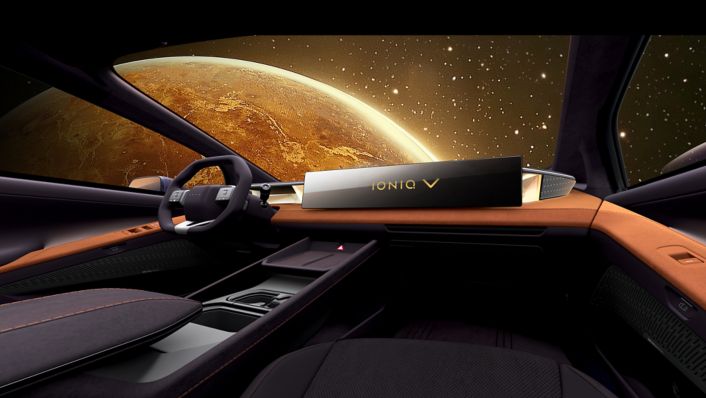
The headline specs are exactly the kind of numbers Hyundai needs if it wants Chinese shoppers to take this seriously: a long-range version with more than 600 km of CLTC-rated range, a 4,900-mm body length, a 2,900-mm wheelbase, and a cabin built around a 27-inch ultra-thin 4K panoramic display. It is not just another global IONIQ model with a different badge. Hyundai is positioning the IONIQ V as a China-first EV shaped around local expectations for space, software, connectivity, and driver assistance.
That distinction matters. China is where global automakers are finding out, sometimes brutally, that good EV hardware is no longer enough. Buyers expect quick software updates, smart-cabin features, strong value, and technology partnerships that feel native to the market. Hyundai’s message in Beijing was basically: we understand that now.
The IONIQ V Is Bigger Than It Looks
Hyundai says the IONIQ V is derived from the VENUS Concept and introduces a new China-market IONIQ design language called “The Origin.” The proportions are clean and sedan-like, with a smooth single-curve silhouette, edge lighting across the front, frameless doors, and floating side mirrors intended to help reduce drag.
The size puts it in a substantial part of the market. At 4,900 mm long and 1,890 mm wide, the IONIQ V is roughly in midsize-sedan territory, but Hyundai is emphasizing cabin space as much as exterior drama. The company quotes 1,078 mm of first-row legroom and 1,019 mm in the second row, plus generous shoulder room for both rows.
Inside, the 27-inch 4K display is paired with what Hyundai calls a Horizon head-up display. The feature list also includes Dolby Atmos support through an eight-speaker audio system, reduced road and wind noise, and suspension tuning aimed at comfort rather than track-day theater.
That sounds less like Hyundai trying to recreate the IONIQ 5’s quirky global personality and more like a direct response to what is selling in China right now: quiet cabins, big digital interfaces, lounge-like interiors, and EVs that feel expensive even when pricing has to stay competitive.
Local Tech Is the Main Point
The most important IONIQ V details may not be the range or the screen. Hyundai says the car uses an LLM-based Smart AI Assistant supported by Qualcomm’s Snapdragon 8295 chipset, with voice interaction for vehicle controls. It also includes advanced driver-assistance technology powered by Momenta, one of the local partners Hyundai is leaning on for its China strategy.
That is a practical admission. Hyundai has excellent EV engineering credentials globally, but China is a software-speed market. Domestic brands like BYD, XPeng, Li Auto, Xiaomi, and NIO are not waiting around for traditional product cycles. Partnering locally on assisted driving and smart-cabin technology gives Hyundai a better shot than trying to transplant a slower global stack into a market that moves every few months.
Safety is still part of the pitch. Hyundai says the IONIQ V uses a reinforced body structure, a nine-airbag system, and Pedal Misapplication Safety Assist, which can apply emergency braking to help prevent unintended acceleration incidents.
Twenty New Models, Not One Show Car
The IONIQ V reveal also came with a much larger product promise. Hyundai and BAIC Group have committed a combined 8 billion yuan investment into Beijing Hyundai, and Hyundai says Beijing Hyundai plans to introduce 20 new models in China over the next five years.
That roadmap will not be battery-electric only. Hyundai says the future rollout will include both BEVs and extended-range EVs, with another SUV model planned for the first half of 2027 before a broader push into midsize and large segments.
That is smartly pragmatic. Extended-range EVs have become a major force in China because they offer electric daily driving without asking families to make the same charging compromises on long trips. If Hyundai wants volume rather than just auto-show applause, it has to meet the market where it is.
The company’s sales ambition is equally direct: Beijing Hyundai is targeting 500,000 annual vehicle sales, supported by renewed growth inside China and export opportunities. That should be read as a target, not a guarantee. The competitive field is savage, and plenty of global brands have learned that investment alone does not buy relevance.
The Motorlinks Take
The IONIQ V is the most convincing piece of Hyundai’s China reboot so far because it moves the story from concepts to a production-intent model with real specs. A 600-km CLTC range claim will need context once final pricing, battery details, and real-world efficiency are clearer, but the overall direction makes sense.
Hyundai is not short on EV credibility. The IONIQ 5, IONIQ 6, and IONIQ 9 have already proved the company can build desirable electric vehicles. The harder question is whether Hyundai can move quickly enough in China, where the benchmark is no longer just range and build quality. It is software polish, local services, pricing discipline, cabin tech, and how fast an automaker can respond when rivals change the game overnight.
The IONIQ V will not solve that by itself. But as a first China-dedicated IONIQ production model, it is a much more serious answer than another imported nameplate. Hyundai finally appears to be treating China not as a regional problem to manage, but as a development hub that can shape the rest of its EV playbook.