Canadian EV Range Ratings: How to Read the EnerGuide Label
NRCan range is a comparison tool, not a winter highway guarantee. Decode EV efficiency, recharge time and annual cost before choosing your next electric car.
Quick Verdict
Use Canada’s EnerGuide label to compare EVs, not to promise yourself a fixed distance between winter charging stops. The range figure is an estimate for a fully charged battery. Your departure charge, arrival reserve and actual driving conditions are separate questions.
For commuters with reliable home charging, compare efficiency and how comfortably the car covers the routine trip. For frequent highway travellers, add route-specific range evidence and charging performance. Paying for the biggest advertised battery is not automatically the best answer for either driver.
The important caveat as Canadians approach winter: a standardized rating and a cold-weather highway journey are different things. A lower result on your own trip does not, by itself, establish a battery fault.
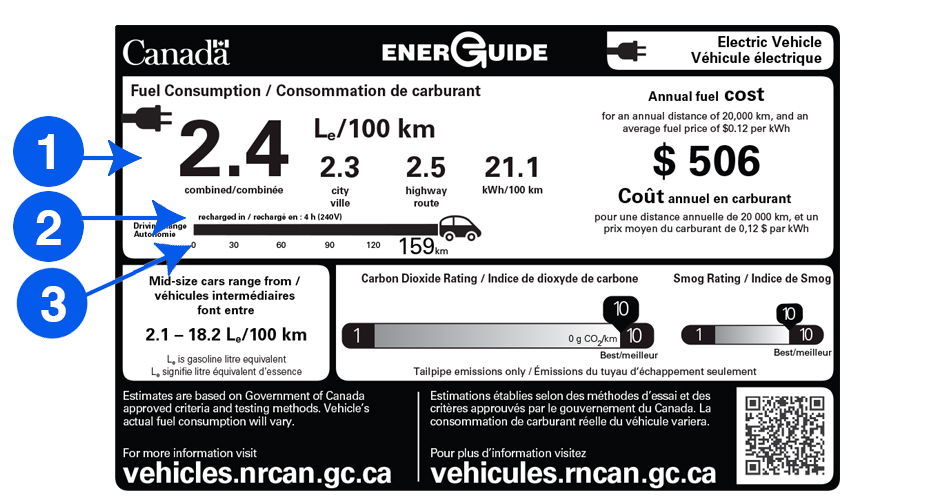
Image: Natural Resources Canada. This is its illustrative sample label, not a current vehicle specification or electricity-price quote.
Start With the Right Canadian Rating
Natural Resources Canada’s battery-electric EnerGuide explainer separates three essentials: energy consumption, estimated recharge time and driving range.
Check the exact model year and vehicle configuration in the official fuel consumption ratings search tool. An advertisement’s “up to” distance is not sufficient evidence for every version of a vehicle. Confirm which configuration the number describes before using it in a comparison.
Also keep the rating system consistent. If a Canadian page cites NRCan and an overseas launch story uses another test standard, the figures are not an apples-to-apples ranking merely because both have been converted into kilometres.
The same principle applies to independent road tests. They add valuable context, but a measured result from one route should be labelled as that—not quietly substituted for an official rating.
Read the Label’s Numbers Separately
NRCan’s sample uses a 159-km range and an electricity-price assumption of $0.12/kWh. Those are illustrative figures on this sample, not the range of a car we are recommending or a current Canadian tariff.
Range: estimated distance from a full battery
This is the familiar kilometre figure. NRCan defines it as the estimated driving distance on a fully charged battery.
That definition does not specify your preferred arrival reserve, your normal charge limit or the distance to a working charger. Those belong in the journey plan.
kWh/100 km: energy consumption
A kilowatt-hour (kWh) measures energy. The label’s kWh/100 km figure describes electricity consumption over distance; lower means less electricity for the same distance under the rating conditions.
Do not confuse it with kilowatts (kW), which measure power. A 150-kW charging specification and a 20-kWh/100 km consumption rating answer different questions.
NRCan says the combined consumption rating reflects 55% city and 45% highway driving. That is a standardized blend, not a description of every owner’s commute. A driver spending almost the whole journey on a highway should not assume the combined result represents that route precisely.
Le/100 km: an energy equivalent, not gasoline burned
The prominent Le/100 km number means gasoline litres equivalent per 100 kilometres. NRCan uses 8.9 kWh of electricity as the energy equivalent of one litre of gasoline.
A battery EV displaying 2.4 Le/100 km is not consuming 2.4 litres of gasoline. Nor is that number an electricity-price comparison with buying gasoline. It translates energy into a familiar unit; local energy prices still determine spending.
Recharge time: read the voltage
NRCan’s sample label describes the estimated time to fully recharge at 240 volts. That is not a DC fast-charging time.
A quoted 10–80% DC charging time uses a different charge window and different equipment. Do not choose between road-trip cars by comparing one model’s full 240-volt recharge time with another’s partial DC session.
Why Winter and Highway Results Differ
NRCan’s testing overview explains why controlled laboratory testing and analytical procedures are used: real-world weather and road conditions make repeatable on-road comparisons difficult.
Its broader five-cycle explanation includes cold operation, air-conditioning use and higher-speed driving alongside city and highway conditions. That does not turn the published number into a guarantee for every temperature and route.
NRCan’s AutoSmart winter guidance identifies temperature, road conditions and accessory loads as energy-use factors. It also explains that protecting an EV from extreme temperatures and using supported plugged-in preheating can help.
There is no need to invent one universal winter deduction. A short trip starting from a cold soak and a long journey after the car has warmed are different use cases. A winter estimate for one model should not become a percentage rule for every battery, route and climate.
For a purchase, look for credible cold-weather evidence for the particular vehicle and examine the test conditions. For an actual journey, use the car’s supported navigation and charging guidance, weather information and a sensible reserve.
A 500-km Car Does Not Necessarily Offer 500 km Between Stops
Consider a hypothetical EV rated at 500 km. Suppose your plan is to leave a charging stop at 80% and arrive at the next at 10%.
That uses 70 percentage points of displayed charge. Applying that share to the full rating gives:
500 km × 0.70 = 350 km.
This is only a reference calculation assuming distance scales with that charge window under unchanged conditions. It is not a forecast of 350 winter highway kilometres. Actual consumption and the vehicle’s charge estimate still matter.
The point is the missing charge window, not a new range claim. Starting at 80% and keeping a reserve means you never intended to use the entire full-battery figure in the first place.
Nor is 80% a universal daily charging instruction. Follow your manufacturer’s guidance for your battery and use case; some batteries have different recommendations.
Annual Cost Is a Comparison Assumption, Too
The dollar figure on a label is not your future electricity bill. NRCan’s current explanation of its tables bases estimated annual cost on 20,000 km and specified energy-price assumptions. It currently lists $0.18/kWh for electricity.
That differs from the older $0.12/kWh assumption visible in NRCan’s illustrative label above. Always read the basis attached to the actual rating or label you are using.
A home-charging household and a driver relying on public fast charging can face different effective prices. Substitute your own driving distance and relevant tariff when making a budget, and account separately for applicable fees.
Be careful about measurement boundaries as well. A label consumption figure, an in-car driving display and energy billed by a charger should not automatically be treated as identical. Our charging-loss explainer explains why adding a blanket loss allowance to every number can double-count energy.
A Better Buying Checklist
Before paying extra for a longer-range trim, answer five questions:
- Which exact vehicle does the rating cover? Match the model year and configuration, rather than borrowing the best “up to” number.
- What is your routine distance? Separate the everyday commute from the occasional longest journey.
- Where can you charge reliably? Home access changes the ownership calculation; public charging location and price matter if you depend on it.
- What does credible winter or highway evidence show? Check conditions and methodology, not just the headline distance.
- How useful is a charging stop? Consider the charging curve and the next reachable station, not only peak power.
Then compare the total purchase and ownership budget, using the Canadian EV incentive and affordability guide for that broader decision.
The label is a valuable starting point precisely because it standardizes the comparison. The buying decision gets better when you keep that role separate from predicting your next trip.
FAQ
Is an EV’s NRCan range guaranteed in winter?
No. NRCan defines range as an estimated distance on a fully charged battery. Temperature, road conditions and driving affect actual range; the rating is not a promise for a particular winter highway trip.
What does Le/100 km mean on an electric car?
It means gasoline litres equivalent per 100 kilometres, an energy comparison rather than gasoline consumption. NRCan uses 8.9 kWh of electricity as the energy equivalent of one litre of gasoline.
Is the EnerGuide recharge time a DC fast-charging time?
No. NRCan’s battery-electric vehicle label describes the estimated time to fully recharge at 240 volts. It does not describe a DC fast-charging stop.
Does a 500-km range rating mean 500 km between charging stops?
Not necessarily. The rating refers to a fully charged battery. A stop-to-stop plan also depends on departure charge, arrival reserve and actual conditions. Using 80% down to 10% represents only 70% of the battery’s displayed charge window.