
Frozen EV Charge Port or Stuck Cable? Check the Lock Before Pulling
An iced-over charge door, frozen latch and locked EV connector need different fixes. Official Hyundai and Tesla guidance explains what to check before pulling.
Quick Verdict
A charging cable that will not come out is not automatically frozen. Stop charging, follow the normal release sequence and check whether the vehicle still has the connector locked before pulling harder. If ice is the obstruction, use the manufacturer’s thawing instructions. If the normal release still fails, get help from the charging operator or the vehicle’s roadside service.
For drivers in Canada and cold-weather U.S. regions, the useful winter habit is to learn three separate procedures before the first freeze: opening the charge door, unlocking the connector and dealing with a frozen latch. They are not interchangeable.
Hero: Motorlinks / AI-created editorial illustration.
First Identify What Will Not Move
An electric charge port has more than one moving part. A flap that will not open prevents you from plugging in. A cable that will not detach may be held by the vehicle’s connector lock. Ice around the latch is another possibility—and the fix need not be the same as thawing the door.
| What is stuck? | First check | Avoid |
|---|---|---|
| Charge door will not open | Vehicle unlocking and the manufacturer’s door-opening instructions | Prying the flap or overpowering its motor |
| Connector will not detach | Stop charging and complete the normal connector-unlock sequence | Assuming every locked cable is frozen |
| Ice obstructs the door or latch | The manufacturer’s supported thawing method | Treating a manual-release cable as an ice-removal tool |
Do not disconnect while charging. Hyundai’s 2026 IONIQ 5 charging instructions explicitly say to stop charging before disconnecting. At a public station, follow the station’s session-ending instructions as well as the vehicle’s release procedure.
A connector that remains locked after a session ends is not permission to twist, yank or drive away with it attached.
Hyundai: Unlocking and Ice Removal Are Separate Jobs
Hyundai’s cited manual explains that the charging connector locks automatically to prevent unintended detachment during charging. After charging is complete, its stated removal sequence is to unlock any vehicle door, then push and hold the connector latch.
That means a cable can feel stuck even without ice. A completed charge does not remove the need to use the release sequence.
The charging-door section adds another easily missed detail: opening the flap by pushing it requires Park and a recently unlocked vehicle. If unlocking has timed out, unlock again.
For ice around that door, Hyundai instructs owners to tap lightly or push on the door to break the ice, using hand warmth if necessary, or moving the vehicle to a warm place and letting it thaw. It specifically says not to pry the charging door open or use unauthorized tools.
Those instructions apply to the door described in that manual. They are not a recommendation to tap every brand’s charging mechanism. Moving somewhere warm is also only an option when the car is disconnected and otherwise safe to move.
Hyundai IONIQ 5 charging controls and emergency-release illustrations
13
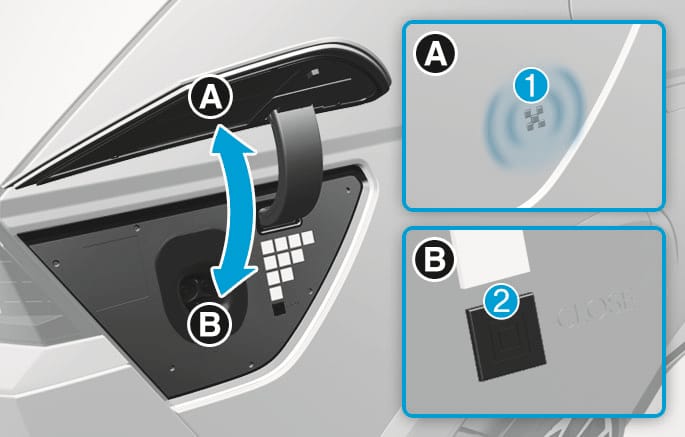
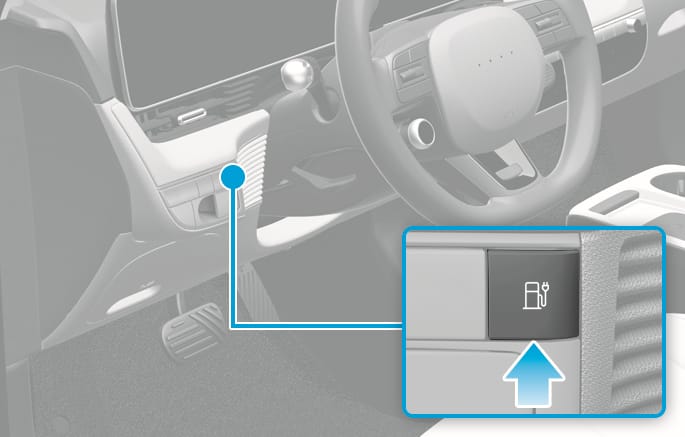
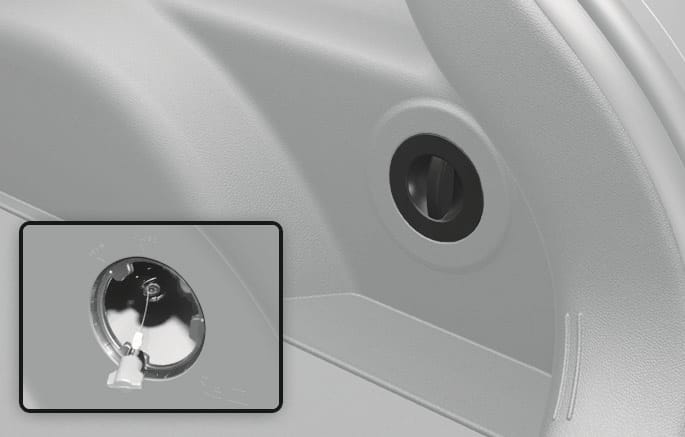
Charging-door controls, as illustrated in Hyundai’s 2026 IONIQ 5 U.S. manual. An iced-over door is a different problem from a locked connector. Illustration: Hyundai.
Illustration sources: Hyundai’s charging-door section and connector-release section.
Tesla: A Frozen Latch Has Its Own Heating Guidance
Tesla’s Model Y cold-weather guidance addresses ice on the charge-port latch directly. It recommends Defrost Car in the mobile app to thaw ice so a charging cable can be inserted or removed.
For a frozen latch trapping the cable, the manual also lists Controls > Service > Inlet Heater, with availability identified for North America, Korea and Japan. Look for the instructions and controls applicable to your own Model Y; do not assume an older vehicle, another Tesla model or a non-Tesla EV has the same menu.
The point is the target of the heat. Battery preparation for fast charging, a warm cabin and thawing a charge-port latch are different jobs. A comfortable passenger compartment alone does not confirm that the connector is ready to release.
If your next concern is departure preparation rather than an obstructed port, the cabin-preheating guide explains that distinction.
The Emergency Release Is Not a Universal Shortcut
Hyundai’s cited 2026 instructions describe an emergency charging-connector cable for situations involving battery discharge or wiring failure that prevents normal release. They identify its location at the right side of the luggage area and say to have the vehicle inspected by an authorized Hyundai dealer if the connector still does not disconnect.
That is a specific failure procedure, not a general instruction to pull a cable whenever there is frost. It does not override the requirement to stop charging before disconnecting, and it does not remove ice from the hardware.
Before using any manual release, read the exact vehicle’s sequence, conditions and warnings. Do not borrow a release location or procedure from a similar-looking model. If you cannot establish the proper procedure, contact the charging operator or roadside assistance.
What to Learn Before Winter
This is useful preparation for an owner and a practical question for an EV buyer who will park outdoors.
- Normal release: Find how the vehicle unlocks its connector after charging.
- Charge-door operation: Check whether vehicle locking, Park or an unlock timeout affects opening.
- Supported thawing: Find whether the manufacturer specifies a heater, defrost function or gentle door-thawing method.
- Emergency instructions: Save the exact manual section offline so it is available without cellular service.
- Support: Keep the charging operator’s contact details and the vehicle’s roadside-assistance information accessible.
After release, inspect the connector and inlet before charging again. Hyundai advises using another normally functioning charger when equipment is worn, exposed or damaged. A thawed connection is not necessarily an undamaged one.
Start with the lock, then the ice—not with more force. The right release sequence can solve a normal locking problem immediately. A frozen mechanism needs the vehicle’s supported thawing method; a persistent fault needs assistance.
FAQ
Does a stuck EV charging cable always mean it is frozen?
No. The connector may still be locked by the vehicle. Stop charging and follow the normal unlock procedure for the vehicle and charger before treating the problem as ice.
What does Tesla recommend for a frozen Model Y charge-port latch?
Tesla’s cited Model Y manual recommends Defrost Car in the app and lists Controls > Service > Inlet Heater for a frozen latch in North America, Korea and Japan. Check the instructions and controls for your exact vehicle.
Should I pull the emergency release when an EV cable is stuck?
Use it only under the conditions and sequence in the exact vehicle’s manual. Hyundai’s cited 2026 IONIQ 5 instructions describe it for battery discharge or wiring failure, not as a general ice-removal method. Stop charging before disconnecting.
Related Articles
- Can You Charge an EV in Rain and Snow? Check the Equipment First
- Preheating an EV in Winter: Cabin Heat, Battery Warm-Up and Plugged-In Power
- EV Breakdown Towing: Why Neutral Is Not Enough