2026 Silverado EV WT vs GMC Sierra EV Elevation: Is the GMC Worth $16,000 More?
The standard-range Silverado EV WT and Sierra EV Elevation share core GM electric-truck hardware, but the GMC costs $16,000 more. Here is what Canadian buyers get for the difference.
General Motors has created an unusually clear electric-truck decision for Canadian buyers. The 2026 Chevrolet Silverado EV Work Truck Standard Range and 2026 GMC Sierra EV Elevation Standard Range use closely related architecture, the same basic battery class, dual-motor four-wheel drive, a 5-foot-11-inch bed and the same published peak charging power.
The prices are not close. Chevrolet Canada’s build tool lists the Silverado EV WT at $68,642.50 including freight and listed fees, while GMC Canada’s configurator puts the Sierra EV Elevation at $84,642.50 on the same broad basis. That is an exact $16,000 difference before taxes and options in the configurations checked on September 11, 2026.
The Silverado is the rational value choice. The Sierra earns its premium with more power, a much higher published maximum towing figure, heated front seats, a heated steering wheel, a more upscale cabin and stronger standard lifestyle equipment. Whether those upgrades are worth $16,000 depends on whether this truck is primarily a tool, a family vehicle or both.
Quick Verdict
Buy the Silverado EV Work Truck Standard Range if you want the least expensive new full-size electric pickup in GM’s Canadian lineup and can live without the GMC’s richer cabin. It travels five kilometres farther on the published estimate, uses the same 220-kW DC charging ceiling and keeps the full crew-cab, short-bed format. Saving $16,000 also leaves substantial room for a home charger, winter tires, bed accessories or simply a lower payment.
Choose the Sierra EV Elevation Standard Range if the truck will regularly tow heavier trailers, serve as the household’s main vehicle or carry clients and family members. Its 605 hp and 605 lb-ft, available 12,500-pound towing rating, heated cabin equipment, power-open eTrunk and polished interior make it a more complete lifestyle truck.
The short answer is Silverado WT for maximum value; Sierra Elevation for capability and comfort. Do not pay the GMC premium only for the badge.
| Item | 2026 Silverado EV WT Standard Range | 2026 Sierra EV Elevation Standard Range |
|---|---|---|
| Published configured price | $68,642.50 before taxes and options | $84,642.50 before taxes and options |
| Price difference | Baseline | $16,000 more |
| Estimated range | Up to 460 km | Up to 455 km |
| Drive system | Dual-motor four-wheel drive | Dual-motor e4WD |
| Power | Up to 510 hp in Tow/Haul Mode | Up to 605 hp |
| Torque | Up to 490 lb-ft in Tow/Haul Mode | Up to 605 lb-ft |
| Maximum towing | Up to 8,500 lb in the listed configuration | Up to 12,500 lb when properly equipped |
| DC fast charging | 475 V; up to 220 kW | 475 V; up to 220 kW |
| AC charging | Up to 11.5 kW with suitable equipment | Up to 11.5 kW with suitable equipment |
| Bed | 5 ft 11 in | 5 ft 11 in |
| Cabin emphasis | Durable work-truck specification | Heated, more upscale lifestyle specification |
| Best fit | Value-first fleet, work or personal buyer | Buyer who needs more comfort and towing capability |
The Silverado WT Keeps the Hardware That Matters
The strongest argument for the Silverado EV WT is not that it is cheap. Nearly $69,000 before tax is still serious money. Its advantage is that Chevrolet has not stripped away the electric hardware that determines whether the truck is useful.
The standard-range WT has dual-motor four-wheel drive, up to 460 km of estimated range, a 475-volt battery system, DC fast charging at up to 220 kW and an onboard AC charger capable of 11.5 kW. It also retains the same broad crew-cab layout and 5-foot-11-inch pickup bed used across the GM electric-truck family.
Chevrolet lists up to 510 hp and 490 lb-ft of torque in Tow/Haul Mode for the standard-range WT. That is not the biggest number in the showroom, but it is more than enough to make a heavy electric pickup feel responsive in daily traffic. The listed configuration can tow up to 8,500 pounds, which covers many utility trailers, boats and moderate travel trailers when payload, hitch weight and the truck’s exact equipment all fit.
The WT also gets a 17.7-inch infotainment display and 11-inch driver information centre for 2026. This is not an old-school vinyl-floor fleet special with a tiny radio. The cabin is simpler than the GMC’s, but the large-screen interface, adaptive cruise control and broad driver-assistance package make it viable as a personal truck.
That combination makes the Silverado difficult to dismiss. It gives up luxury and some capability, not the basic EV experience.
What the Sierra’s $16,000 Buys
The Sierra EV Elevation does not deliver more range or faster standard-battery charging. It delivers a stronger truck around that battery.
GMC lists 605 hp and 605 lb-ft of torque, a substantial increase over the WT. More importantly for shoppers who use a pickup as intended, the configurator lists up to 12,500 pounds of maximum trailering when properly equipped. That is a 4,000-pound advantage over the Silverado configuration in this comparison.
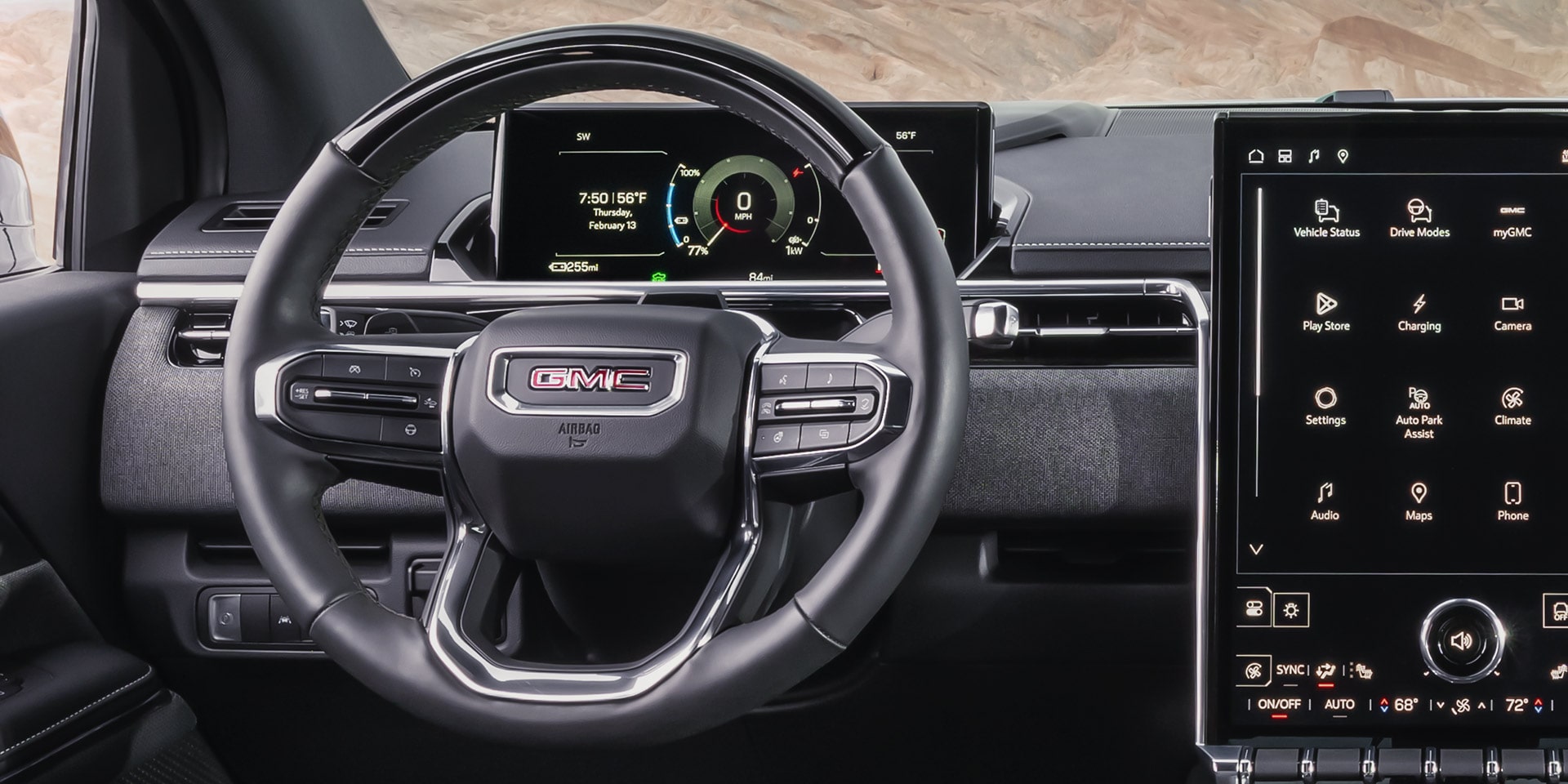
The cabin is also where the premium becomes visible. The Elevation includes heated front seats, a heated steering wheel, an eight-way power driver’s seat, a 16.8-inch infotainment display with Google built-in compatibility, a sliding wireless phone charger and GMC’s CoreTec upholstery. Its power-open eTrunk makes the large front storage compartment easier to use, while the six-function MultiPro tailgate is more versatile than a conventional tailgate.
GMC’s Assisted Driving Package adds adaptive cruise control, HD Surround Vision, traffic-sign recognition, front and rear park assist, rear cross-traffic braking and other active-safety features. Chevrolet also gives the WT a useful driver-assistance suite, so this is not a clean technology knockout. The Sierra’s advantage is the way the comfort, trim and utility pieces add up.
For a contractor carrying clients, a family replacing both an SUV and a pickup, or an owner towing near the Chevrolet’s limit, those upgrades can matter every day. For someone who wants an electric truck for commuting, home projects and occasional light towing, $16,000 is a steep price for nicer touchpoints.
Range and Charging Are Effectively a Tie
The Silverado’s 460-km estimate beats the Sierra’s 455 km, but a five-kilometre difference is statistical noise in real use. Temperature, speed, wind, tires, payload, elevation and trailer drag will move the result far more than that.
Both standard-range trucks are listed with up to 220-kW DC fast charging. Neither gets the 300-kW or 350-kW peak associated with GM’s larger extended- and max-range battery packs. That makes the standard-battery models better suited to buyers who charge at home and use public fast charging as a supplement rather than a weekly routine.
The shared 11.5-kW AC charging capability is more important for ordinary ownership. Reaching that maximum requires a professionally installed circuit and compatible charging equipment. The included dual-level cord can use a NEMA 14-50 outlet at up to 7.7 kW, which may still be enough to replace a typical day’s driving overnight.
Truck buyers should plan charging around winter use and towing, not the unladen maximum range figure. A trailer can cut highway range sharply, and a cold-soaked battery will not always accept peak charging power immediately. If regular long-distance towing is part of the job, the extended-range Silverado or Sierra deserves consideration even though the purchase price rises.
MotorLinks’ home EV charging panel guide explains why charger size, household load and electrical-service capacity should be evaluated together before installation.
The Towing Number Needs Context
The Sierra’s 12,500-pound maximum is the biggest functional reason to spend more, but the headline does not replace a payload calculation.
Trailer tongue weight, passengers, tools, accessories and cargo all count against the truck’s available payload. A trailer that sits below the maximum tow rating can still overload the vehicle once the cab and bed are full. Buyers should check the door-jamb label on the exact truck, not rely only on a model-page maximum.
Range is the other constraint. Electric motors are excellent at moving a heavy load, but aerodynamic drag and mass still consume energy. A tall travel trailer at highway speed can matter more than the difference between 510 and 605 hp. Route planning should account for charger location, trailer-friendly access, charging-stall layout and the possibility that disconnecting the trailer may be necessary.
That is why the Sierra is not automatically the better tow vehicle for every buyer. It is the more capable standard-range truck on paper, but shoppers who routinely approach its limit may be better served by an extended-range battery rather than spending the whole upgrade budget on trim and cabin equipment.
Work Truck or Family Truck?
The Silverado WT makes sense when the buying process starts with a budget and a job list. Its lower price, five-seat crew cab, large displays, useful range and full-size bed cover the essentials. The simpler specification may also be easier to justify in a business where every option has to earn money.
The Sierra Elevation makes sense when the truck has to feel less like equipment after work ends. Heated seats and a heated wheel matter in Canada. The stronger output is enjoyable even without a trailer, and the nicer cabin is easier to appreciate when the truck handles school runs, commuting and weekend travel.
There is also a middle path: the Silverado EV LT Standard Range. Chevrolet’s consumer page lists it close to the Sierra in price, with a more lifestyle-oriented specification than the WT. Buyers attracted to the GMC should compare all three complete written quotes rather than assuming Chevrolet means basic and GMC means premium.
The $16,000 saved by choosing the WT is large enough to change the ownership calculation. It can cover a professionally installed home charging setup, a serious winter wheel-and-tire package, insurance differences and years of electricity. That is why the Chevrolet remains the default recommendation unless the GMC’s added capability has a clear use.
Who Should Buy Each Truck?
Choose the Silverado EV WT Standard Range if:
- purchase price is the first priority
- 8,500 pounds of listed towing capacity is sufficient
- the truck will mostly commute, carry cargo or handle local work
- home charging will cover most energy needs
- durable, straightforward cabin trim is acceptable
Choose the Sierra EV Elevation Standard Range if:
- you regularly need more than the Silverado’s listed towing capacity
- heated cabin equipment is essential rather than optional
- the truck will replace a family SUV as well as a work vehicle
- stronger acceleration and a richer interior matter every day
- the $16,000 premium does not prevent moving to a larger battery if long trips demand it
Consider an extended-range configuration instead if frequent highway towing or remote travel is central to the purchase. More usable trip range may improve the truck more than either badge or interior package.
Bottom Line
The 2026 Chevrolet Silverado EV Work Truck Standard Range is the better value. It keeps the core electric-truck hardware, offers slightly more listed range and costs exactly $16,000 less in the Canadian configurations checked for this comparison.
The 2026 GMC Sierra EV Elevation is the better all-purpose truck. Its 605-hp output, higher published towing ceiling, heated cabin and more polished equipment make it easier to live with as a primary vehicle.
Pay for the Sierra if the extra capability and comfort solve real weekly needs. Otherwise, buy the Silverado WT, invest part of the savings in charging and winter equipment, and keep the rest.
FAQ
Should Canadians buy the Silverado EV WT or Sierra EV Elevation?
Buy the Silverado EV WT for the lowest price and strong basic utility. Choose the Sierra EV Elevation if you need its higher towing rating, stronger output and more comfortable cabin.
How much more does the Sierra EV Elevation cost?
The Canadian build tools listed the two standard-range configurations at $68,642.50 for the Silverado EV WT and $84,642.50 for the Sierra EV Elevation on September 11, 2026. That is a $16,000 difference before taxes and options.
Which truck has more range?
The Silverado EV WT is listed at up to 460 km, compared with 455 km for the Sierra EV Elevation. The five-kilometre gap is too small to matter in normal driving.
Do they charge at the same speed?
Yes on the published standard-battery specifications. Both support DC fast charging at up to 220 kW and AC charging at up to 11.5 kW with compatible equipment.
Sources
- Chevrolet Canada: 2026 Silverado EV models, pricing, range and equipment
- Chevrolet Canada: Silverado EV Standard Range build details
- GMC Canada: 2026 Sierra EV Elevation range and equipment
- GMC Canada: Sierra EV Standard Range Elevation build details