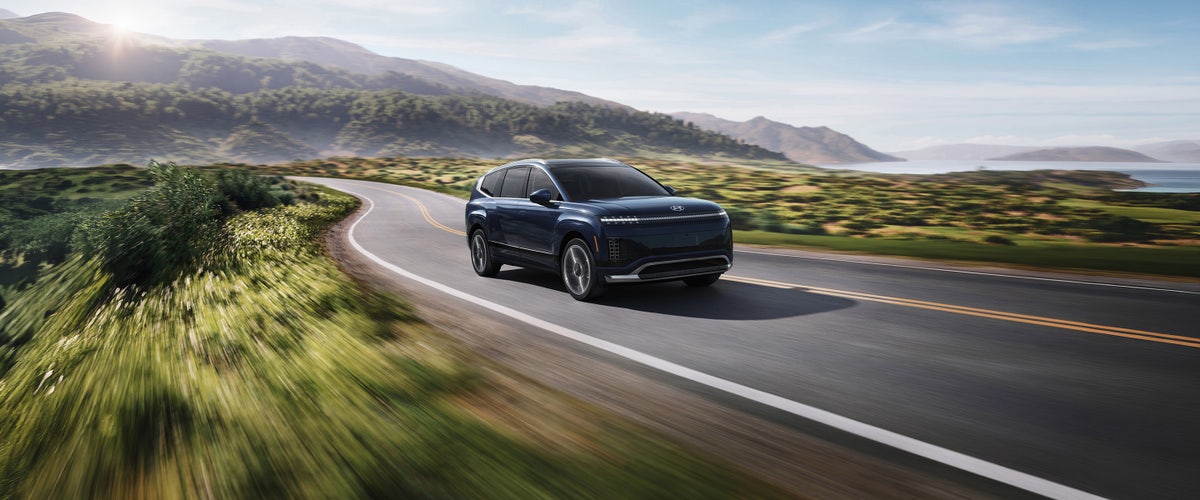
2026 Hyundai IONIQ 9 Trim Guide: Preferred AWD Is Canada's Smart Pick
The 2026 Hyundai IONIQ 9 offers 539 km with RWD or two AWD power levels. Preferred AWD is the best Canadian blend of range, traction and equipment.
Image: Hyundai
Hyundai gives Canadian buyers an unusually tidy choice with the 2026 IONIQ 9. Every version has three rows, a 110.3-kWh battery, 800-volt charging hardware and at least 500 km of listed range. The decision is mainly about how much traction, power and cabin equipment the household needs.
The $59,999 Essential RWD is the range leader at 539 km. The $64,999 Preferred AWD gives up 24 km but adds a second motor, 5,000-pound towing capacity and the equipment most families will appreciate. The $64,999 Preferred AWD+ trades another 15 km and some comfort-oriented specification for a serious 422-hp performance upgrade. Those prices and ranges come from Hyundai Canada’s current build tool.
Those are MSRPs before additional fees and taxes. Hyundai’s online builder displayed higher totals when checked on August 20, 2026, so compare itemized, tax-exclusive quotes rather than assuming the headline number is the drive-away price.
October Source Update
The generic showroom links now open 2027; use the recovered 2026 overview for this historical trim guide. The builder returned an application shell, so the original $59,999/$64,999 figures and equal AWD/AWD+ price are not a newly verified current quote. The fastest DC claim requires suitable 350-kW CCS equipment and the approved CCS1 DC adapter; the AC interface is J1772. Range and comfort equipment must match the exact package, not the maximum model headline.
Quick Verdict
Buy Preferred AWD if this will be the household’s all-weather family vehicle. Its 303 hp and 446 lb-ft are already ample for a three-row SUV, while 515 km of listed range, 19-inch wheels, leatherette upholstery and 5,000-pound towing capacity form the most balanced package.
Buy Essential RWD if maximum range and the lowest payment matter more than all-wheel drive. Saving $5,000 while gaining 24 km is meaningful, and the base car still includes the full-size battery, rapid charging, heated front seats and a strong driver-assistance suite. Its cloth cabin and 3,500-pound tow rating are the main compromises.
Buy Preferred AWD+ if acceleration is part of the reason for going electric. It costs the same as Preferred AWD before options but jumps from 303 to 422 hp and cuts the manufacturer-listed 0-to-100-km/h time from 6.7 to 5.2 seconds. The cost is 15 km of range, 21-inch tires and a more basic standard seat covering unless the Ultimate Calligraphy package is added.
| Item | Essential RWD | Preferred AWD | Preferred AWD+ |
|---|---|---|---|
| Starting MSRP | $59,999 | $64,999 | $64,999 |
| Listed range | 539 km | 515 km | 500 km |
| Battery | 110.3 kWh | 110.3 kWh | 110.3 kWh |
| Output | 215 hp; 258 lb-ft | 303 hp; 446 lb-ft | 422 hp; 516 lb-ft |
| 0-100 km/h | 9.4 sec | 6.7 sec | 5.2 sec |
| Drivetrain | Rear-wheel drive | All-wheel drive | All-wheel drive |
| Wheels | 19-inch | 19-inch | 21-inch |
| Standard seating | 7 passengers; cloth | 7 passengers; leatherette | 7 passengers; cloth |
| Braked towing capacity | 3,500 lb | 5,000 lb | 5,000 lb |
| Best for | Maximum range and lower cost | All-weather family balance | Maximum performance |
2026 Hyundai IONIQ 9 official gallery
14


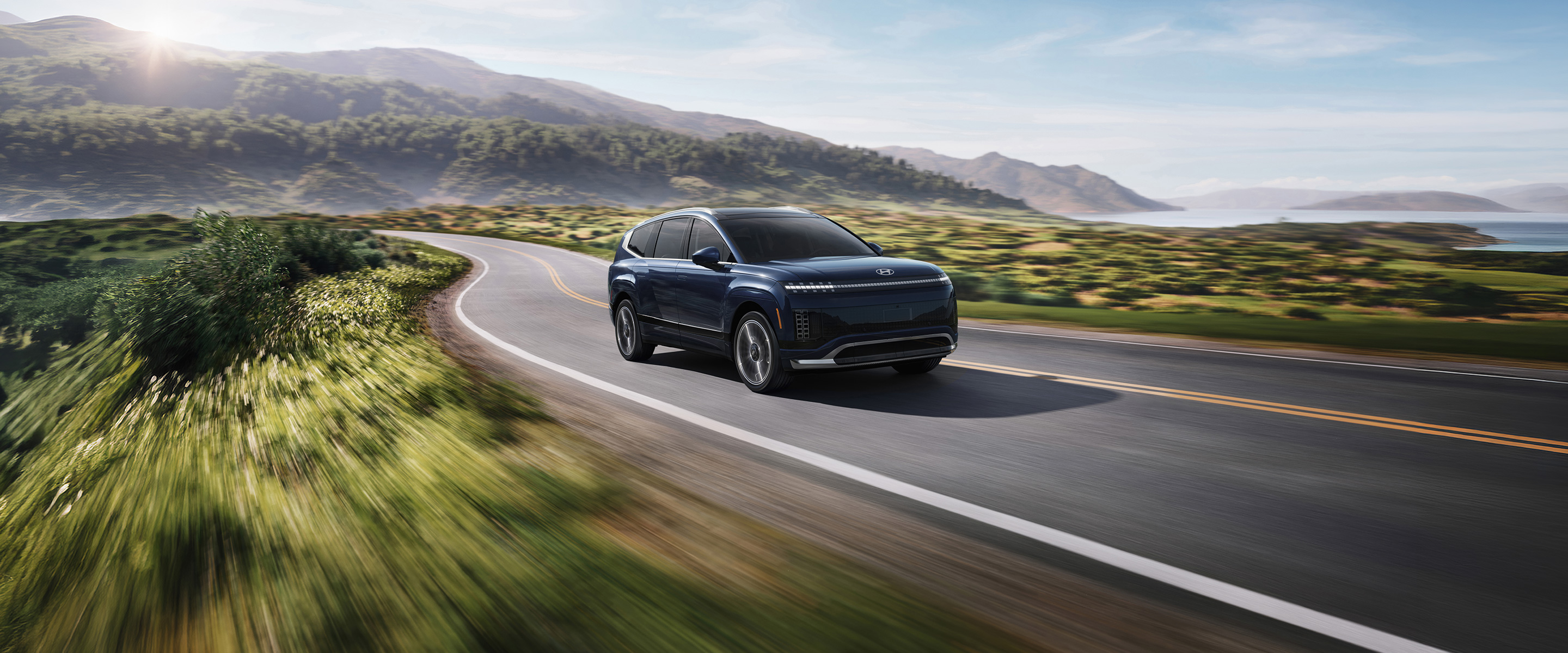


All Canadian IONIQ 9 trims use the same 110.3-kWh battery and 800-volt charging architecture.
Essential RWD: The Rational Range Pick
The base IONIQ 9 is not a small-battery special created to advertise a low starting price. It receives the same 110.3-kWh pack as every other trim, and Hyundai Canada lists 539 km of range. That is 39 km more than the most powerful AWD+ version.
Its single rear motor produces 215 hp and 258 lb-ft. Hyundai lists 9.4 seconds from 0 to 100 km/h, so this is the relaxed member of the range rather than a sleeper performance SUV. For a family vehicle that spends most of its time commuting, moving children and covering long highway distances, that output may be perfectly adequate.
Essential also avoids a punishment-box equipment list. Standard hardware includes 19-inch alloy wheels, heated front seats, a power driver’s seat, dual-zone climate control with separate second-row controls, a smart power liftgate, dual 12.3-inch displays, wireless Apple CarPlay and Android Auto, wireless phone charging and seven USB-C ports. Highway Driving Assist 2, adaptive cruise control and a broad collision-avoidance suite are included.
The trade-offs are straightforward. Seats are stain-resistant cloth, the front passenger seat is manually adjusted, and the towing limit is 3,500 pounds rather than the AWD models’ 5,000 pounds. Rear-wheel drive is workable through a Canadian winter with suitable winter tires, but buyers who regularly tackle steep, poorly cleared roads may reasonably value a second driven axle.
Choose Essential when the written $5,000 saving survives dealer fees and finance comparisons. That money can cover winter wheels, home charging work and a substantial portion of the first years of electricity.
Preferred AWD: The Canadian Sweet Spot
Preferred AWD is the sensible default because its upgrades line up with how a big family SUV is likely to be used.
The front motor adds traction and raises total output to 303 hp and 446 lb-ft. The 0-to-100-km/h estimate drops to 6.7 seconds, while range remains a useful 515 km. Losing 24 km compared with Essential is a modest exchange for the extra driven axle when winter hills, cottage roads or regular towing are part of the job.
Towing capacity rises to 5,000 pounds, and Hyundai adds trailer pre-wiring, terrain drive modes and a self-leveling rear suspension. Those details make Preferred AWD more than an acceleration upgrade. The suspension can maintain ride height with people or cargo aboard, while the higher tow limit creates room for a broader selection of small campers and recreational trailers. Actual EV towing range will fall significantly with a trailer, so route planning still needs a conservative energy estimate.
The cabin also moves to leatherette seating and adds an eight-way power front passenger seat, a heated steering wheel, Digital Key 2.0 and a sensor-based rear-occupant alert. It keeps the range-friendly 19-inch wheels, which should provide more sidewall and lower replacement costs than the AWD+ model’s 21-inch setup.
For most Canadian households, this is the combination to quote first. It does not have the biggest horsepower number or the lowest MSRP, but it spends the upgrade money on traction, towing and everyday cabin improvements.
Preferred AWD+: Same MSRP, Very Different Priorities
Preferred AWD+ is the enthusiast’s loophole in the lineup. Hyundai’s builder listed it at the same $64,999 MSRP as Preferred AWD when checked, yet its dual 160-kW motors deliver 422 hp and 516 lb-ft. That is 119 hp more without a higher base MSRP.
There are real reasons not to choose it automatically. Range falls from 515 to 500 km, and the standard wheels grow from 19 to 21 inches. Larger tires generally cost more to replace, provide less sidewall over broken pavement and can make a winter-wheel package more expensive. The standard AWD+ specification also returns to cloth seating, even though it adds useful features such as blind-view monitoring.
This is therefore a powertrain-first trim. It makes sense for a buyer who wants the quickest IONIQ 9 and prefers to choose luxury equipment separately. It is less compelling for someone who sees identical MSRPs and assumes AWD+ must simply include everything from Preferred AWD.
Hyundai’s Ultimate Calligraphy package is available on AWD+ and transforms the cabin into the six-passenger flagship with second-row captain’s chairs. It also brings the features Hyundai highlights in its premium imagery, including relaxation-style seating and a full-display digital rearview mirror. Get the complete package price in writing: it is the equipment, not the AWD+ badge alone, that creates the flagship experience.
What the Luxury and Calligraphy Packages Change
Hyundai treats its upper equipment groups as packages rather than separate core powertrains. The Luxury package is tied to Preferred AWD, while Ultimate Calligraphy is tied to Preferred AWD+.
That distinction matters because the package also determines the seating layout. Core trims and Preferred AWD with Luxury retain a seven-passenger second-row bench. Ultimate Calligraphy switches to six-passenger seating with captain’s chairs. The captain-chair layout improves second-row comfort and creates a clearer aisle to the back, but it removes one seating position.
Families should test the exact layout with their child seats and regular passengers. Hyundai lists 813 mm of third-row legroom and 620 litres of cargo volume behind the third row, useful figures for the class, but a specification cannot show how easily a particular booster seat, stroller or hockey bag moves through the cabin.
The middle-row choice is more important than a premium audio badge. A household that occasionally needs seven seats should not be talked into a six-seat flagship merely because it looks richer in the showroom.
Charging Is Strong Across Every Trim
There is no charging reason to avoid the base model. Every IONIQ 9 uses an 800-volt architecture, and Hyundai estimates approximately 24 minutes from 10 to 80 percent on a suitable 350-kW DC fast charger under ideal conditions. Temperature, battery conditioning, charger output and starting state of charge will change the result.
All trims also use a 10.9-kW onboard AC charger. Hyundai lists about 9 hours 40 minutes for a Level 2 session under its test conditions. Most owners will rarely arrive home with a completely depleted 110.3-kWh pack, so overnight charging can work well when the circuit and charging equipment are properly sized.
The Canadian 2026 IONIQ 9 has a native NACS inlet. Hyundai says adapters are included for compatible CCS equipment, which broadens the useful charging options. Native NACS does not mean every Tesla site or every stall generation will necessarily work, and adapter hardware does not guarantee maximum charging speed. Confirm network access, stall compatibility and payment setup before a long trip. MotorLinks’ native NACS versus adapter guide explains the distinctions.
Space, Tires and Winter Ownership
The IONIQ 9 is a genuinely large vehicle: 5,060 mm long, 1,980 mm wide and 1,790 mm tall, riding on a 3,130-mm wheelbase. Hyundai lists 1,323 litres behind the second row and 2,462 litres with the second and third rows folded. There is also a front trunk, sized at 88 litres on the RWD model and 52 litres on AWD versions.
Those dimensions are good news for passengers and cargo but relevant in an older garage or tight urban parking space. Measure the opening, not only the floor. The long wheelbase and nearly two-metre body width deserve a real parking test before purchase.
Essential RWD and Preferred AWD ride on 19-inch wheels, which are the practical choices. Preferred AWD+ and Ultimate Calligraphy use 21s; the Luxury package uses 20s. Ask for winter-tire and replacement-tire prices with each quote because the recurring cost can change the trim-value calculation.
All-wheel drive helps the vehicle accelerate on slippery surfaces, but it cannot create braking grip. Proper winter tires remain the first cold-weather upgrade on every trim. Cold temperatures, cabin heating, roof accessories and winter tires also reduce real range, so treat Hyundai’s ratings as comparison numbers rather than guaranteed February distances.
Incentives and the Final Price
Do not build the purchase around an assumed rebate. Program rules, eligible vehicle prices, buyer qualifications and available funding can change. The IONIQ 9’s price and option packages may also place different configurations on opposite sides of a program threshold.
Check MotorLinks’ Canadian EV incentive and affordable-EV guide, then ask the retailer to identify any claimed support by program name and amount on the written quote. Compare cash price, finance rate, mandatory fees, insurance and charging-installation costs together.
Bottom Line
The 2026 Hyundai IONIQ 9 Preferred AWD is the best trim for most Canadian buyers. It retains 515 km of listed range and sensible 19-inch wheels while adding the traction, 5,000-pound towing capacity and cabin upgrades that suit a year-round family SUV.
Essential RWD is the smart budget and range choice. It saves $5,000, travels 24 km farther on its listed rating and keeps the important battery, charging and safety hardware. Buy it when rear-wheel drive and cloth seats are acceptable.
Preferred AWD+ is the exciting one. Getting 422 hp at the same base MSRP as Preferred AWD is genuinely appealing, but its 21-inch wheels, 500-km rating and cloth standard seats show that it is a different branch rather than a straight upgrade. Choose it for performance or as the foundation for Ultimate Calligraphy—not because the plus sign looks more complete.
Which 2026 Hyundai IONIQ 9 trim is best for Canadian buyers?
Preferred AWD is the all-around choice. It combines 515 km of listed range with AWD, 303 hp, a 5,000-pound tow rating, 19-inch wheels and leatherette seating.
How much range does the 2026 IONIQ 9 have?
Hyundai Canada lists 539 km for Essential RWD, 515 km for Preferred AWD and 500 km for Preferred AWD+. All use a 110.3-kWh battery.
How quickly can it charge?
Hyundai estimates about 24 minutes from 10 to 80 percent at a suitable 350-kW DC fast charger under ideal conditions. All versions use 800-volt architecture and a 10.9-kW onboard AC charger.
Does the Canadian IONIQ 9 use NACS?
Yes. Hyundai Canada says the 2026 IONIQ 9 has a native NACS inlet and includes J1772 AC and CCS1 DC adapters for compatible equipment. Check specific networks and stalls before travelling.