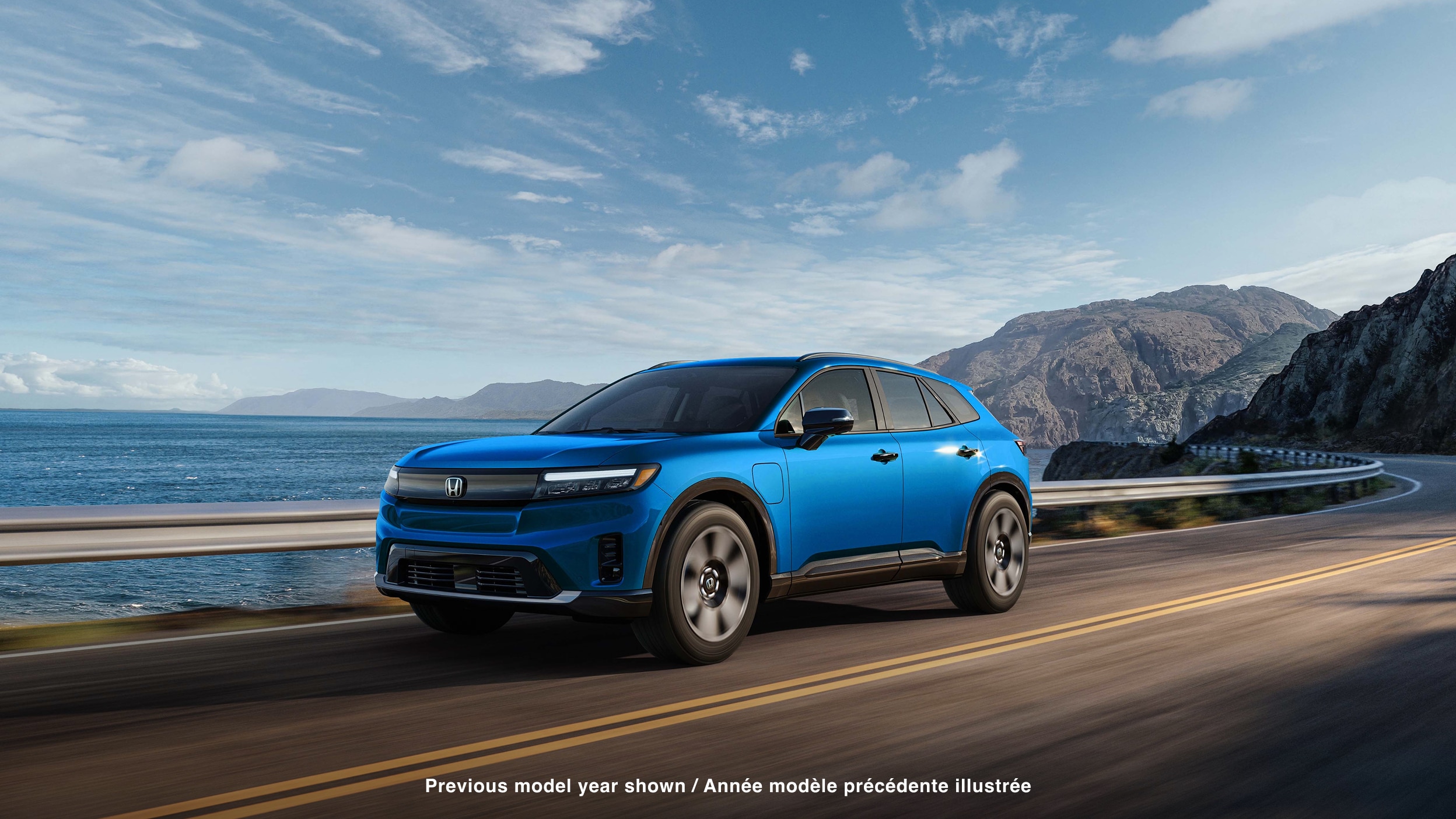
2026 Honda Prologue vs Chevrolet Blazer EV in Canada: Wait or Buy Now?
The Honda Prologue and Chevrolet Blazer EV share key electric hardware, but their Canadian availability, range, charging and cabin experiences are notably different. Here is which one makes more sense now.
The 2026 Honda Prologue and 2026 Chevrolet Blazer EV are close relatives underneath, but they are not interchangeable products in a Canadian showroom.
Honda makes the Prologue the simpler proposition: three trims, an 85-kWh battery and dual-motor all-wheel drive across the lineup. Chevrolet offers a broader Blazer EV range with front-wheel drive, all-wheel drive and the 3.4-second SS performance model. It also has the practical advantage of a published price and vehicles in inventory, while Honda’s Canadian site still marks the 2026 Prologue as Coming Soon.
This is a specification and buying-context comparison, not a road test. Prices, availability and manufacturer claims reflect information checked on August 3, 2026.
Quick Verdict
Buy the Chevrolet Blazer EV if the vehicle is needed now. Chevrolet’s Canadian build tool lists it from $59,098, the front-wheel-drive LT and RS reach up to 502 km, and the model is available through a national dealer network. It is also the only one here offering both a lower-consumption FWD configuration and a serious performance version.
Wait for the Honda Prologue if standard AWD, conventional phone integration and Honda’s cleaner cabin are the priorities. The EX and EX-L are rated at 473 km, the battery can move from 20 to 80 per cent in a claimed 35 minutes, and wireless Apple CarPlay and Android Auto are standard. The catch is substantial: Honda limits the Prologue to select dealers in British Columbia, Ontario and Quebec, and has not posted a useful 2026 Canadian price on its public trim page.
The short answer is Blazer EV for availability, choice and maximum range; Prologue for standard AWD and a more familiar Honda-style interface. Anyone outside the three participating provinces has an especially easy decision today.
| Item | 2026 Honda Prologue | 2026 Chevrolet Blazer EV |
|---|---|---|
| Canadian availability | Coming Soon; select dealers in British Columbia, Ontario and Quebec | Available through Chevrolet inventory and build tools across Canada |
| Published starting price | Not shown on Honda Canada trim page | $59,098 on Chevrolet Canada build-and-price page |
| Drive layouts | Dual-motor AWD only | FWD, AWD and performance AWD depending on trim |
| Battery | 85 kWh on EX, EX-L and Touring | 85 kWh on LT and RS; 102 kWh on SS |
| Listed range | 473 km EX and EX-L; 455 km Touring | Up to 502 km with FWD; up to 486 km on SS |
| DC charging claim | 20-80% in 35 minutes; up to 101 km in 10 minutes | 10-80% in approximately 39 minutes; up to 133 km in 10 minutes with FWD or 120 km with AWD |
| Power headline | 300 hp and 355 lb-ft on every trim | SS reaches 0-96 km/h in a GM-estimated 3.4 seconds |
| Displays and phone integration | 11-inch driver display, 11.3-inch touchscreen, wireless Apple CarPlay and Android Auto, Google built-in | 11-inch driver display, 17.7-inch touchscreen and Google built-in compatibility |
| Maximum cargo claim | Up to 1,634 L on EX with rear seat folded | Up to 1,674 L |
| Charging connector | CCS; approved NACS-to-CCS adapter available | CCS; approved NACS-to-CCS adapter available |
| Best fit | AWD shopper who prefers Honda packaging and phone mirroring | Buyer who wants inventory, more configurations or the longest listed range |
Honda Prologue and Chevrolet Blazer EV official gallery
14
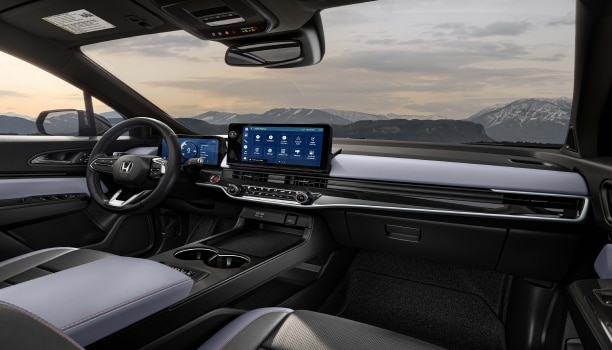
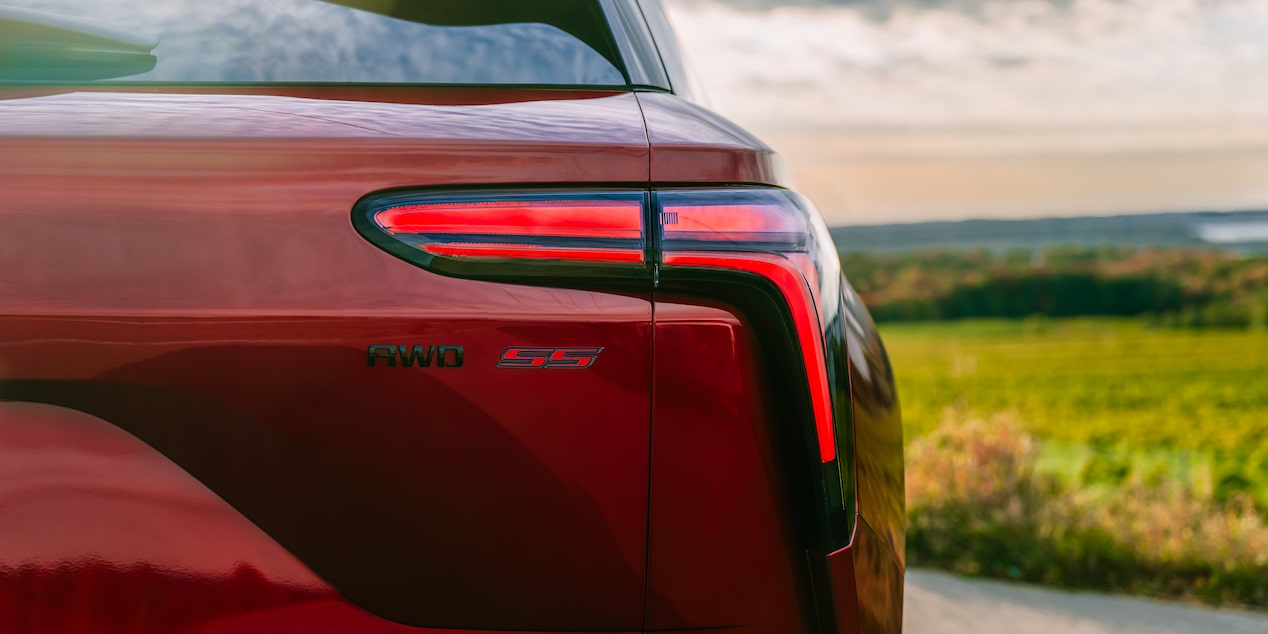
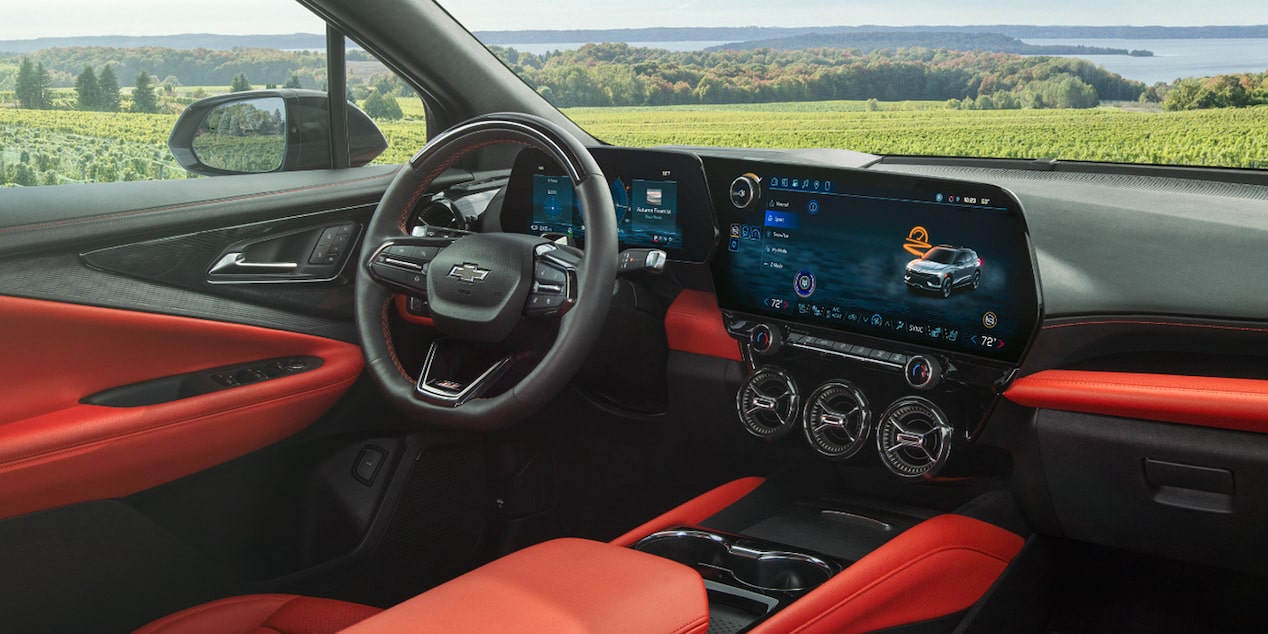
The Prologue uses a calmer, more conventional SUV design and comes only with dual-motor all-wheel drive in Canada. Image: Honda Canada.
The Blazer EV Wins on Availability
The most important difference is not range, power or screen size. It is whether a buyer can get the vehicle.
Honda Canada’s Prologue trim page labels the EX, EX-L and Touring Coming Soon. It also says 2025 and 2026 Prologue availability is restricted to select dealers in British Columbia, Ontario and Quebec. That excludes a large part of the country before price or equipment enters the conversation.
Chevrolet’s position is much clearer. The Canadian Blazer EV page links directly to inventory and configuration tools, and Chevrolet’s build-and-price page lists a $59,098 starting point. A final quote can still change with trim, freight, fees, paint, accessories, financing and dealer inventory, but at least the buyer has a real number and vehicles to inspect.
Honda may post pricing and dealer stock soon. Until it does, this is a wait-versus-buy comparison rather than a conventional head-to-head deal analysis. A refundable deposit can preserve a place in line; it should not replace a complete written quote or an inspection of an available alternative.
Range Depends on Comparing the Same Drive Layout
Chevrolet owns the headline with 502 km, but that figure belongs to the front-wheel-drive Blazer EV LT and RS.
Honda Canada lists 473 km for the AWD Prologue EX and EX-L, while the heavier Touring on 21-inch wheels is rated at 455 km. Since Canada does not get a front-wheel-drive Prologue, comparing 502 against 473 makes the Chevrolet look further ahead than a same-layout comparison would.
The useful takeaway is simple. Choose Blazer EV FWD when maximizing official range matters more than AWD. Choose Prologue when dual-motor traction is non-negotiable and 455 to 473 km meets the household’s normal routes. For either vehicle, winter temperature, highway speed, snow, wind, cabin heat and tires will reduce the distance available from a full charge.
The Blazer EV SS is a different calculation. Chevrolet lists up to 486 km despite its larger 102-kWh battery and performance focus. It is remarkably capable on paper, but someone paying for the SS is choosing speed, equipment and design rather than maximizing range per dollar.
Prologue Has the Better Published Charging Window
Honda’s specification sheet says the Prologue can charge from 20 to 80 per cent in 35 minutes and add up to 101 km in 10 minutes at a suitable DC fast charger. All three trims use the same 85-kWh battery, so the basic charging conversation stays consistent across the lineup.
Chevrolet says the Blazer EV can move from 10 to 80 per cent in approximately 39 minutes. Its FWD models can add up to 133 km in 10 minutes, while AWD versions can add up to 120 km under the manufacturer’s stated conditions. The LT and RS use an 85-kWh pack with up to 150-kW DC charging; the 102-kWh SS supports up to 190 kW.
Those percentages do not create a perfectly controlled race because Honda starts its claim at 20 per cent and Chevrolet starts at 10. The honest conclusion is that neither is an 18-minute, 800-volt charging champion. Both are workable road-trip EVs, but a buyer who depends on public charging should expect stops closer to the mid-30-minute range than a quick coffee splash.
Both vehicles use a CCS charge port. Honda and Chevrolet sell approved adapters for compatible Tesla Superchargers and other NACS DC sites. That improves network access, but it does not create a native NACS experience: the adapter must be carried, the correct app and account must be configured, and compatibility still needs to be checked before a trip.
MotorLinks’ native NACS versus adapter guide explains why network permissions, payment and cable reach matter alongside the plug itself.
The Cabins Reveal Different Priorities
The Prologue’s cabin is the easier transition for a driver who already likes Honda’s approach. It has an 11-inch digital instrument cluster, an 11.3-inch centre touchscreen, physical controls for frequently used functions and standard wireless Apple CarPlay and Android Auto. Google built-in is also supported, with the data-plan conditions Honda describes for connected services.
The Blazer EV makes a bigger visual statement. Its standard 17.7-inch touchscreen dominates the dashboard, paired with an 11-inch driver-information display. Google built-in compatibility, route planning through the myChevrolet app and available Super Cruise on selected configurations give Chevrolet the stronger big-screen, GM-ecosystem pitch.
This is not a question of one cabin being universally better. Drivers who want their phone apps mirrored wirelessly should put the Honda high on the list. Buyers who prefer a larger integrated display and are comfortable living inside GM’s software environment may prefer the Blazer immediately.
Both are wide five-seat SUVs rather than compact crossovers. The Honda measures 4,877 mm long on a 3,094-mm wheelbase. Chevrolet lists the Blazer EV at 4,883 mm long, so garage fit is effectively a draw. The Prologue EX offers up to 1,634 litres behind the front seats; Chevrolet quotes up to 1,674 litres for the Blazer EV. Manufacturer cargo methods can differ, so the shape of the hatch and floor should be tested with the household’s stroller, dog crate, hockey bags or luggage.
Standard AWD Is Honda’s Clearest Advantage
Every Canadian Prologue has dual-motor AWD, 300 hp and 355 lb-ft of torque. That keeps the trim decision focused on comfort and equipment rather than powertrain. EX covers the essentials, EX-L adds leather and more convenience equipment, and Touring brings the most premium cabin and 21-inch wheels.
Chevrolet lets the buyer choose. FWD is the range play, AWD adds traction, and SS turns the same broad vehicle family into a GM-estimated 3.4-second performance SUV. That flexibility is valuable, but it also means a shopper cannot compare badges alone. An LT FWD and a Prologue Touring answer very different questions despite their shared engineering roots.
AWD helps distribute power on slippery roads, but it does not shorten braking distances like appropriate winter tires do. A front-wheel-drive Blazer EV on quality winter rubber can be the sensible range choice for many urban and highway drivers. The Prologue’s standard AWD is more compelling for steep routes, regular cottage access or buyers who simply want extra traction without climbing the options list.
Incentives Should Be Confirmed on the Contract
Honda’s site currently highlights Quebec’s Roulez vert program for eligible Prologue EX and EX-L purchases, while Chevrolet publishes affordability claims that may depend on vehicle, buyer, transaction and program rules. These programs can change faster than a model-year specification sheet.
Do not build the purchase decision around an incentive banner. Ask the dealer to identify the exact program, eligible trim, transaction-value test, buyer conditions and amount on the purchase or lease agreement. A vehicle that appears eligible in a general marketing message can fall outside a program because of configuration, timing or depleted funding.
The MotorLinks Canadian EV incentive guide is the right starting point for the current framework. The final authority remains the program administrator and the signed deal.
Which One Should Canadians Choose?
Choose the Honda Prologue EX or EX-L if:
- standard all-wheel drive is a priority
- 473 km of listed range covers normal regional travel
- wireless Apple CarPlay or Android Auto matters
- a participating dealer in British Columbia, Ontario or Quebec is convenient
- waiting for published pricing and inventory is acceptable
Choose the Prologue Touring if:
- premium cabin equipment matters more than maximum range
- 455 km still leaves a comfortable winter buffer
- the larger wheels and additional features justify the likely price increase
Choose a Blazer EV LT or RS if:
- a vehicle is needed now
- front-wheel drive and up to 502 km make more sense than standard AWD
- national dealer access and visible inventory matter
- the larger touchscreen and GM software approach are appealing
Choose the Blazer EV SS if:
- performance is a real priority
- a 3.4-second 0-to-96-km/h claim and Super Cruise capability justify the cost
- 486 km is sufficient despite the larger wheels and power output
Bottom Line
The Chevrolet Blazer EV is the stronger Canadian purchase today because it is available, priced and offered in more configurations. Its 502-km FWD range also gives road-trip shoppers a clear reason to pick it even after the Prologue reaches dealers.
The Honda Prologue is worth waiting for when standard AWD, wireless phone integration and a simpler trim structure match the household better. It is an appealingly restrained interpretation of shared GM electric hardware, and its 35-minute published charging window is respectable.
Availability prevents a blanket recommendation. Outside British Columbia, Ontario and Quebec, start with the Chevrolet. Inside those provinces, wait only until Honda provides an exact delivered price and date. Then compare written quotes, sit in both cabins and map the chargers used on actual trips.
FAQ
Should Canadians buy a Honda Prologue or Chevrolet Blazer EV?
Buy the Blazer EV if you need a vehicle now, want a published price or prefer the longer-range FWD configuration. Wait for the Prologue if standard AWD, wireless Apple CarPlay and Android Auto, or Honda’s cabin layout matter more and a participating dealer is nearby.
Which has more range?
Chevrolet lists up to 502 km for the FWD Blazer EV. Honda lists 473 km for the AWD Prologue EX and EX-L and 455 km for Touring. That is not a like-for-like drivetrain comparison, but Chevrolet still owns the maximum-range headline.
Can both use Tesla Superchargers?
Yes, at compatible locations with the appropriate approved NACS-to-CCS adapter and required account setup. Both Canadian vehicles retain CCS charge ports for 2026.
Is the 2026 Honda Prologue available across Canada?
No. Honda says 2025 and 2026 Prologue availability is limited to select dealers in British Columbia, Ontario and Quebec. Its 2026 trim page currently labels EX, EX-L and Touring Coming Soon.
Sources
- Honda Canada: 2026 Prologue overview, availability and charging access
- Honda Canada: 2026 Prologue specifications PDF
- Honda Canada: 2026 Prologue trims and availability
- Chevrolet Canada: 2026 Blazer EV range, charging, cargo and equipment
- Chevrolet Canada: 2026 Blazer EV build and price