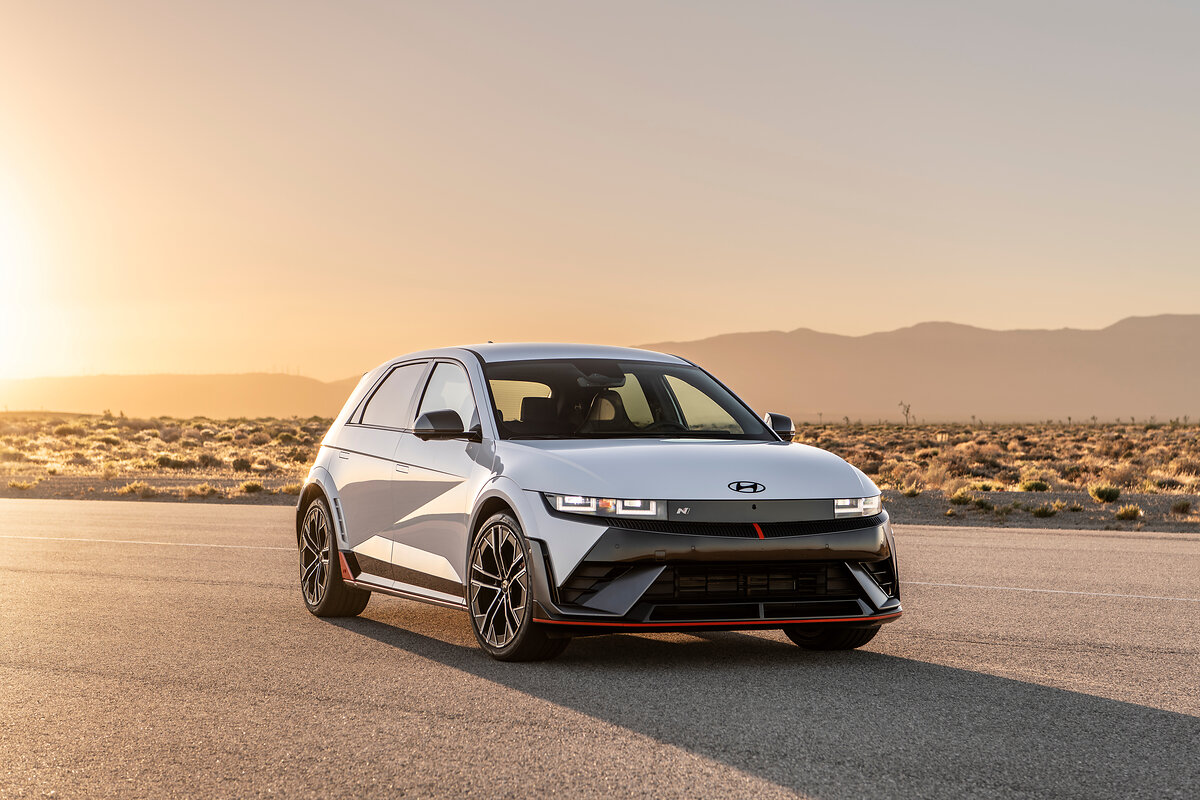
Hyundai IONIQ 5 N vs Tesla Model Y Performance: Which One Wins Now?
Hyundai cut the 2026 IONIQ 5 N by $6,300. Here is how its track-focused hardware, charging and range compare with the Tesla Model Y Performance.
Hyundai has removed the biggest objection hanging over the IONIQ 5 N: its price. The 2026 model starts at $59,900 before destination, a $6,300 reduction that puts this 641-horsepower electric bruiser into a much tighter fight with the Tesla Model Y Performance.
The numbers make them look almost interchangeable. Both have dual-motor all-wheel drive, adaptive suspension, five seats and a manufacturer-claimed 0-60 mph time in the low-three-second range. Their personalities are not interchangeable at all.
Quick Verdict
Buy the Hyundai IONIQ 5 N if you want the more serious performance tool. Its battery conditioning, adjustable torque distribution, track-focused cooling, N Drift Optimizer, simulated gearshifts and 800-volt charging system give an enthusiast more to work with than a quick acceleration number.
Buy the Tesla Model Y Performance if this will be your only vehicle and road trips matter more than track days. Tesla offers 306 miles of EPA-estimated range, more cargo capacity and the most direct Supercharger experience. It is the easier high-performance EV to justify as a family crossover.
Check both live transaction prices before deciding. Hyundai’s $59,900 figure is a published MSRP and excludes a $1,600 destination charge. Tesla changes prices and incentives frequently, so a stale screenshot can distort the comparison by thousands of dollars.
| Specification | Hyundai IONIQ 5 N | Tesla Model Y Performance |
|---|---|---|
| Starting price | $59,900 plus $1,600 destination | Verify current order-page price and fees |
| Drive | Dual-motor all-wheel drive | Dual-motor all-wheel drive |
| Maximum output | 641 hp for 10 seconds with N Grin Boost | Tesla does not publish horsepower on its product page |
| 0-60 mph claim | 3.25 seconds with N Launch Control and N Grin Boost | 3.3 seconds with rollout subtracted |
| EPA-estimated range | 221 miles | 306 miles |
| Fast charging | 10-80% in about 18 minutes on a 350-kW charger | Up to 250 kW; up to 144 miles added in 15 minutes |
| Charge port | Native NACS; CCS adapters included | Native NACS |
| Performance focus | Track battery modes, adjustable drift control, torque distribution and simulated shifts | Adaptive suspension and fast-road focus |
Why Hyundai’s $6,300 Price Cut Matters
Hyundai did not create a lower-output trim or remove the equipment that makes the N special. The company’s July 15 announcement keeps the full performance package and lowers MSRP from the previous model year by $6,300.
That changes the question from whether the IONIQ 5 N is worth a large premium to whether its specialized hardware is more valuable than Tesla’s extra range and everyday efficiency.
The 2026 Hyundai also gets a useful charging update. A native NACS port replaces CCS, opening compatible Tesla Superchargers without a DC adapter. Hyundai includes adapters for CCS charging, plus a dual-amperage Level 1/Level 2 cable. N Drift Optimizer also expands from one setting to 10 selectable stages.
This is the right kind of model-year update: lower price, less charging friction and more control over the feature that tells you exactly how unserious this family-sized hatchback can become on a closed course.
The IONIQ 5 N Is the Driver’s Choice
The Hyundai’s advantage is not simply that it can briefly produce 641 hp. Tesla’s 3.3-second acceleration claim is effectively tied with Hyundai’s 3.25-second claim, and that difference is meaningless away from a prepared launch.
What matters is what happens after the first straight.
Hyundai built the N around repeatability and adjustability. N Battery Preconditioning has drag and track settings. N Race can prioritize a short burst of maximum power or manage temperature for longer sessions. N Torque Distribution lets the driver adjust front-to-rear balance, while the revised N Drift Optimizer offers 10 levels of assistance.
Then there are N e-Shift and N Active Sound+. The simulated eight-speed shifts deliberately interrupt the smooth surge that defines most EVs. That is less efficient and slower in theory, but the point is communication and involvement. Drivers can feel and hear where they are in the car’s power delivery instead of watching a speed readout climb in silence.
Nobody needs fake gears in an EV. That is precisely why they are interesting: Hyundai spent engineering time on emotion after completing the serious work on cooling, brakes, suspension and power management.
The Model Y Performance Is the Better Everyday EV
Tesla’s answer is more pragmatic. Its official Model Y specification page lists 306 miles of EPA-estimated range, 76 cubic feet of maximum cargo space, adaptive suspension, 21-inch wheels and up to 250-kW Supercharging.
That 85-mile range advantage is substantial. It creates more winter margin, fewer charging stops and more flexibility when the best charger is not exactly where the battery wants it. A buyer who takes long highway trips every month may get more real value from that range than from every adjustable N mode combined.
The latest Model Y Performance also leans harder into daily usability than the previous version. Tesla’s public specifications emphasize adaptive suspension and straight-line speed, while independent instrumented testing has described it as a more rounded fast crossover rather than a track-day special.
That distinction should guide the purchase. The Tesla is not slow, soft or ordinary. It is simply optimized around being a Model Y first and a performance derivative second. The Hyundai reverses those priorities.
Charging: One Has the Faster Session, the Other Has the Easier Network
The IONIQ 5 N uses Hyundai’s 800-volt E-GMP architecture. Hyundai says it can charge from 10 to 80 percent in approximately 18 minutes on a compatible 350-kW charger. That is excellent performance, especially because a percentage-based claim describes a useful charging window instead of one brief peak.
Tesla describes the Model Y Performance differently: a 250-kW maximum and up to 144 miles added in 15 minutes under its stated conditions. The Tesla does not match Hyundai’s 800-volt headline, but its efficiency means every kilowatt can translate into more road miles.
Both now have native NACS ports. That removes the old connector advantage, but it does not make the experiences identical. Tesla still owns the tightest integration between vehicle, route planner, charger status and payment. Hyundai counters with faster charging on powerful CCS hardware and includes adapters so the new port does not strand owners between standards.
Frequent road-trippers should compare routes, not logos. Look at the exact Superchargers open to Hyundai, the 350-kW CCS options along regular drives, cable reach and winter charger reliability.
Which One Should You Buy?
Choose the IONIQ 5 N if:
- You will use its track battery conditioning, adjustable drive systems or closed-course capability.
- Driver involvement matters enough that simulated shifts and sound feel entertaining rather than gimmicky.
- An 18-minute 10-to-80-percent charging claim is more useful to you than maximum range.
- Hyundai’s new MSRP lands close enough to the Tesla’s live transaction price.
Choose the Model Y Performance if:
- You want 300-plus miles of EPA-estimated range.
- This is the household’s primary road-trip and cargo vehicle.
- Seamless Supercharger routing and payment matter more than maximum charging voltage.
- You prefer a fast, efficient crossover with fewer track-specific layers to configure.
The IONIQ 5 N is the more exciting answer because it treats performance as a discipline rather than a trim badge. The Model Y Performance is the more rational answer because it sacrifices less of what makes a normal EV useful.
Hyundai’s price cut does not produce one universal winner. It finally makes the enthusiast’s choice financially defensible.
FAQ
Should I buy the Hyundai IONIQ 5 N or Tesla Model Y Performance?
Choose the IONIQ 5 N for track capability, adjustable driving modes and fast 800-volt charging. Choose the Model Y Performance for longer range, more cargo space and the simplest road-trip charging experience.
How much cheaper is the 2026 Hyundai IONIQ 5 N?
Hyundai reduced the 2026 IONIQ 5 N MSRP by $6,300 compared with the previous model year. It now starts at $59,900 before a $1,600 destination charge in the United States.
Does the 2026 Hyundai IONIQ 5 N have a NACS charging port?
Yes. Hyundai replaced the CCS port with NACS for 2026 and includes adapters for CCS AC and DC charging.
Which has more range, IONIQ 5 N or Model Y Performance?
The Tesla Model Y Performance has the higher EPA estimate at 306 miles, versus 221 miles for the 2026 Hyundai IONIQ 5 N.
Sources
- Hyundai Motor America: 2026 IONIQ 5 N pricing and model-year changes
- Hyundai USA: 2026 IONIQ 5 N specifications
- Tesla: Model Y Performance specifications