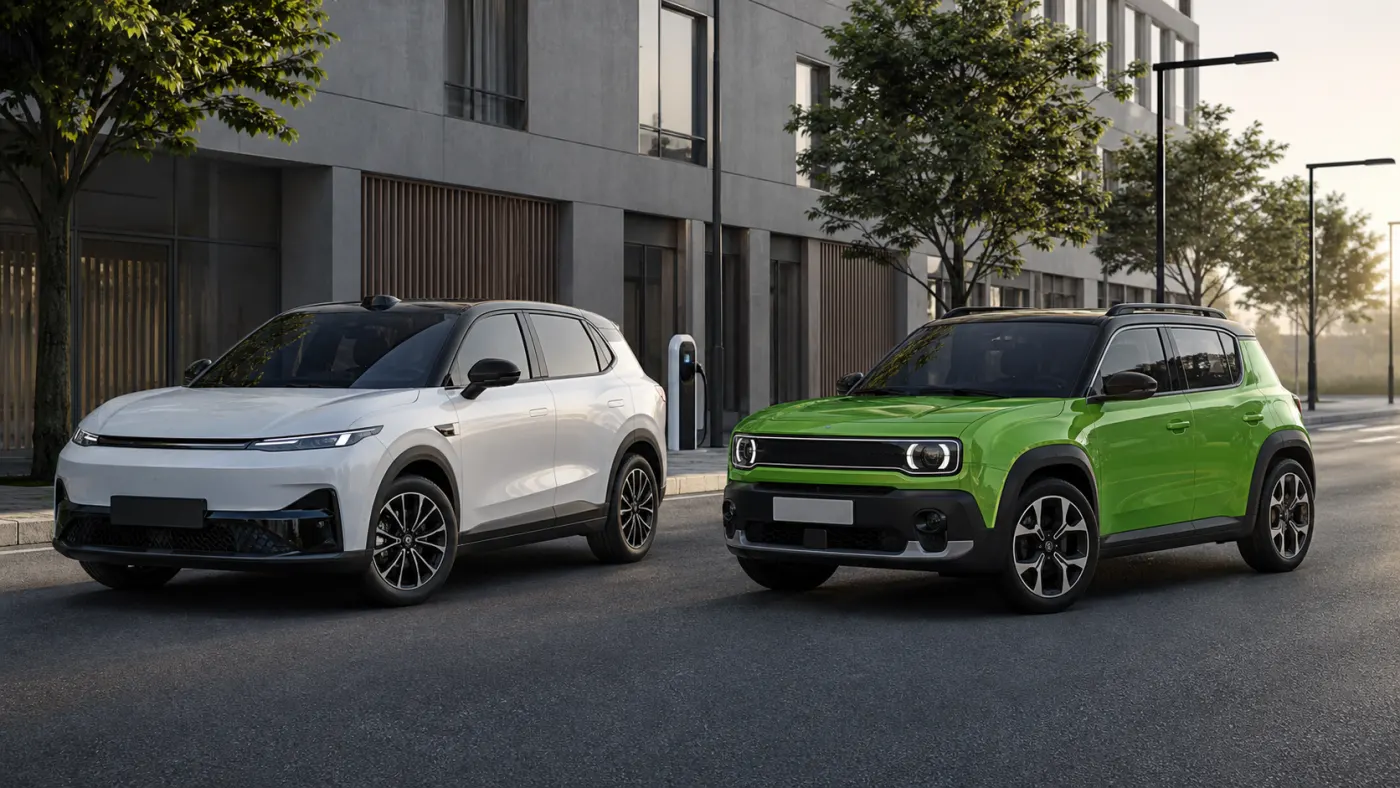
Leapmotor B03X vs Renault 4: Europe's Affordable Electric Crossover Fight
The €24,900 Leapmotor B03X brings 382 km of WLTP range and 197 hp to Europe's small-EV market. Here is how it compares with the Renault 4 E-Tech.
Europe’s affordable-EV market has reached the point where a new €24,900 electric crossover can no longer be dismissed as a stripped-out city car. The Leapmotor B03X is 4.27 metres long, offers up to 382 km of WLTP range, produces 197 hp, and claims a remarkably short fast-charging stop.
That specification puts it in an awkwardly strong position beside the Renault 4 E-Tech Electric. The Renault is shorter, more characterful and already backed by an established European dealer network, but its long-range version offers similar battery capacity with less power and a slower advertised charging session.
The simple verdict is that the B03X looks like the stronger value on paper, especially for buyers who want maximum cabin size and performance for the money. The Renault 4 remains the safer ownership choice for buyers who care about proven local support, mature software, residual values and a model built in Europe.
This is not a road test. It is a specification and market comparison based on the manufacturers’ current European information, and the B03X still needs independent range, charging and quality testing before its price advantage can be treated as the whole story.
Quick Verdict
Choose the Leapmotor B03X if price, interior space, straight-line performance and short advertised DC stops matter most. Its 53-kWh version is the one to buy for mixed use; the 39.8-kWh model is better suited to commuters who can charge at home.
Choose the Renault 4 E-Tech if dealer coverage, familiar controls, European production and ownership confidence matter more than winning every specification row. The 52-kWh, 150-hp version is the better all-rounder for regular motorway travel.
Wait before ordering either if the final B03X price in your country is loaded with delivery fees, the nearest Leapmotor service point is inconvenient, or independent testing shows its charging curve and motorway efficiency fall short of the headline numbers.
| Specification | Leapmotor B03X 53 kWh | Renault 4 E-Tech 52 kWh |
|---|---|---|
| Battery | 53.0 kWh LFP | 52 kWh |
| Maximum WLTP range | 382 km | About 400 km, version-dependent |
| Drive / power | FWD / 197 hp | FWD / 150 hp |
| Torque | 200 Nm | 245 Nm |
| 0-100 km/h | 8.6 seconds | About 8.2 seconds |
| DC charge claim | 30-80% in about 16 min | 15-80% in about 30 min |
| Length | 4,270 mm | 4,144 mm |
| Wheelbase | 2,605 mm | 2,624 mm |
| Starting-price context | B03X range from €24,900 | Varies by market, trim and incentive |
The B03X Is Bigger Than Its Price Suggests
Leapmotor calls the B03X an urban crossover, but its dimensions stretch that label. At 4,270 mm long, 1,810 mm wide and 1,635 mm tall, it is 126 mm longer and 63 mm taller than the Renault 4. The Renault counters with a 19-mm longer wheelbase despite its shorter body, which should help it use cabin space efficiently.
The B03X’s extra body length should benefit rear-seat and luggage room, although Leapmotor has not published every European cargo measurement needed for a clean comparison. Renault lists 420 litres of minimum boot volume for the 4 E-Tech in the UK specification, along with a low loading lip and a front passenger seat that can fold flat on some versions.
For dense cities, the Renault’s shorter body is an actual advantage. A 12.6-cm difference is noticeable when parallel parking or fitting into an older garage. The B03X is still compact by crossover standards, but it is closer to a small family SUV than a tiny city EV.
The design choice is subjective. Renault has turned the original 4’s upright shape into a modern retro crossover with distinctive lighting and useful roof rails. The B03X is smoother and more anonymous. Some buyers will prefer its cleaner, less nostalgic look; others will see the Renault as the car with a stronger identity and likely better recognition at resale time.
Leapmotor Wins The Battery-Choice Argument
The B03X offers two lithium-iron-phosphate battery packs. The 39.8-kWh version is rated at up to 292 km WLTP, while the 53-kWh version reaches 382 km. LFP chemistry generally offers useful durability and cost advantages, although cold-weather performance and energy density remain important real-world questions.
Renault also divides the 4 range between urban and comfort batteries. The long-range 52-kWh version reaches roughly 400 km WLTP, depending on the exact trim and market specification. That gives it a modest laboratory advantage over the larger B03X pack, while the Renault’s lower roof and narrower body may help at sustained motorway speeds.
Neither WLTP figure is a promise. Winter temperature, rain, wind, speed, wheel choice and cabin heating can all cut range. A buyer expecting frequent cold-weather motorway travel should treat both figures as comparison tools, then leave a healthy buffer for actual route planning.
The B03X’s smaller battery is the more interesting value play. A 292-km rating is enough for urban and suburban routines when home charging is available, and carrying less battery than needed can reduce cost and material use. It becomes a poor bargain if the driver regularly depends on public rapid charging or needs a large winter range reserve.
Charging Could Be The B03X’s Knockout Specification
Leapmotor says both B03X batteries use 2.5C fast-charging capability and can move from 30 to 80 percent in approximately 16 minutes. That is unusually quick for an affordable small EV.
Renault quotes around 30 minutes from 15 to 80 percent for the 52-kWh Renault 4 on a 100-kW DC charger. The Renault adds more energy because its session starts at a lower state of charge, so the two times are not directly comparable. Even with that caveat, the B03X claim suggests a stronger peak rate and potentially a more aggressive charging curve.
The key word is claim. A useful charging curve must hold meaningful power through the middle of the pack, work after sustained motorway driving, and remain repeatable in cool weather. Independent tests will need to establish whether the production B03X can deliver that 16-minute figure consistently.
Renault’s system is less spectacular but easier to understand. The 52-kWh model supports up to 100-kW DC charging and an 11-kW AC onboard charger. It also offers route planning through Google-based OpenR Link on equipped versions, battery preconditioning, and bidirectional functions in supported markets and configurations.
Leapmotor’s official B03X announcement highlights smartphone integration, remote control and Leap OS 4.0, but country-level equipment lists will matter. A low entry price loses some of its appeal if heat-pump hardware, navigation-based battery preconditioning or common driver-assistance features require a costly trim upgrade.
The Power Numbers Do Not Tell The Whole Story
The B03X uses a front-mounted motor producing 197 hp and 200 Nm. Leapmotor claims zero to 100 km/h in 8.6 seconds and a top speed of 160 km/h.
The long-range Renault 4 makes 150 hp and 245 Nm, with zero to 100 km/h taking about 8.2 seconds. The Renault is down 47 hp yet slightly quicker on the published numbers, likely reflecting its torque delivery, gearing, mass and calibration.
Neither is a performance EV, and that is appropriate. Predictable low-speed response, ride quality, steering, brake blending and traction on wet roads will matter far more than a few tenths in a sprint. Renault’s multi-link rear suspension and well-developed AmpR Small platform are meaningful advantages on paper, but the B03X needs a proper European road test before its dynamic trade-offs are clear.
Price Is The Headline, Support Is The Fine Print
Leapmotor says B03X orders opened at European dealerships in early July with a starting list price of €24,900. The range is structured around Life and Design trims and the two battery sizes.
That number is compelling, but European EV pricing is messy. Incentives, battery sourcing rules, dealer contributions, registration fees and finance offers can change the apparent gap between two cars. Renault’s advertised prices can include country-specific support, while a B03X base price may not represent the larger battery or the equipment most buyers want.
Compare total prices for equivalent specifications: battery size, heat pump, charging cables, driver assistance, warranty, delivery fee and financing cost. A monthly payment with a large final balloon is not the same thing as a lower vehicle price.
Service access deserves equal weight. Leapmotor International is a Stellantis-controlled joint venture, giving the Chinese brand a much faster route into European retail and repair networks than an independent startup would have. That reduces risk, but it does not instantly create the parts supply, technician experience or used-car demand of Renault.
Renault builds the 4 E-Tech in northern France and has decades of dealer relationships across Europe. For a buyer who keeps a car for several years, that support may justify paying more even when the B03X is stronger on battery and power specifications.
What This Fight Means Beyond Europe
The B03X shows how quickly the definition of an affordable EV is improving. A low-cost electric car no longer has to mean a 25-kWh battery, slow charging and a cramped cabin. It can be a family-sized crossover with two battery choices and enough claimed charging performance for road trips.
That pressure is good for buyers. Renault, Volkswagen, Stellantis and other European manufacturers must compete on usable range and charging, not just heritage or local production. Chinese brands, meanwhile, have to prove that aggressive specifications translate into quality, software stability, repairability and durable resale values.
Canadian shoppers should watch the contest without assuming either model is coming here. Leapmotor describes the B03X as a global vehicle, but no Canadian launch, price or timeline has been announced. Renault does not currently sell passenger vehicles in Canada. The relevance is strategic: affordable-EV technology is moving faster in markets where several manufacturers are fighting around the €25,000-to-€35,000 band.
The B03X wins this paper comparison on value and charging ambition. The Renault 4 wins on ownership confidence and established-market fit. If independent testing validates Leapmotor’s range and 16-minute charging claim, Europe’s familiar brands will have to respond with more than a better badge.
FAQ
Is the Leapmotor B03X cheaper than the Renault 4 E-Tech?
Leapmotor has announced a €24,900 starting list price for the B03X in Europe. Renault 4 pricing varies by country, trim, battery and incentive. Compare written, like-for-like quotes because advertised prices may include different government or dealer support.
Which has more range, the Leapmotor B03X or Renault 4 E-Tech?
The 52-kWh Renault 4 is rated at up to roughly 400 km WLTP depending on version, while the 53-kWh B03X is rated at 382 km. The 39.8-kWh B03X has a 292-km rating.
Which charges faster, the Leapmotor B03X or Renault 4 E-Tech?
Leapmotor claims a 30-to-80-percent B03X charge in about 16 minutes. Renault quotes about 30 minutes from 15 to 80 percent for the 52-kWh Renault 4. Because the starting percentages differ, the figures are not directly equivalent, and the B03X claim still needs independent validation.
Is the Leapmotor B03X coming to Canada?
Not at this point. Leapmotor calls it a global model, but the company has not announced Canadian sales, pricing or timing. Renault also does not currently sell passenger vehicles in Canada.
Sources
- Leapmotor B03X European order-opening announcement
- Renault 4 E-Tech Electric specifications
- Renault electric-vehicle charging times