Toyota Hilux BEV Explained: The Electric Truck That Knows Its Limits
Toyota's first electric Hilux uses a 59.2-kWh battery, permanent AWD, 257 km of WLTP range, and real off-road hardware. That restraint is the point.
Toyota’s first electric Hilux is not trying to win the electric-pickup spec war.
That is what makes it interesting.
The all-new ninth-generation Toyota Hilux now includes a battery-electric version, a 2.8-litre diesel mild hybrid, conventional diesel and petrol options for some Eastern European markets, and a hydrogen fuel cell version planned for 2028. Toyota calls that its multipath strategy. In plain language, it means Toyota still does not believe one powertrain can cover every truck job.
The Hilux BEV proves the point. It has permanent AWD, real off-road hardware, a frame-mounted battery, and the same 700 mm wading depth Toyota quotes for the other new Hilux models. But it also has a modest 59.2-kWh battery, up to 257 km of WLTP combined range, 1,600 kg of towing capacity, and 710 to 715 kg of payload.
Those numbers will not scare a Chevrolet Silverado EV, Rivian R1T, or Tesla Cybertruck. They are not supposed to.
Quick Verdict
The Hilux BEV is best understood as an electric work truck for short, repeatable, high-confidence duty cycles, not as a long-range lifestyle pickup.
That makes it less glamorous than the big-battery electric trucks North Americans tend to talk about, but arguably more honest. Toyota is aiming at single-location operations such as forestry, industrial complexes, airports, ferry terminals, infrastructure sites, and small-business use where the truck returns to base and can charge predictably.
For Canadian and American buyers, there is an obvious catch: Toyota has not turned the Hilux into a North American pickup. This is still a global-market Hilux story, not a Tacoma EV launch. But the engineering lesson matters here because the next affordable electric trucks need exactly this kind of discipline: match the battery to the job, protect the hardware, and stop pretending every EV pickup has to tow a giant trailer across a continent.
The Hilux BEV Spec Snapshot
| Item | Toyota Hilux BEV | Why It Matters |
|---|---|---|
| Battery | 59.2-kWh water-cooled lithium-ion battery mounted within the frame | Smaller than full-size EV truck packs, which helps cost and weight but limits long-distance range |
| Drive system | Permanent AWD with front and rear eAxles | Gives Toyota precise torque control without a conventional transfer-case layout |
| Motor output | 80 kW and 205 Nm at the front, 128 kW and 268 Nm at the rear | The emphasis is traction and control, not drag-strip numbers |
| Range | Up to 257 km WLTP combined; up to 380 km city cycle | Enough for local fleets and site work, not a road-trip towing substitute |
| Charging | 10 to 80 percent DC fast charging in about 30 minutes with a 125-kW or higher CCS2 charger; 10 to 100 percent AC charging in about 6.5 hours at up to 10 kW | Depot or overnight charging is the natural fit |
| Payload and towing | 710 to 715 kg payload; up to 1,600 kg towing | Useful, but clearly below the diesel mild-hybrid Hilux for heavy work |
| Off-road hardware | 29-degree approach angle, 24-degree departure angle, 212 mm ground clearance, 700 mm wading depth, and BEV-specific Multi-Terrain Select | Toyota kept the Hilux identity instead of turning it into a soft electric crossover |
Why Toyota Kept The Battery Modest
A 59.2-kWh battery sounds small because the electric-truck conversation has been distorted by massive packs.
Full-size EV pickups often need enormous batteries because they are big, powerful, heavy, and expected to handle highway range, passenger comfort, cold weather, accessories, and occasional towing. That can make them impressive, but it also makes them expensive. It is one reason electric pickups have struggled to become affordable mainstream tools instead of high-priced statements.
Toyota’s answer is different. The Hilux BEV is aimed at users who can define the job before they buy the truck. If the route is short, the site is controlled, and the truck comes back to base, a smaller battery can make sense. It lowers mass, reduces cell cost, and avoids turning the vehicle into a six-figure battery hauler.
That does not make the trade-off disappear. A 257 km WLTP combined rating is not generous, and real-world range will depend on payload, terrain, weather, tires, speed, accessories, and how much time the truck spends off-road. Add a trailer and the use case narrows quickly.
But that is exactly why the Hilux BEV feels more credible than a vague “electric truck for everyone” promise. Toyota is effectively saying: use it where it fits.
Official Toyota Hilux BEV gallery: exterior, road use, and utility details
13
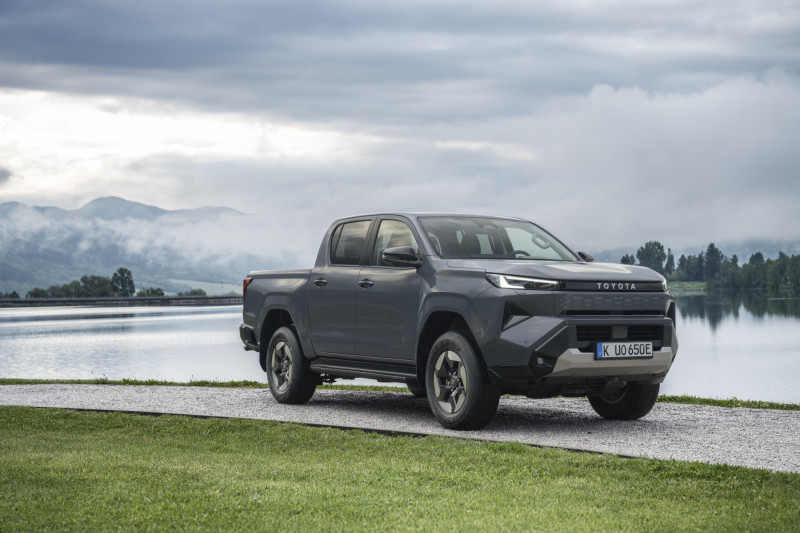
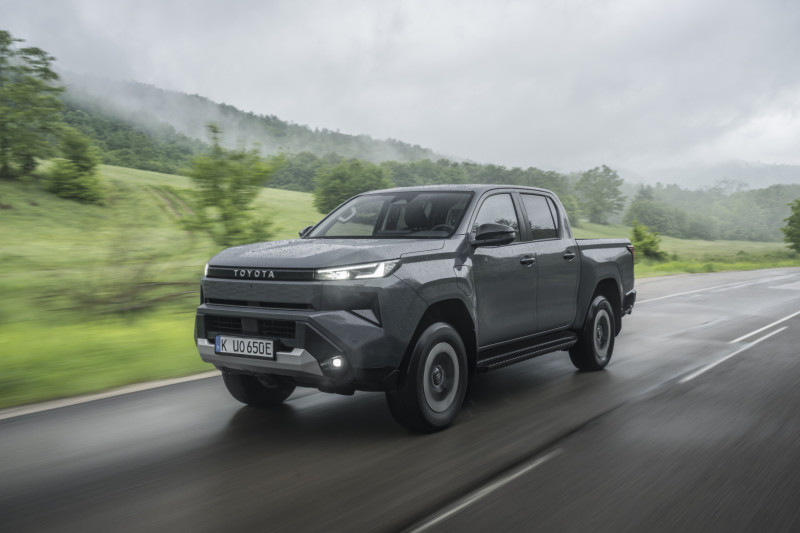
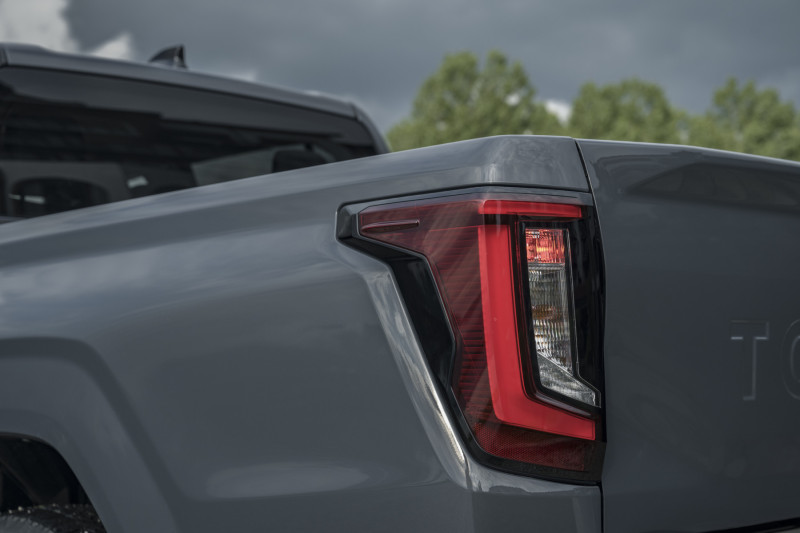
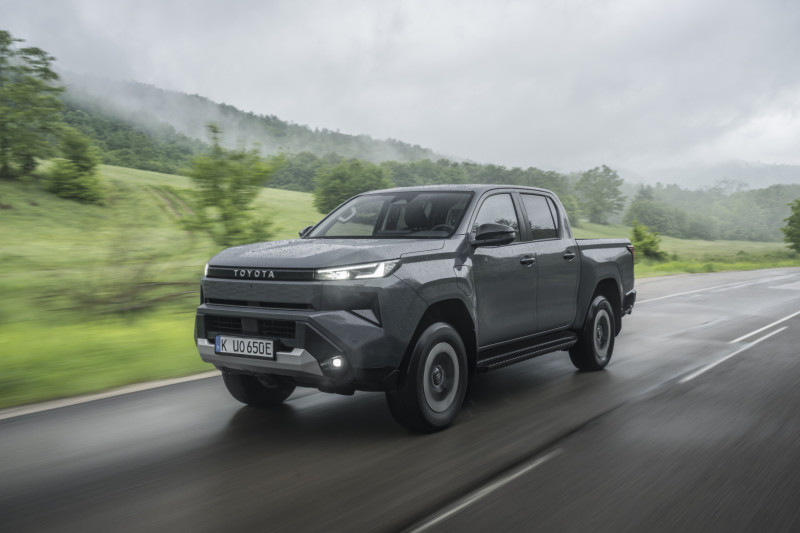
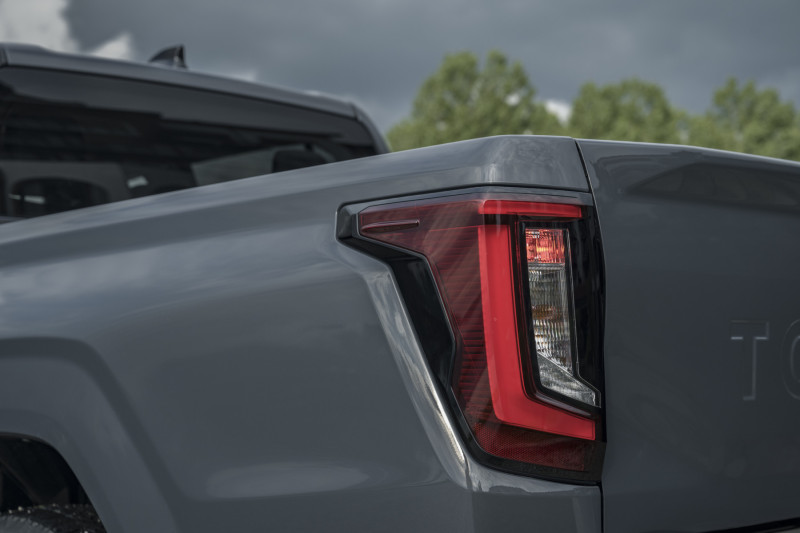
The Hilux BEV keeps the double-cab pickup format, but swaps the grille-heavy front end for a cleaner electric face. Image: Toyota.
The Off-Road Details Matter
The best part of the Hilux BEV is that Toyota did not just drop electric motors into a pickup shell and call it rugged.
The battery is mounted within the frame and protected by a dedicated structure. Toyota says it designed flexibility into the frame and used a battery sub-frame to avoid sending damaging torsional forces into the pack during rough off-road use. The eAxles also get protective undercovers, and the battery sits low enough to help stability without intruding into the cabin or load area.
There is also a BEV-specific version of Multi-Terrain Select. Instead of relying on a traditional low range, the system uses torque and braking control to help the truck work through rock, sand, mud, dirt, and mogul settings. That last mode is notable because Toyota says it is a first for one of its BEVs.
The numbers still show compromise. Ground clearance drops to 212 mm because of the battery under the floor, while the diesel mild-hybrid Hilux is listed with 309 mm. Break-over angle also takes a hit. But approach and departure angles remain 29 degrees and 24 degrees, and the 700 mm wading figure is a serious statement for an EV work truck.
Where It Fits Against Bigger EV Trucks
The Hilux BEV is not a rival to the biggest North American electric pickups. It is closer to a proof of concept for the truck market’s next phase: smaller battery, clearer job, lower drama.
That puts it in the same philosophical conversation as Ford’s future affordable EV pickup and the Slate Truck, even though the vehicles themselves are very different. Ford is trying to make a mainstream low-cost electric pickup work at scale. Slate is stripping the truck idea down to a simple two-seat EV utility vehicle. Toyota is taking the proven Hilux formula and electrifying it only far enough to suit specific users.
Those are healthier ideas than pretending every electric truck needs 800 km of range, sports-car acceleration, luxury trim, and huge towing claims.
MotorLinks covered that affordability fight in our Ford vs Slate cheap EV truck comparison. The Hilux adds a third lesson: restraint can be a feature if the job is honest.
The Canadian Angle
Canadian buyers should not read this as a hidden Tacoma EV announcement.
The Hilux is not Toyota Canada’s pickup, and Toyota has not announced a Canadian Hilux BEV launch. Canada also has different truck expectations, safety regulations, charging conditions, winter demands, and dealer realities than the European markets Toyota is addressing with this release.
Still, the Hilux BEV is relevant because Canada has plenty of fleets and work sites where short-route electrification could make sense before long-distance personal truck use does. Municipal yards, campuses, ports, utilities, mining support sites, airport operations, parks departments, and private industrial sites all have more predictable operating patterns than the average pickup owner’s weekend fantasy.
That is where electric trucks may quietly do some of their best work. Not by replacing every diesel in one move, but by taking over the jobs where charging, range, payload, and route planning are controlled enough to make the numbers work.
Bottom Line
The Toyota Hilux BEV is not the electric pickup for someone who wants one truck to tow far, road-trip often, and replace a diesel without compromise.
It is more limited than that, and more interesting because of it.
Toyota built an electric Hilux around a defined job: local work, predictable charging, real off-road toughness, and enough utility for buyers who can live inside its range and towing envelope. That will make it easy to dismiss from a North American spec-sheet perspective. It also makes it one of the more honest electric trucks Toyota could have built.
The EV truck market needs more of that honesty. Huge batteries can solve some problems, but they create others. The Hilux BEV shows another path: start with the work, size the battery around the work, and do not pretend the result is universal.
Is the Toyota Hilux BEV coming to Canada?
Toyota has not announced a Canadian Hilux BEV launch. The Hilux is not part of Toyota Canada’s pickup lineup, so Canadian buyers should treat this as a global-market electric-truck signal rather than a local showroom product.
What is the Toyota Hilux BEV range?
Toyota lists up to 257 km WLTP combined range and up to 380 km on the city cycle. Real-world range will vary with load, terrain, weather, speed, and accessories.
How fast can the Hilux BEV charge?
Toyota says the Hilux BEV can charge from 10 to 80 percent in about 30 minutes on a DC fast charger rated at 125 kW or higher. AC charging from 10 to 100 percent takes about 6.5 hours at up to 10 kW.
Can the Hilux BEV still go off-road?
Yes, within its limits. Toyota lists permanent AWD, BEV-specific Multi-Terrain Select, 29-degree approach and 24-degree departure angles, 700 mm wading depth, and a protected frame-mounted battery. Ground clearance is lower than the diesel mild-hybrid model because of the battery location.