Subaru's In-House EV Delay Makes Its Toyota Tie-Up More Important
Subaru's latest EV reset does not kill its electric lineup, but it changes what buyers should expect from Solterra, Uncharted, Trailseeker, and Getaway.
Photo: Subaru
Subaru’s latest EV reset is easy to read the wrong way.
The headline version is simple: Subaru is delaying the next wave of independently developed EVs after a rough financial year, and U.S. demand is part of the explanation. That sounds like another retreat from battery-electric cars. It is that, partly.
But for shoppers, the more useful takeaway is narrower: Subaru’s current electric lineup now depends even more heavily on the Toyota relationship.
That means the Solterra, Uncharted, Trailseeker, and upcoming Getaway become more important, not less. They are the bridge between Subaru’s first awkward EV attempt and whatever a more Subaru-led electric vehicle eventually becomes.
What Changed This Month
Subaru’s own filings show why the company is being more cautious. In a May 11 forecast revision, Subaru cut its fiscal-year operating-profit forecast from 130 billion yen to 40 billion yen and said it had revised its medium- to long-term outlook for U.S. electrified-vehicle demand. Subaru also said it reassessed recoverability of development assets tied to battery EVs and recognized an impairment loss.
A few days later, Subaru reported a sharper non-consolidated hit. Its May 15 financial notice showed operating income falling from 279.1 billion yen in the prior fiscal year to 1.45 billion yen for the year ended March 31, 2026. Net income swung to a 51.36 billion yen loss, with Subaru citing U.S. tariffs, environmental-credit losses, and BEV-related expenses.
That is the financial backdrop behind the reports that Subaru has pushed back the target for its more independent EV program. Carscoops and Electrek both summarized industry reporting that Subaru’s Oizumi plant, previously tied to future self-developed EVs, is now expected to start with gasoline and hybrid models instead while Subaru rechecks its EV timing.
In other words, Subaru has not stopped selling EVs. It has slowed the part of the plan where Subaru becomes much more independent from Toyota.
The Toyota Link Is Now the Strategy
That distinction matters because Subaru already has EVs arriving in showrooms.
Subaru said in February that it had begun BEV production at the Gunma Yajima Plant, with the Trailseeker as the first global BEV model produced there. Subaru’s own release described the Trailseeker as jointly developed with Toyota and built on a line designed to handle BEVs, gasoline vehicles, and hybrids.
That flexible-production line is now the key detail. Subaru is not trying to outspend bigger automakers on dedicated EV scale. It is trying to keep enough manufacturing and product flexibility to react if U.S. demand, tariffs, incentives, or battery economics move again.
The buyer-facing result is a familiar Subaru compromise. The current EVs are not clean-sheet Subaru-only machines. They are Toyota-linked vehicles with Subaru tuning, Subaru design priorities, Subaru dealer support, and Subaru branding. For some shoppers, that will feel less authentic. For others, it may be the reason the cars exist at all.
Current Subaru EV Buyers Are Not Out of Options
The timing is awkward because Subaru’s EV lineup has finally become more credible.
Subaru of America said its EV family had its best month yet in April 2026, with 2,053 electric vehicles sold as Trailseeker and Uncharted began reaching retailers, according to its April sales report. That is still small beside Forester, Crosstrek, and Outback volume, but it is no longer a one-car footnote.
The shopping logic now looks like this:
- Solterra is the improved, familiar compact EV SUV.
- Uncharted is the smaller, more affordable entry with the strongest range headline.
- Trailseeker is the outdoorsy Subaru-flavored EV that best fits the brand.
- Getaway is the three-row family EV waiting on final price and timing clarity.
That is enough for a real showroom conversation. It also gives Subaru a way to keep EV intenders in the brand while it delays the next, more independent phase.
Subaru's current EV bridge
13
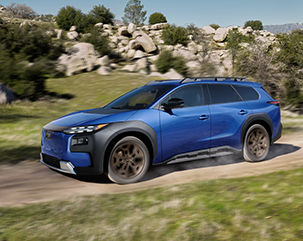
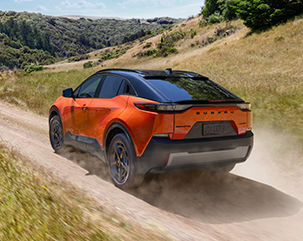
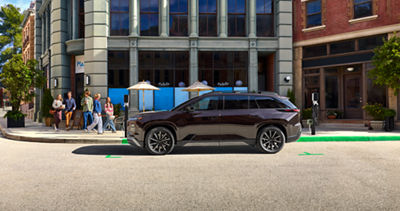
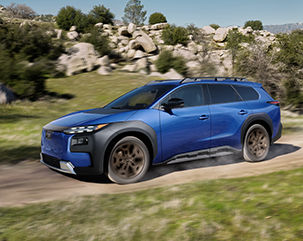
The Trailseeker is the clearest symbol of Subaru's current EV path: Subaru branding and capability layered over a Toyota-linked electric program.
The Risk Is Differentiation
The risk is not that Subaru has no EV story. The risk is that its EV story becomes too dependent on Toyota’s timing.
Subaru’s identity is unusually specific. Its best vehicles usually feel useful in bad weather, easy to live with, slightly outdoorsy, and less image-driven than much of the market. If Subaru can translate that into EVs, there is a real opening. A Trailseeker with credible range, charging, ground clearance, cargo room, and Subaru dealer support makes sense for exactly the sort of buyer who already understands Forester and Outback.
But the more Subaru leans on shared Toyota architectures, the more it has to prove that its versions are meaningfully different. A grille, badge, and marketing theme will not be enough. Subaru needs steering feel, ride tuning, cabin packaging, AWD behavior, roof-rack practicality, snow-and-gravel confidence, and pricing that fit the brand.
That is why this delay matters even if the current EVs keep selling. A Toyota-linked product can be a good Subaru. It just has less room for Subaru to define the rules.
What It Means for Shoppers
For buyers looking now, the delay should not automatically scare anyone away from Subaru’s current EVs. The Solterra, Uncharted, and Trailseeker are active products, and the Getaway remains the one to watch for families who need three rows.
The bigger question is expectations. If you want Subaru’s first truly independent next-generation EV, you may be waiting longer than previously expected. If you want a practical electric Subaru in 2026, the current Toyota-linked lineup is the plan.
That also makes price discipline more important. Without the old federal-credit environment doing as much work, a Subaru EV has to make sense on payment, range, charging access, winter usability, and resale confidence. Buyers should compare real transaction prices against the Chevrolet Equinox EV, Kia EV3, Hyundai IONIQ 5, Toyota bZ, and Tesla Model Y. Canadian shoppers should also check the current Canadian EV incentive guide, because provincial and federal support can change the value equation quickly.
The best Subaru EV buy is probably not the one with the boldest promise. It is the one with enough range, enough charging confidence, and enough Subaru usefulness to justify choosing it over the more established EV players.
The Motorlinks Take
This is not a clean win or a clean retreat. It is Subaru choosing flexibility after a brutal financial hit.
The optimistic read is that Subaru has bought time. It can use Toyota-linked EVs to stay in the market, keep dealers learning, and avoid overcommitting to expensive dedicated EV capacity before demand is clearer.
The skeptical read is that Subaru is falling farther behind on the hardest parts of EV development: battery cost, software, platform efficiency, and manufacturing scale. The longer Subaru waits to define its own EV technology, the harder it gets to stand apart.
For shoppers, the answer is practical. Judge the current Subaru EVs as real cars, not as symbols. If the Uncharted or Trailseeker fits your life and leases or sells at the right number, Subaru’s strategy drama does not make it a bad buy. If you were holding out for Subaru’s self-developed EV breakthrough, this is a signal to keep waiting.