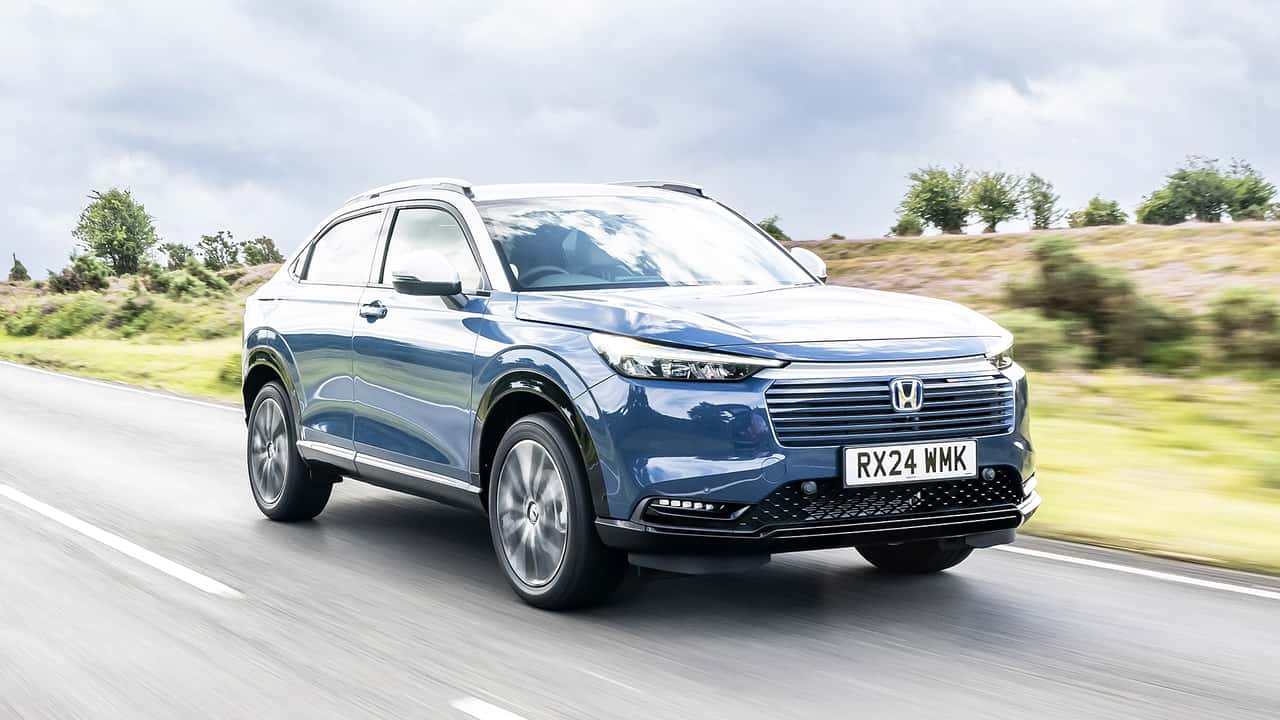
The 2024 Honda HR-V Is Pricier But Still Value Packed
Honda's redesigned subcompact SUV costs more than the model it replaces, but the roomier interior, composed handling, and class-leading cargo flexibility make a strong case for it.
The 2024 Honda HR-V enters its second generation with a higher price tag and a genuinely roomier interior. It’s a different kind of subcompact SUV — one that prioritizes space and refinement over the last word in acceleration. Whether that trade-off makes sense depends on what you need from a small crossover.
What’s New for 2024
Everything. The previous HR-V was a quirky, somewhat cramped thing that leaned on fuel economy and Honda reliability. The 2024 model is a ground-up redesign built on a new platform with a larger footprint and a substantially more spacious cabin. The old 1.8-liter four-cylinder is gone, replaced by a 2.0-liter unit. The exterior styling is bolder, the interior is bigger, and the list of standard safety features has grown considerably.
Pricing and Trims
The 2024 Honda HR-V starts at $26,600 MSRP for the LX FWD trim. All-wheel drive adds $1,500 across the board. The three trims are:
| Trim | Drivetrain | MSRP (approx.) |
|---|---|---|
| LX | FWD | $26,600 |
| LX | AWD | $28,100 |
| Sport | FWD | $28,050 |
| Sport | AWD | $29,550 |
| EX-L | FWD | $30,750 |
| EX-L | AWD | $32,250 |
That’s a meaningful jump from the previous generation’s $21,700 starting price. But the previous HR-V was smaller in every meaningful dimension, and this one competes in a more sophisticated segment.
Design: Mature Without Being Dull
The 2024 HR-V looks like a shrunken CR-V, which is intentional. The design language Honda calls “sporty and sophisticated” works well here — the aesethetic is confident without being shouty. The slimmer LED headlights and the wider grille give it a more mature presence than the outgoing model.
The interior is a genuine highlight. Honda clearly prioritized cabin space in this redesign. The dash is clean and sensibly arranged, with physical controls for the climate system — a relief in an era of everything-via-touchscreen. The EX-L’s leather-trimmed seats and leather-wrapped steering wheel lift the ambiance noticeably compared to the base LX.
Performance: Underpowered But Not Unbearable
Here’s where the HR-V makes its most obvious compromise. The 2.0-liter four-cylinder produces 158 horsepower and 138 lb-ft of torque, channeled through a CVT. For context, the Toyota Corolla Cross makes 169 hp from its 2.0-liter, and the Mazda CX-30 makes 191 hp from its 2.5-liter.
The HR-V feels slow. Not dangerously so — this is a commuter crossover, not a sports sedan — but the lack of power is genuinely noticeable when merging onto a highway or climbing a hill with passengers. The CVT exacerbates the issue: when you ask for power, the transmission holds engine revs in the meat of the power band with an uninspiring rubber-band effect.
That said, the engine is refined at cruising speed. At 70 mph on the highway, the HR-V settles into a quiet, relaxed groove. The CVT’s simulation of gear shifts in Sport mode makes it feel slightly more responsive, though it’s a band-aid on a fundamental limitation.
Fuel economy is competitive: an EPA-rated 26 city / 32 highway / 28 combined mpg for FWD models, dropping to 25 city / 30 highway / 27 combined with AWD. Those numbers are solid for the class and make the HR-V an easy weekend road-trip companion.
Handling: The HR-V’s Secret Weapon
The one area where the HR-V genuinely shines is chassis dynamics. MotorTrend praised its “engaging steering and composed handling,” and the praise is earned. The fully independent suspension (struts up front, multilink rear) does an excellent job of controlling body roll through corners while maintaining a comfortable ride over broken pavement.
The steering is the highlight: it’s weighted nicely and communicates more road feel than most subcompact crossovers. The HR-V isn’t fun in the way a Mazda CX-30 is fun, but it is genuinely pleasant to drive on a curvy road — something you can’t say about every vehicle in this segment.
Braking feel is strong. The brake pedal is firm and progressive, with smooth integration between regenerative and friction braking — a detail many EVs struggle with, and Honda gets right even in this ICE vehicle.
Interior and Cargo: Class-Leading Space
This is the HR-V’s headline feature. The second-row seat offers genuinely generous legroom — Honda claims it’s the most rear-seat spacious in the segment, and the claim is credible. Adults over six feet will find their knees have actual clearance, a rarity in subcompact crossovers.
Cargo space measures 24.4 cubic feet behind the rear seats and 55.1 cubic feet with the second row folded flat. Those figures compete with some compact crossovers, not just subcompact ones. The Magic Seat system — which lets you flip the rear cushion up to create a tall cargo mode — remains a clever Honda touch for carrying bikes or tall items.
The 9-inch touchscreen (standard on Sport and EX-L) runs Honda’s latest infotainment with wireless Apple CarPlay and Android Auto. The base LX makes do with a 7-inch display and wired smartphone integration, which feels like a notable omission at the price.
Safety: Honda Sensing Standard
Every 2024 HR-V comes standard with Honda Sensing, Honda’s suite of driver-assistive features, including:
- Collision Mitigation Braking System (CMBS)
- Road Departure Mitigation (RDM)
- Lane Keeping Assist System (LKAS)
- Adaptive Cruise Control with Low-Speed Follow
The HR-V earned a 5-star overall safety rating from NHTSA and was named a Top Safety Pick+ by the IIHS. That peace of mind is worth something, especially for a vehicle likely to be used for family hauling.
The Competition
The subcompact crossover segment is crowded, and the HR-V’s key rivals are worth understanding:
| Feature | Honda HR-V | Toyota Corolla Cross | Mazda CX-30 |
|---|---|---|---|
| Engine | 2.0L I4, 158 hp | 2.0L I4, 169 hp | 2.5L I4, 191 hp |
| MPG (FWD) | 28 combined | 32 combined | 26 combined |
| Cargo (cu ft) | 24.4 / 55.1 | 21.5 / 54.5 | 20.2 / 47.1 |
| Hybrid option | No | Yes | No |
| Starting MSRP | ~$26,600 | ~$24,000 | ~$24,000 |
The Toyota Corolla Cross offers better fuel economy and a hybrid option, plus a comparable price at the base level. The Mazda CX-30 is the driver’s choice in the segment, with more power and genuinely excellent handling dynamics — though it sacrifices rear seat and cargo space to achieve them.
The HR-V slots in as the best all-rounder: more practical than the CX-30, more powerful than the Corolla Cross hybrid, and with the segment’s best combination of passenger space and cargo flexibility.
The Verdict
The 2024 Honda HR-V is a better vehicle than the model it replaces in almost every way that matters. It’s more spacious, better built, safer, and more pleasant to drive on a winding road. The engine is genuinely underpowered for the class, and the CVT doesn’t do it any favors — those are real flaws.
But here’s the thing about value: it isn’t just about the price on the window. The HR-V delivers more usable interior space than most competitors at this price point, with a cabin that feels a class above and a chassis that rewards a driver who enjoys the act of driving. If you can live with the engine’s limitations — and many buyers in this segment absolutely can — the 2024 HR-V is a well-rounded subcompact crossover that earns its higher price.
For $26,600 to $32,250, Honda isn’t selling the cheapest option in the segment. But it might be selling the best all-around one.
Pros:
- Class-leading rear seat legroom and cargo flexibility
- Composed handling and comfortable ride
- Honda Sensing standard on all trims
- Excellent build quality and interior materials
Cons:
- Underpowered engine for the class
- CVT dulls the driving experience
- No hybrid option (unlike Corolla Cross)
- Base LX lacks wireless smartphone integration
Rating: 7.5/10
The 2024 Honda HR-V is a thoughtful, well-executed subcompact SUV that costs more than before but delivers meaningfully more in return. It’s not the fastest, the most efficient, or the most exciting vehicle in its class. But as a daily driver that happens to be genuinely spacious, well-built, and pleasant to pilot on a back road, it punches above its weight.
Related Articles
- Honda Prologue First Drive: Honda’s First Real Electric SUV Is Impressive
- BMW i5 M60 xDrive Review: The Electric 5-Series Mercedes Should Fear
- Federal EV Tax Credit Expired: What October 2025 Means for U.S. EV Sales