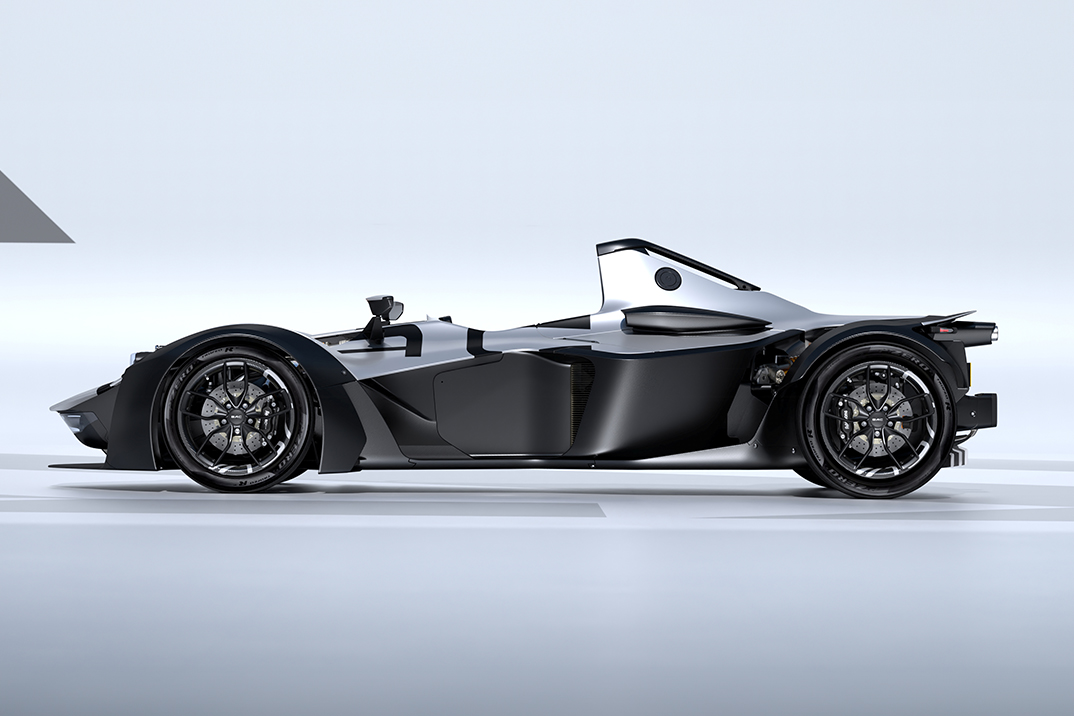
2024 BAC Mono Review: The Blade Gets Sharper
We put the 2024 BAC Mono through its paces — 311 hp, 1,257 lbs, and a whole lot of focus. Here's what makes the world's only road-legal single-seater supercar so compelling.
The BAC Mono is not a car you buy with your head. You buy it with something far less rational — something that makes you reread the price tag and then call your bank anyway. At roughly $185,000 before options, the Mono is a carbon-fiber blade with a Mountune-tuned 2.5-liter four-cylinder mounted behind the driver, routing its 311 hp to the rear wheels through a six-speed sequential gearbox. No roof. No passenger seat. No apologies.
I spent a day at Thunderhill West with the 2024 Mono, and I’m still trying to work out whether I’m grinning because it was fun or because I survived it.
What Is the 2024 BAC Mono?
The Mono is built by Briggs Automotive Company — a small British manufacturer based in Liverpool. It’s been around since 2011, but the 2024 model represents the most significant overhaul in the car’s history. Debuting at Monterey Car Week 2023, the new generation brought a revised carbon-fiber monocoque, updated suspension geometry, an improved aerodynamic package, and a retuned version of its naturally aspirated 2.5L four.
The core philosophy hasn’t changed: absolute driver focus, minimal mass, and maximum feel. At 1,257 lbs (570 kg), it’s lighter than a Mazda MX-5. The engine sits amidships, the driver sits ahead of the rear axle, and the only sound between your helmet and the asphalt is the wail of a high-revving four-cylinder.
Performance Numbers
| Specification | 2024 BAC Mono |
|---|---|
| Engine | 2.5L Inline-4, Naturally Aspirated |
| Output | 311 hp @ 7,500 rpm |
| Torque | 231 lb-ft @ 5,500 rpm |
| Transmission | 6-Speed Sequential |
| Weight | 1,257 lbs (570 kg) |
| 0-60 mph | ~2.8 seconds |
| Top Speed | 170 mph (claimed) |
| Drivetrain | RWD |
The numbers don’t tell the whole story. A 0-60 time of sub-3 seconds is genuinely quick, but the Mono’s party trick isn’t straight-line velocity — it’s the way it dismantles a corner. The weight distribution, the carbon ceramic brakes, the sticky Pirelli P Zero Trofeo R tires (spec on the 2024 model) — everything is tuned for apex exit, not headline figures.
On Track: Thunderhill West
Pulling out of the pit lane, the Mono immediately demands your attention. The seating position is extreme — you sit incredibly low, hips below the sill, knees bent sharply. The visibility is genuinely excellent by single-seater standards; the windshield frames the track like a visor. But the first corner arrives fast, and you realize the Mono isn’t waiting for you to warm up.
The steering is immediacy itself. No power assistance, no insulation, just a direct mechanical link from your palms to the front contact patches. Turn-in response is telepathic. The front end bites, rotates, and the rear follows with the precision of something bolted together rather than assembled. The sequential ‘box is satisfyingly mechanical — full-throttle upshifts snap home with a violence that never gets old, and the auto-blip on downshifts keeps the revs matched perfectly.
What strikes you most is the brakes. The carbon ceramic discs (6-piston front, 4-piston rear) have remarkable feel and huge reserves of retardation. You brake later than seems possible, and they don’t fade even after session after session. The pedal is firm, responsive, and communicates exactly how much grip is available at the front end.
Engine and Sound
The 2.5L Mountune-tuned four is a gem. Peak power arrives at 7,500 rpm, and the redline sits at 8,300. The torque curve is relatively flat from 4,000 to 7,500, so you’re always in the meat of the rev range. The sound is pure racing — a hard, metallic wail that’s part motorcycle, part Formula 4 car. There’s no bass rumble, no low-end shove; this is a high-revving screamer that rewards keeping it pinned.
On the road — yes, it is road-legal — the Mono is surprisingly docile. The low-speed throttle mapping is smooth, the clutch take-up is progressive, and the ride quality, while firm, is far more bearable than you’d expect. It idles cleanly, doesn’t stall, and can trickle through traffic. But the moment you find a clear road or a track entry, all pretense of normality evaporates.
Cabin and Equipment
There is no infotainment system. There is no climate control. There is a digital dash display that shows speed, revs, gear position, and a handful of warning lights. That’s it.
What the Mono does have is a fully adjustable steering column, a weight-optimized carbon-fiber dashboard, and an Alcantara steering wheel with a built-in OLED display. The optional carbon hybrid wheels — a $15,000 upgrade — save 23% of unsprung mass across both axles and make a measurable difference in ride quality and steering response.
The build quality is exceptional for a car produced in tiny numbers. Every surface you touch is either carbon fiber, alcantara, or machined aluminum. There’s a neatness to it that speaks to genuine craftsmanship, not just lightweighting for its own sake.
Aerodynamics and Downforce
The 2024 Mono generates meaningful downforce without the drama of a GT3 car’s massive wing. The rear wing is integrated cleanly into the bodywork, and the underfloor diffuser works in concert with the front splitter to plant the car at speed. At 100 mph, the downforce is noticeable — the Mono feels more planted at the limit than it does at seven-tenths, which is a rare and beautiful thing.
Price and Options
At approximately $185,000 base, the Mono isn’t cheap. But when you consider what it is — a hand-built, road-legal, single-seater track car with genuine motorsport pedigree — the price starts to look less insane. Option the carbon wheels, the carbon ceramic brakes, the full Alcantara interior, and you could easily see $210,000+. But at that price, you’re getting something that genuinely cannot be compared to anything else on four wheels.