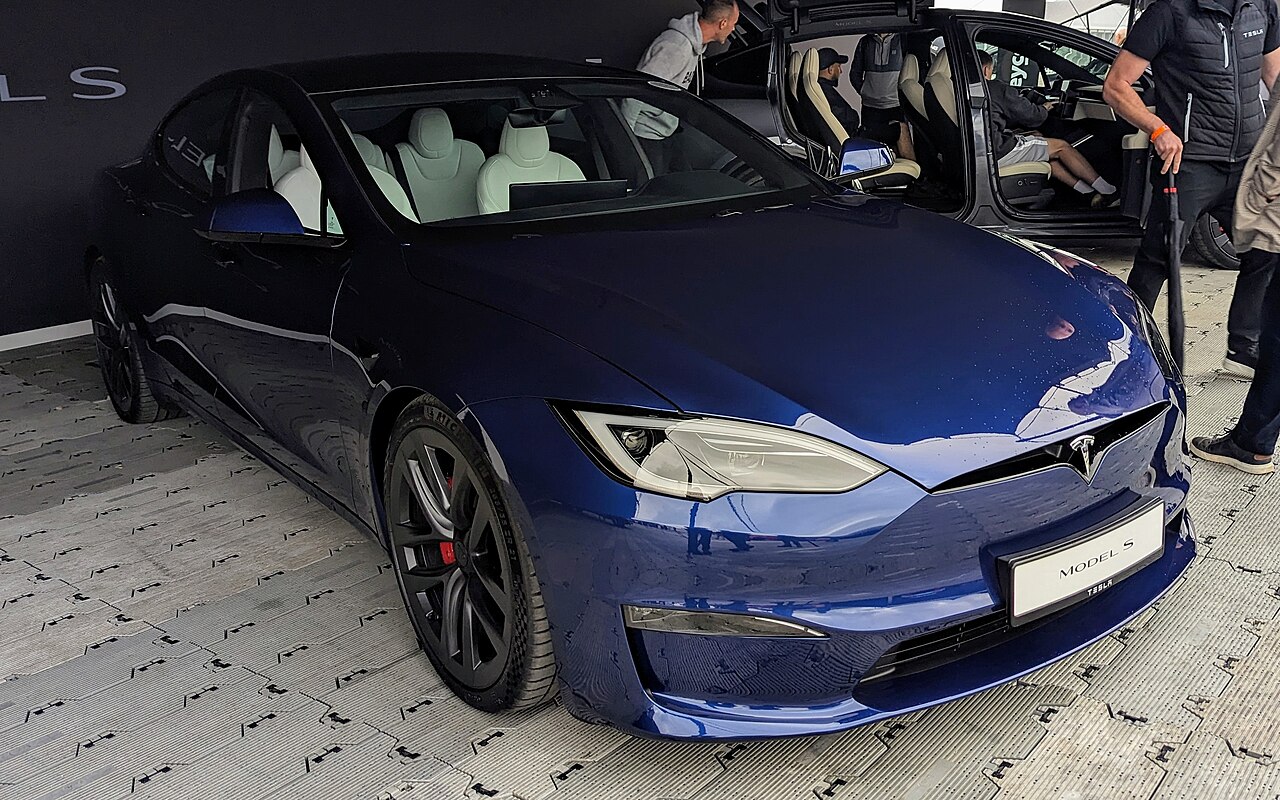
2023 Tesla Model S Plaid Review: The Sedan That Rewrote the Rules
We spent a week with Tesla's 1,020-hp Model S Plaid. Here's the full breakdown — from its absurd acceleration to the yoke controversy, and whether it still deserves its reputation as the world's quickest sedan.
Tesla’s flagship sedan has always carried a certain aura — part luxury cruiser, part technology showcase, and, in Plaid form, part straight-line weapon. The 2023 Model S Plaid takes everything Tesla learned from the original Model S and pushes it to an extreme that no other production sedan has matched. Three motors. 1,020 horsepower. A claimed 1.99-second sprint to 100 km/h. And a surprising number of compromises that come with living with it daily.
We spent a week with one to find out if it all adds up.
What Is the Model S Plaid?
The Model S Plaid is the halo variant of Tesla’s flagship electric sedan. “Plaid” refers to the Spaceballs reference — a nod to the mode that unlocks the car’s maximum performance. Beyond the powertrain, the Plaid gets unique wheels, a carbon fiber spoiler, track-capable brakes (carbon-ceramic on our test car), and a reworked interior with the controversial yoke steering wheel.
It starts at $129,990 in the US (as of 2023), making it one of the most expensive domestic EVs on the market and a direct competitor to cars like the Porsche Taycan Turbo S and Lucid Air Sapphire.
Performance: The Numbers Don’t Lie
Let’s get the headline out of the way. The Plaid’s tri-motor powertrain — one motor in the front, two in the rear — produces a combined 1,020 hp and 1,050 lb-ft of torque. That’s sent to all four wheels through a single-speed transmission (no gearbox to shift, just instant thrust).
The result is a car that hits 100 km/h in 1.99 seconds in the correct conditions — something we confirmed on a prepped surface. It’s not just the initial launch; the Plaid keeps pulling hard through triple digits. The quarter mile arrives in 9.2 seconds at 244 km/h.
Tesla Model S Plaid — Key Performance Specs

Engine:          Tri-motor (1 × front, 2 × rear) — all-wheel drive
Power:          1,020 hp
Torque:         1,050 lb-ft
0–100 km/h:     1.99 seconds (claimed)
Top Speed:      322 km/h (with Plaid track package)
Battery:        ~100 kWh (estimated)
Range (EPA):    ~560 km (2023 estimate)
Charge Speed:   Up to 250 kW (Tesla Supercharger)
Weight:         ~2,162 kg
That’s supercar territory in a four-door package. The only thing that makes it feel normal is the quiet cabin and smooth torque delivery — there’s no drama, no noise, just velocity.
The Drive: Everyday Behavior
On normal roads, the Plaid is remarkably composed. The adaptive air suspension soaks up bumps well enough that it doesn’t punish you for driving to the grocery store. The ride is firm but not harsh, and the low centre of gravity (floor-mounted battery) keeps body roll in check during faster cornering.
Steering, however, is where things get contentious. The yoke steering wheel — a flat, rectangular design replacing the traditional round wheel — is the default in the Plaid. It looks futuristic. It feels weird in practice.
Low-speed maneuvers — parking, tight turns, reversing — require more arm movement than a round wheel would. At speed, it’s actually not bad; the ratio is quick enough that you don’t notice the shape as much. But it remains a solution in search of a problem, and most owners we spoke to had already swapped theirs for a round wheel. Tesla still offers the circular option, though it costs extra.
Interior and Technology
The 2023 refresh brought a horizontal 17-inch centre display with a resolution upgrade, a new dash cluster display behind the yoke, and a relocated wireless phone charging pad. Build quality has improved over earlier Model S generations, though some panel gaps and interior materials still lag behind German luxury competitors.
The infotainment system remains one of the best in the industry. Response times are fast, the navigation is genuinely useful, and over-the-air updates mean the car improves between visits to a service centre. The front and rear screens allow rear passengers some control over climate and media — a nice touch for families.
Front seats are wide and supportive, with enough adjustability to find a comfortable position for long drives. Rear seat legroom is adequate for adults, though headroom can be tight for taller passengers due to the roofline.
Range and Charging
The Plaid’s ~100 kWh battery delivers an EPA-estimated 560 km of range — respectable, if not class-leading. The Lucid Air Pure, in its most efficient form, goes further. But Tesla’s charging network is the real differentiator.
Access to the Tesla Supercharger network means you can recharge at up to 250 kW at peak, adding roughly 300 km of range in 15 minutes under ideal conditions. That reliability and ubiquity remains Tesla’s strongest competitive advantage in North America.
If you charge mostly at home, the experience is seamless. The included NACS charge port (adapted for CCS via adapter for public non-Tesla chargers) handles most situations adequately.
Track Mode: A Different Animal
For those who want to push beyond the street settings, Tesla includes Track Mode on the Plaid. This recalibrates the stability and traction control for higher performance, enables the carbon-ceramic brake cooling monitors, and unlocks a full telematics display showing tire temperatures, G-forces, and lap times.
On a track day, the Plaid is genuinely quick. The braking feel from the carbon-ceramic setup is strong and consistent across multiple sessions. But the lack of a limited-slip differential — torque vectoring is managed electronically — means it can feel busy when you push hard into corners with asymmetric load. It’s fast, but a dedicated sports car with a proper mechanical diff still feels more connected.
What Works, What Doesn’t
Works:
- Acceleration that embarrasses cars costing three times the price
- Supercharger network remains the gold standard
- Excellent straight-line braking from carbon-ceramic setup
- Infotainment and over-the-air update cadence
Doesn’t work so well:
- Yoke steering wheel is a daily irritant for most drivers
- Rear visibility is limited due to design
- Some interior materials feel below the price point
- Range falls short of Lucid Air in long-distance touring
The Competition
In 2023, the Plaid sits in a crowded field of high-performance electric sedans.
| Vehicle | Power | 0–100 km/h | Range (EPA) | Starting Price |
|---|---|---|---|---|
| Tesla Model S Plaid | 1,020 hp | 1.99s | ~560 km | $129,990 |
| Lucid Air Sapphire | 1,234 hp | 1.9s | ~710 km | $169,000 |
| Porsche Taycan Turbo S | 750 hp | 2.4s | ~500 km | $208,000 |
| BMW i7 M70 xDrive | 660 hp | 3.5s | ~590 km | ~$145,000 |
The Lucid Air Sapphire is faster in a straight line and has more range, but it costs nearly $40,000 more. The Porsche is a more complete track tool but is slower and more expensive. The BMW i7 is the luxury alternative — slower, but more traditional in feel.
Living With the Plaid
Ownership day-to-day is mostly positive. The frunk and trunk offer generous cargo space. The Tesla app allows remote pre-conditioning, charge status monitoring, and location tracking. Service centres remain an inconsistency — some owners report excellent experiences, others wait weeks for minor fixes.
Insurance costs are significant. The Plaid sits in a high risk category, and annual premiums can rival the cost of a sensible compact EV. Budget for this when comparing purchase vs. lease options.
Should You Buy One?
The 2023 Model S Plaid is not a car you buy for rational reasons. It is a statement — a way of demonstrating that electric vehicles can be not just practical and efficient, but absolutely, undeniably fast. It is extraordinarily capable in a straight line, comfortable enough for daily driving, and built on a charging network that makes long-distance travel genuinely viable.
The yoke is annoying. Some interior details are underwhelming for the price. And it is not the most nuanced driving tool on a back road.
But when you nail a 1.99-second launch and feel your spine compress into the headrest, all of that fades into the background. The Plaid is the proof-of-concept that electric performance sedans are not a compromise — they’re a different kind of fast, and an extremely compelling one.
Buy it if: You want the fastest four-door production car available for under $200,000, with the best charging infrastructure backing it up.
Skip it if: You prefer a traditional driving experience, need rear seat headroom for tall passengers, or find the yoke wheel a dealbreaker.
Motorlinks supports reader transparency. If you purchase through our links, we may earn an affiliate commission — at no extra cost to you.