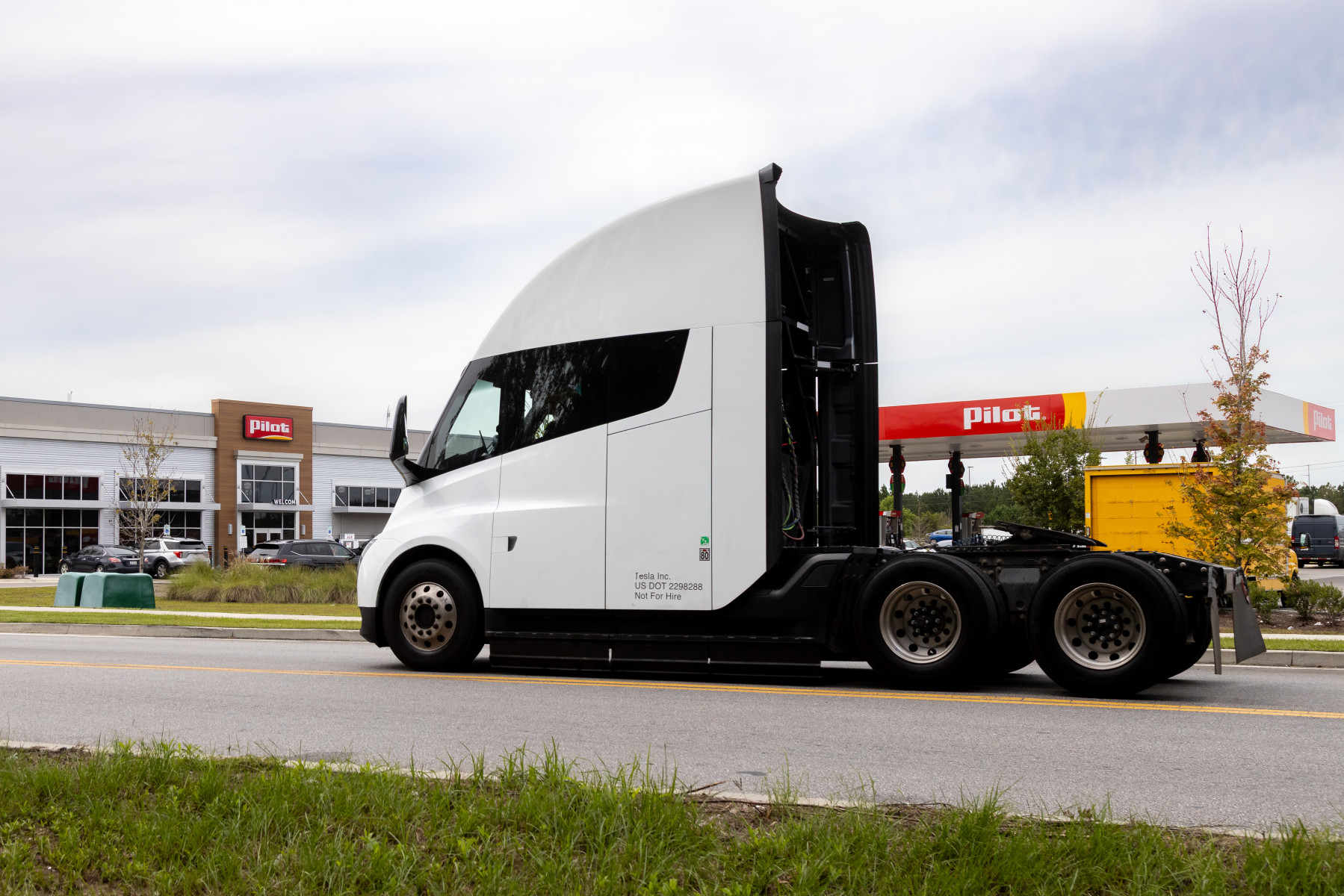
Pilot and Tesla Open First Megacharger Site for Electric Trucks in Georgia
Pilot's first Tesla Megacharger site opens with six stalls in Ellabell, Georgia. Twelve more U.S. heavy-duty charging locations are under construction.
Pilot and Tesla have opened their first joint Megacharger site in Ellabell, Georgia, with six heavy-duty charging stalls. Pilot says 12 additional locations are actively under construction, bringing its electric-truck charging partnership beyond a network announcement and into an operating travel center.
The October 8 announcement from Pilot identifies the open location as Pilot #1390, at 130 Interstate Exchange Way. The rollout is aimed at major U.S. freight corridors, rather than passenger-car charging.
For electric freight, that distinction matters. A truck needs enough charging power, physical space and route coverage to fit its working day; a map full of passenger-car chargers does not solve those problems on its own.
Six Stalls Now, More Sites Under Construction
Pilot names three of the 12 construction locations as nearing completion:
- Tulare, California: Flying J #1071, 979 E. Paige Ave., with an opening scheduled for October 9 in the announcement.
- Fort Stockton, Texas: Flying J #553, 2571 N. Front St.
- North Las Vegas, Nevada: Pilot #341, 3812 E. Craig Road.
The release confirms Ellabell is open. It gives Tulare a scheduled date, not a subsequent opening confirmation; it does not provide firm opening dates for Fort Stockton or North Las Vegas. The 12 sites under construction should not be counted as 12 additional operating locations.
The companies announced the partnership in January 2026. Pilot says the planned network follows I-5, I-10 and other major freight corridors across California, Georgia, Indiana, Nevada and Texas. Those are rollout plans, not evidence that every corridor already has continuous charging coverage.
What the 1.2-Megawatt Claim Means
Pilot says each location will have four to eight high-power stalls using Tesla’s V4 cabinet technology. According to Tesla, as quoted in the release, each stall can deliver up to 1.2 megawatts, or 1,200 kW, allowing a Tesla Semi to recover 60% of charge in 30 minutes.
That is a manufacturer charging claim, not a guarantee for every session. “Up to” describes a peak capability, while the charging rate over a full stop can vary. Nor does a per-stall figure establish that all six Georgia stalls can deliver their maximum power simultaneously; the announcement does not disclose the site’s total available power.
The release also does not specify a starting state of charge or the battery configuration behind the 30-minute claim. It should not be treated as a universal 10–80% charging time, or converted into an EPA or NRCan driving-range figure.
Pilot and Tesla's first Megacharger site
13
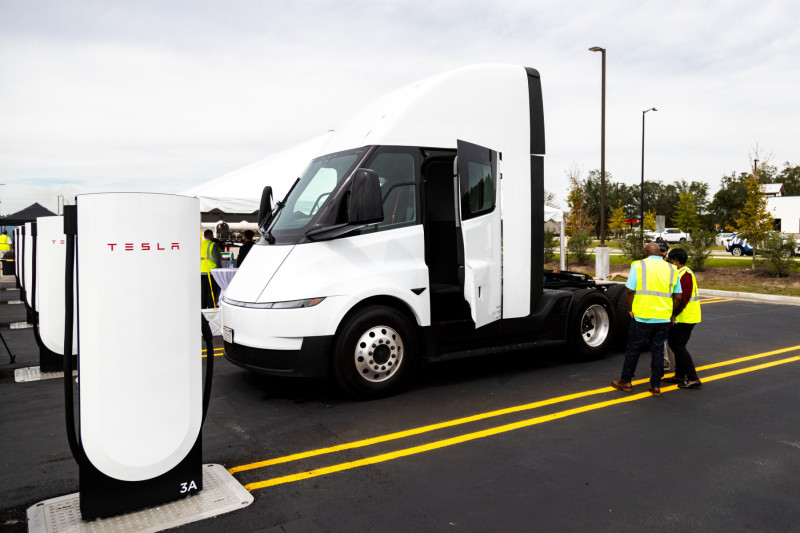
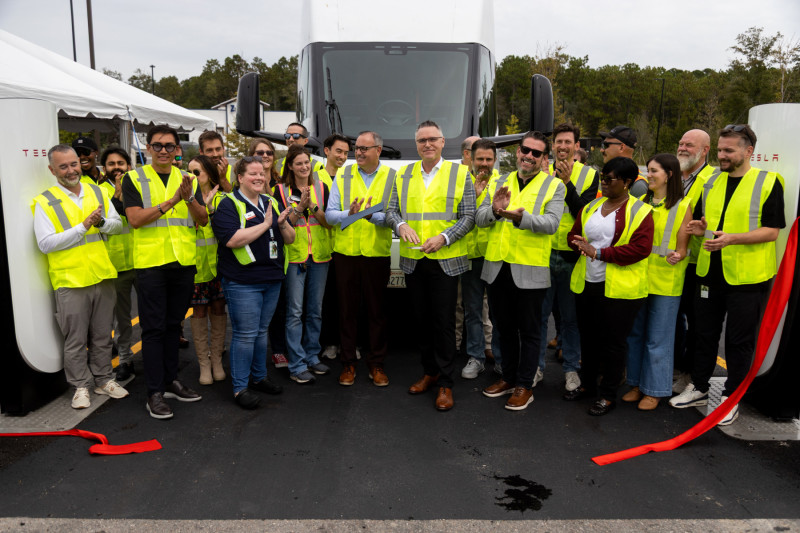
A Tesla Semi beside the truck-focused charging equipment at Pilot's opening event. Photo: Pilot.
This Is Truck Infrastructure, Not Another Supercharger Stop
Megachargers serve the heavy-duty electric-truck rollout. Passenger-EV drivers should not read this announcement as new access for a Model 3, Model Y or another NACS-equipped car. Pilot’s separate passenger-EV charging network is a different part of its infrastructure business.
For fleet operators, the next useful details are access arrangements, energy pricing and dependable coverage along actual routes. Pilot’s release does not publish charging tariffs, reservation terms, independently measured uptime or access rules for other truck brands. Those details will determine how useful a site is beyond its peak-power headline.
The Canadian scope is also clear: the announced Megacharger locations are in the United States. Although Pilot operates travel centers in Canada, this release does not announce a Canadian Megacharger site or opening schedule. Canadian fleets cannot infer domestic coverage from Pilot’s broader North American footprint.
Why This Opening Matters
Depot charging remains a different operating model from charging while travelling a freight corridor. An open truck-focused site at a travel center adds an option beyond returning to base, with the driver’s services and amenities nearby.
The meaningful milestone is six open stalls at a named Georgia location. The next test is whether the construction pipeline becomes a useful network, with sites spaced and operated for the routes electric trucks actually run. Twelve projects under construction are encouraging, but they are not yet twelve places a fleet can rely on.
Photography: Pilot, from its official Megacharger announcement.
Related Articles
- Tesla Semi’s European Specifications Put Range and Charging in Focus
- What Tesla Semi’s European Freight Numbers Mean
- FedEx Orders 2,000 Harbinger Electric Trucks for the U.S. and Canada
Sources
- Pilot: First Megacharger Site Opens, With Three Additional Locations Coming Soon — October 8, 2026; site status, construction locations and Tesla-attributed charging specifications.