Global EV Sales Rise 9% in July as North America Falls 27%
Benchmark Mineral Intelligence says 1.85 million EVs were sold globally in July 2026, but North American sales fell 27% as Europe and emerging markets surged.
Global electric-vehicle sales are growing again, but North America is increasingly the exception.
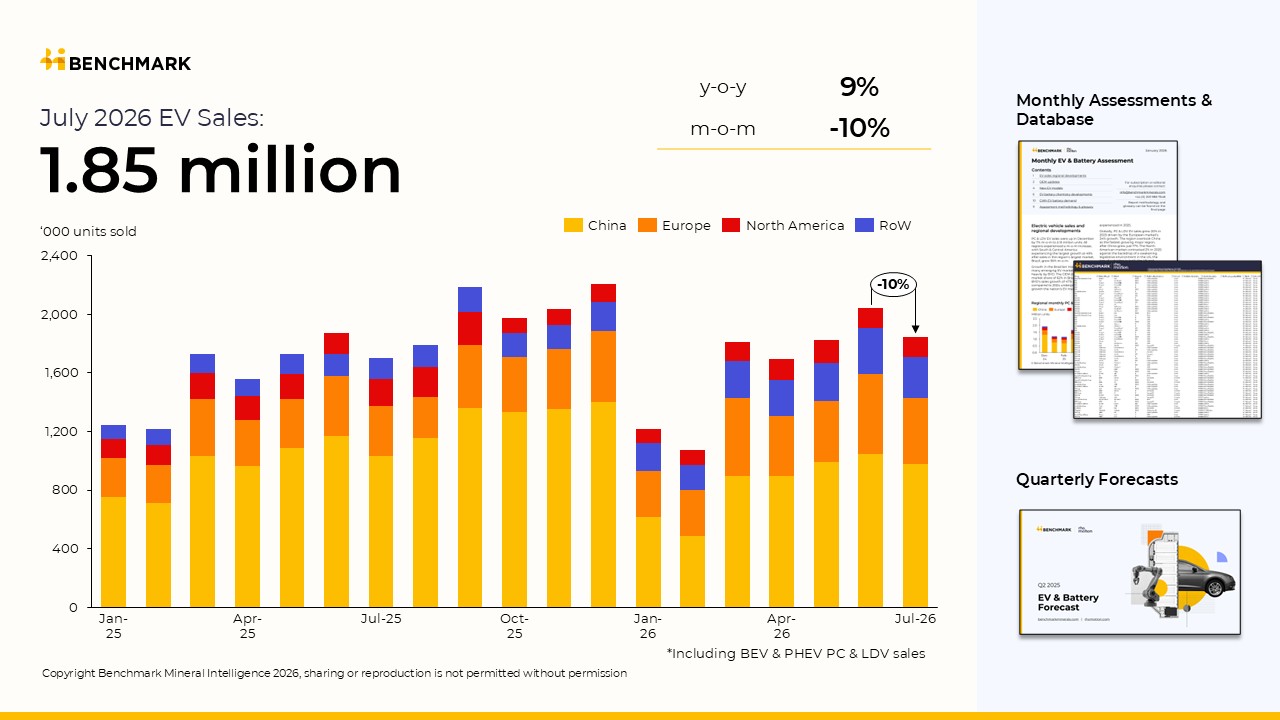
Benchmark Mineral Intelligence says 1.85 million battery-electric and plug-in hybrid vehicles were sold worldwide in July 2026. That was 9% more than in July 2025 and brought the year-to-date total to 11.5 million vehicles, up 4%.
North American sales moved sharply in the other direction. The region recorded about 140,000 EV sales in July, down 27% year over year. Europe grew 33%, while markets outside China, Europe and North America nearly doubled their combined volume.
The result is not a simple referendum on whether buyers want EVs. It is a map of how quickly policy, pricing and product availability can pull major markets apart.
July’s EV Market in One Table
| Region | July sales | Year over year | Month over month | 2026 YTD | YTD change |
|---|---|---|---|---|---|
| China | 0.98 million | -5% | -7% | 5.9 million | -12% |
| Europe | 0.45 million | +33% | -17% | 3.0 million | +28% |
| North America | 0.14 million | -27% | -1% | 0.90 million | -18% |
| Rest of world | 0.28 million | +97% | -11% | 1.7 million | +96% |
| Global | 1.85 million | +9% | -10% | 11.5 million | +4% |
July was down 10% from June globally, but that monthly decline needs context. June is typically a stronger end-of-quarter month, while summer seasonality often softens July registrations in Europe. The year-over-year comparison is the cleaner signal: worldwide plug-in sales are still expanding, and the growth is coming from almost everywhere except North America.
North America’s Recovery Just Hit Another Bump
North American EV sales had shown signs of stabilizing in the second quarter. July interrupted that progress.
Benchmark’s data puts regional sales at 900,000 vehicles through July, down 18% from the same period in 2025. U.S. sales fell by more than 30% year over year during the month, according to the research cited in Electrek’s report.
The comparison is unusually tough. American buyers rushed to complete purchases and leases last summer before the federal EV tax credit ended on September 30, 2025. July 2026 is therefore being measured against a market that was already pulling future demand forward.
That does not explain everything. Carmakers have delayed or cancelled EV programs, affordable choices remain thin, and buyers are being asked to make the numbers work without the old federal support. New models such as the returning Chevrolet Bolt can help, but one lower-priced EV cannot repair the whole market.
Canada is included in Benchmark’s North American total, so the regional figure should not be presented as a Canadian sales result. Still, Canadian buyers face many of the same product-planning pressures. Vehicles delayed for the U.S. are usually delayed here too, and decisions about North American factory capacity shape what reaches Canadian showrooms.
Canada has its own mix of federal and provincial policy, and buyers should check the current Canadian EV incentive and affordability guide rather than assume a U.S. incentive change applies directly north of the border.
Europe Is Building Momentum, Not Just Recovering
Europe delivered the clearest growth among major established EV markets. July sales reached 450,000 vehicles, up 33% from a year earlier. Through the first seven months of 2026, the region is up 28% at 3.0 million sales.
That growth is being supported by a combination North America has not yet matched: renewed purchase incentives in several countries, high fuel costs and a deeper selection of smaller EVs. France’s July plug-in sales rose 81% year over year, while Germany increased 46% and the United Kingdom gained 43%, according to Benchmark’s regional data.
The contrast matters because Europe is not relying only on expensive electric SUVs. Automakers are introducing compact EVs with smaller batteries and prices closer to mainstream gasoline hatchbacks. Those vehicles fit dense cities and shorter average travel distances, but their bigger advantage is financial: they give buyers a path into an EV without paying for 500 kilometres of range they may rarely use.
North America still leans heavily toward crossovers and trucks. That preference is not going away, but it makes affordability harder when every new EV needs a large battery, all-wheel drive and a generous highway-range target to look competitive.
China’s Decline Hides a Shift Toward Full EVs
China remained the largest market by far, with 980,000 plug-in vehicles sold in July. Benchmark’s combined battery-electric and plug-in hybrid total was down 5% year over year, while sales through July were down 12%.
The powertrain split tells a more interesting story. Electrek’s analysis of Chinese market data found battery-electric sales up 6% year over year in July, while plug-in hybrid sales fell 21.1% and extended-range EV sales dropped 16.5%.
In other words, China’s combined plug-in category declined even as fully electric vehicles gained ground. More than 500,000 new-energy vehicles were also exported during the month, another record. China’s domestic slowdown is pushing automakers to compete more aggressively overseas rather than retreat from electrification.
The Fastest Growth Is Happening Outside the Big Three
The most dramatic number in Benchmark’s July report is the 97% increase across the rest of the world. Those markets bought about 280,000 EVs during the month and 1.7 million through July.
No single country explains that gain. It reflects growing demand across parts of Southeast Asia, Latin America, Africa and other developing EV markets where Chinese brands are adding lower-cost models and local distribution. The combined volume is now twice North America’s monthly total.
That gap should get the industry’s attention. North America has more charging infrastructure, higher average vehicle spending and decades of manufacturing scale. Yet faster-growing regions are proving that buyers will adopt EVs when the products and prices fit local needs.
What July’s Numbers Actually Say
The global EV market is not following one curve. Europe is accelerating, China is shifting from plug-in hybrids toward full EVs, emerging markets are expanding rapidly, and North America is still absorbing the loss of incentives and a wave of product-plan changes.
For buyers, soft North American demand can create discounts and more negotiating room. It can also lead automakers to trim choice or postpone future models. The useful question is not whether worldwide EV sales rose 9%; it is whether the specific vehicle, local incentive, home-charging setup and ownership costs work for your household.
For automakers, July is a warning. Global EV demand is moving forward without North America. If local sales are going to rejoin that growth, the market needs more affordable vehicles and a steadier policy environment, not another round of distant promises.