
Ford Energy Makes EV Battery Capacity a Grid-Storage Business
Ford Energy is now detailing a U.S.-assembled 5.45 MWh LFP battery storage block, turning underused EV battery know-how into a grid-scale business.
Photo: Ford
Ford is making its next battery move somewhere most drivers will never park: the grid.
The new Ford Energy site now lays out a utility-scale battery storage business built around U.S.-assembled lithium-iron-phosphate battery systems. The headline product is a standardized 20-foot DC block rated at 5.45 MWh, using 512 Ah LFP prismatic cells, liquid cooling, and 2-hour or 4-hour configurations. Ford says units are planned for availability beginning in late 2027, with projected annual manufacturing capacity of 20 GWh.
That is not a new electric truck or crossover. It still matters for the EV world because it shows how automakers are trying to turn battery manufacturing capacity, supply-chain work, and LFP chemistry into more than vehicle programs. In a market where EV demand can move unevenly, stationary storage gives Ford another place to use battery expertise while utilities, data centers, factories, and charging operators look for more flexible power.
pv magazine reported on May 12 that Ford has formally unveiled Ford Energy as a wholly owned battery energy storage subsidiary. Ford’s own product material positions the business around grid, industrial, and commercial applications rather than consumer home backup, at least for this first major system.
Ford Energy official storage images
12

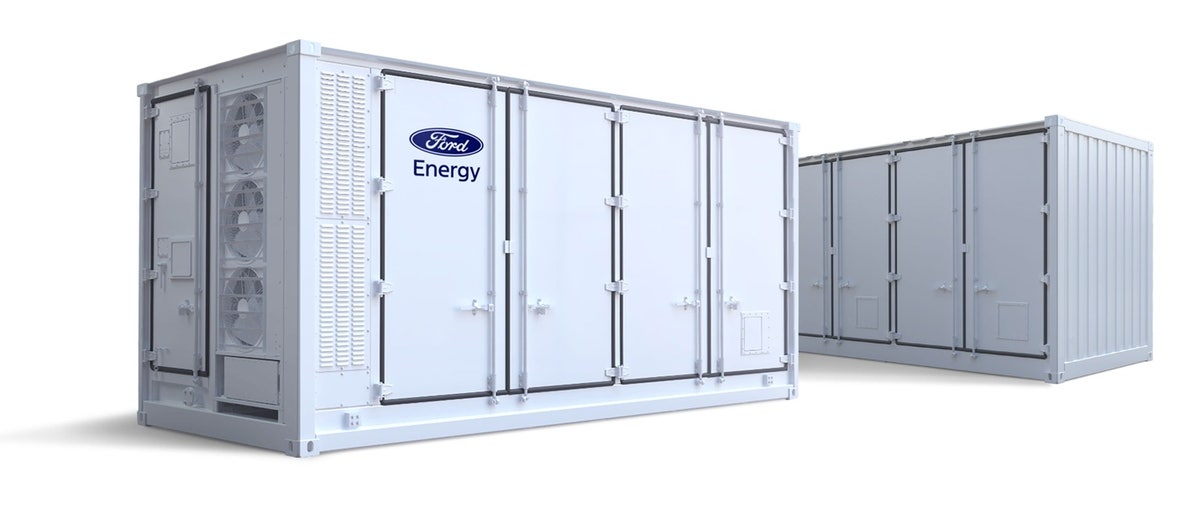

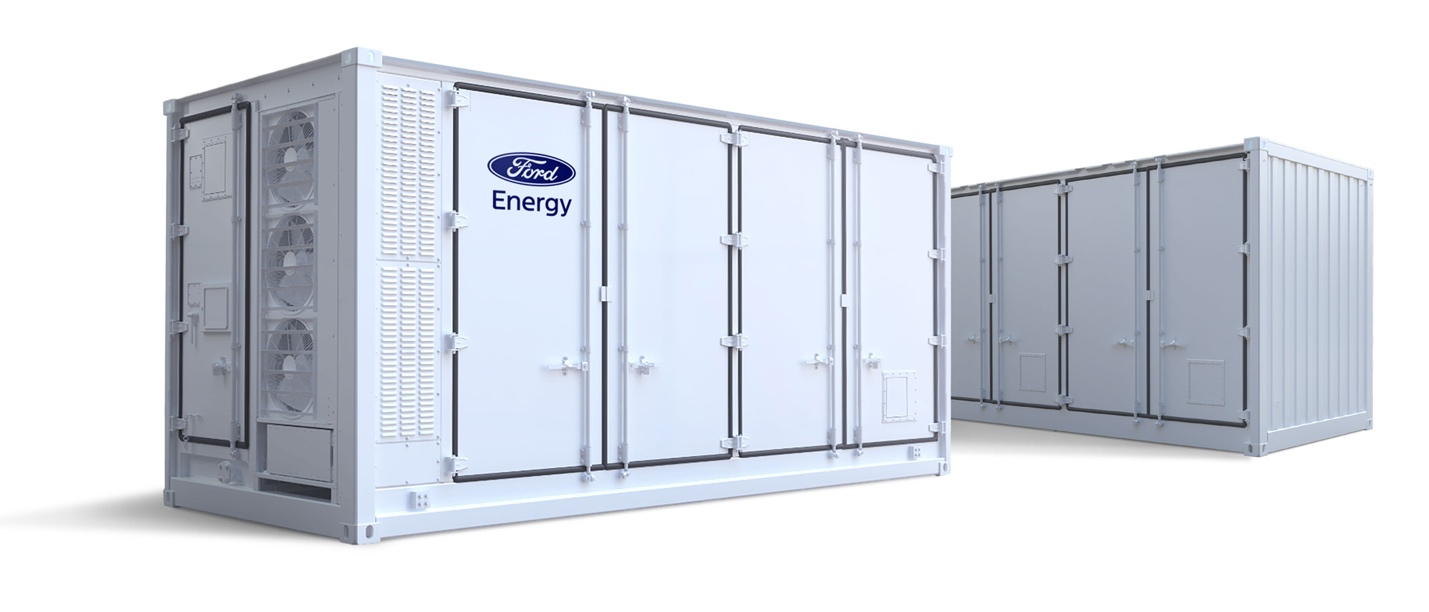
Ford Energy is positioning its first DC block for utility, industrial, and commercial storage projects. Image: Ford Energy.
The Product Is Big, Standardized, and Very LFP
The Ford Energy product page describes the DC block as a containerized battery energy storage system built for demanding applications. The basic specs are refreshingly concrete: 5.45 MWh of rated energy, a 1040-1500 VDC voltage range, liquid-cooled thermal management, IP55 ingress protection, C5 corrosion protection, operation from -35°C to +55°C, and a listed product weight of about 43.5 tonnes.
Those numbers put this squarely in serious project territory. A 5.45 MWh block is not meant to sit beside a suburban garage. It is the kind of building block a developer, utility, factory, or large charging site could use for peak load shifting, backup power, grid services, renewable smoothing, or demand-response programs.
The chemistry choice is important too. LFP does not usually deliver the same energy density as nickel-rich chemistries used in long-range performance EVs, but that trade-off matters less in stationary storage. For a container that sits on a pad instead of under a vehicle, thermal stability, cycle life, cost discipline, and predictable degradation can be more valuable than squeezing every possible mile out of a pack.
That is why LFP has become such a powerful crossover technology. It makes sense for affordable EVs, where lower cost and durability matter. It also makes sense for stationary storage, where weight is less punishing and long service life is the real prize.
Why This Matters to EV Shoppers
At first glance, Ford Energy looks like an infrastructure story, not a car story. But the line between the two is getting blurry.
Every automaker with serious EV ambitions has had to build battery knowledge: cell sourcing, pack assembly, thermal management, software controls, safety testing, quality assurance, and long-term support. Stationary storage uses many of those same muscles. The enclosure is different. The duty cycle is different. The customer is different. But the core challenge is still battery hardware that has to be safe, durable, traceable, and economically useful over many years.
For EV shoppers, the takeaway is that battery capacity is becoming a platform, not just a part number inside a vehicle. If an automaker can use LFP cells in affordable EVs, grid storage, charging-site buffers, and future second-life systems, the whole ecosystem gets more resilient. Battery factories do not have to live or die by one vehicle launch. Charging networks can use local storage to reduce demand spikes. Retired EV packs can eventually flow into lower-stress stationary roles before recycling.
That does not mean Ford Energy will directly make the next Mustang Mach-E cheaper. It does mean the economics around EV batteries are broadening. The more uses there are for cells, modules, controls, and manufacturing capacity, the less the industry depends on a perfectly smooth EV sales curve.
Ford Is Not Alone, but Its Timing Is Telling
Tesla has already shown how powerful the vehicle-plus-energy model can be with its storage business. Mercedes-Benz Energy has been active in battery reuse and stationary storage. GM has also moved deeper into energy products around home backup, commercial power, and bidirectional charging.
Ford’s move is interesting because it lands after a period of more cautious EV planning across the industry. Automakers have been trimming timelines, slowing some factory ramps, and pushing harder on hybrids or range-extender ideas where customers are not ready to jump all the way to battery-electric. A grid-storage subsidiary gives Ford another lane for electrification investment without needing every buyer to pick a pure EV today.
It also fits the moment outside the auto world. Data centers are hungry for power. Utilities need storage to balance renewables and peak demand. Industrial sites want resilience. Fast-charging hubs can be expensive to connect if every kilowatt has to come straight from the grid at peak times. Battery storage is not glamorous in the way a new electric pickup is, but it is becoming one of the foundations that makes broader electrification work.
The Caution: Execution Still Has to Prove It
The big caveat is that Ford Energy is still a plan on the way to late-2027 availability. Product specs are one thing; bankable deployments are another. Ford will have to prove cost, reliability, certification, service support, supply consistency, and warranty confidence in a market where utilities and large commercial customers do not buy on brand nostalgia.
There is also a strategic risk. If EV demand accelerates sharply again, Ford will need to balance vehicle battery needs against storage opportunities. If demand stays choppy, the storage business could become a useful outlet for capacity but also a reminder that some EV manufacturing assumptions were too aggressive. Either way, Ford Energy is a practical hedge.
The most encouraging part is that Ford is not pitching this as a moonshot. The product is a standardized container around proven LFP prismatic technology. The value proposition is manufacturing discipline, U.S. assembly, quality control, traceability, regulatory readiness, and long-term support. That is not flashy, but it is exactly the kind of boring credibility grid-storage buyers care about.
The Motorlinks Take
Ford Energy is a battery story with a car-company logo on it.
For enthusiasts, it will never be as exciting as a quick EV, a clever platform, or a genuinely affordable electric truck. But it may be just as important. The EV transition needs more than vehicles. It needs charging sites that can handle demand, grids that can absorb renewable power, factories that can rely on cleaner electricity, and battery supply chains that are useful even when vehicle demand does not move in a straight line.
Ford is clearly trying to make its battery investment work harder. If Ford Energy can turn U.S.-assembled LFP systems into dependable grid-scale storage, it gives the company another electrification business while strengthening the power infrastructure future EVs will depend on.
That is a quieter kind of EV news, but it is worth watching.