Stellantis Posts First Full-Year Loss in Company History Amid $25 Billion in Charges
Stellantis reported a full-year 2025 net loss of €1.5 billion, its first annual loss ever, as the automaker absorbed €25.4 billion in impairments and charges related to its failed EV transition and operational missteps.
Stellantis N.V. on February 26, 2026 reported its first full-year net loss in the company’s history — and the numbers are staggering. The automaker posted a net loss of €1.5 billion for fiscal year 2025, compared to net income of €11.8 billion in 2024, as it absorbed approximately €25.4 billion in unusual charges, impairments, and restructuring costs. The loss caps a disastrous year for the Jeep, Ram, Fiat, and Peugeot parent company that saw its stock fall more than 40 percent.
The Charges in Detail
The €25.4 billion in unusual items includes:
- €8.2 billion in impairments on equity investments and goodwill
- €6.1 billion in write-downs on EV inventory and assets
- €4.7 billion in restructuring and severance costs
- €3.8 billion in supplier contract obligations (primarily battery supply agreements no longer needed at current production volumes)
- €2.6 billion in regulatory compliance costs related to emissions
The scale of the impairments reflects a fundamental reassessment of the company’s asset base. Stellantis’ EV investments — particularly in the STLA Large and STLA Medium platforms, and the now-cancelled Dodge Hornet EV — were valued at multiples based on projected EV adoption rates that clearly will not materialize on the original timeline.
Revenue and Volume
Total net revenues for 2025 were €153.5 billion, down 2 percent from €156.9 billion in 2024, on a 4 percent decline in global vehicle shipments to approximately 5.5 million units. The U.S. market, where Stellantis depends on Ram trucks and Jeep Grand Cherokee for the majority of its profits, saw a modest volume recovery in Q3-Q4 following a disastrous 2024.
Adjusted operating income (AOI) was negative €842 million — the company’s first operating loss — reflecting the combined pressure of lower volumes, higher warranty costs (the Hornet and 500e generated disproportionate service claims), and the overhead burden of maintaining EV development programs that are being scaled back.
Tavares’ Tenure Under Scrutiny
CEO Carlos Tavares, who has led Stellantis since its 2021 formation, has faced mounting pressure from the company’s board and major shareholders. The company’s board met in emergency session in January 2026 to discuss leadership succession, though no announcement was made.
Tavares’ defenders argue that the EV transition was always going to be expensive and that Stellantis’ problems are industry-wide, not unique to the company’s strategy. Ford and GM have absorbed similar or larger impairments. But Stellantis’ 2024 results — which were strong — suggested the company had more runway. The speed of the deterioration in 2025 surprised even internal skeptics.
The Turnaround Plan
Stellantis outlined a five-point restructuring plan alongside the earnings release:
- Product priority: Focus investment on Ram trucks, Jeep Grand Cherokee, and the Peugeot 3008/5008 family — the products that actually generate profit.
- Platform consolidation: Cancel development of STLA Medium Extended (a long-wheelbase version) and freeze STLA Large for passenger vehicles. The STLA Frame architecture (for Ram and Jeep trucks) continues.
- U.S. dealer optimization: Reduce the Jeep dealer footprint by approximately 20 percent, eliminating low-volume stores that were diluting brand equity.
- Battery supply renegotiation: Renegotiate or exit battery supply contracts signed during peak EV hype — including LG Energy Solution agreements for the Hornet and 500e.
- Hybrid acceleration: Introduce hybrid powertrains on 80 percent of the North American lineup by 2027.
What This Means for U.S. Consumers
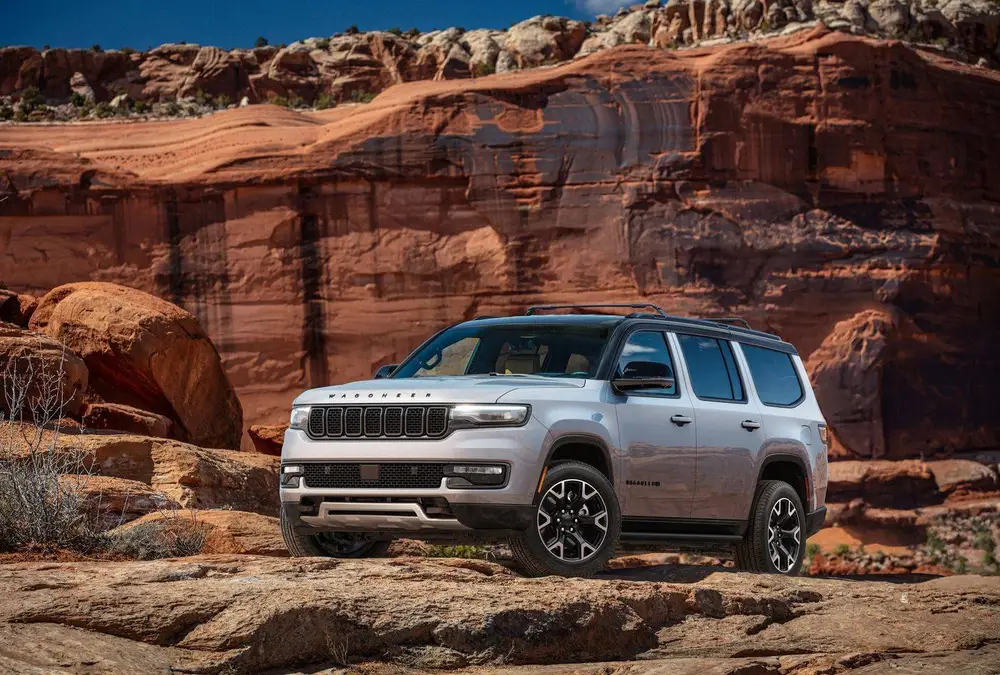
For buyers in the U.S., the most visible impact will be the reduction in Jeep dealer locations and the likely slowdown in new model introductions. The new Jeep Wagoneer S — a fully electric midsize SUV launched in 2024 — is expected to be discontinued by 2027. The plug-in hybrid Grand Cherokee 4xe will remain in production and is likely to receive more marketing investment as a “transitional” product.
Ram trucks and the Grand Cherokee will continue to get updates and refreshed models. These are the company’s bread-and-butter products in the U.S., and the turnaround plan explicitly protects them.
Motorlinks covers major automaker earnings and strategy shifts. See our analysis of the EV market reset for broader context.