Trump Signs Off on CAFE Reset: What the New Fuel Economy Roadmap Means for Your Next Car
President Trump formally proposed resetting Corporate Average Fuel Economy standards back to levels automakers can meet with conventional powertrains. The move marks a dramatic reversal of the Biden-era regulatory framework.
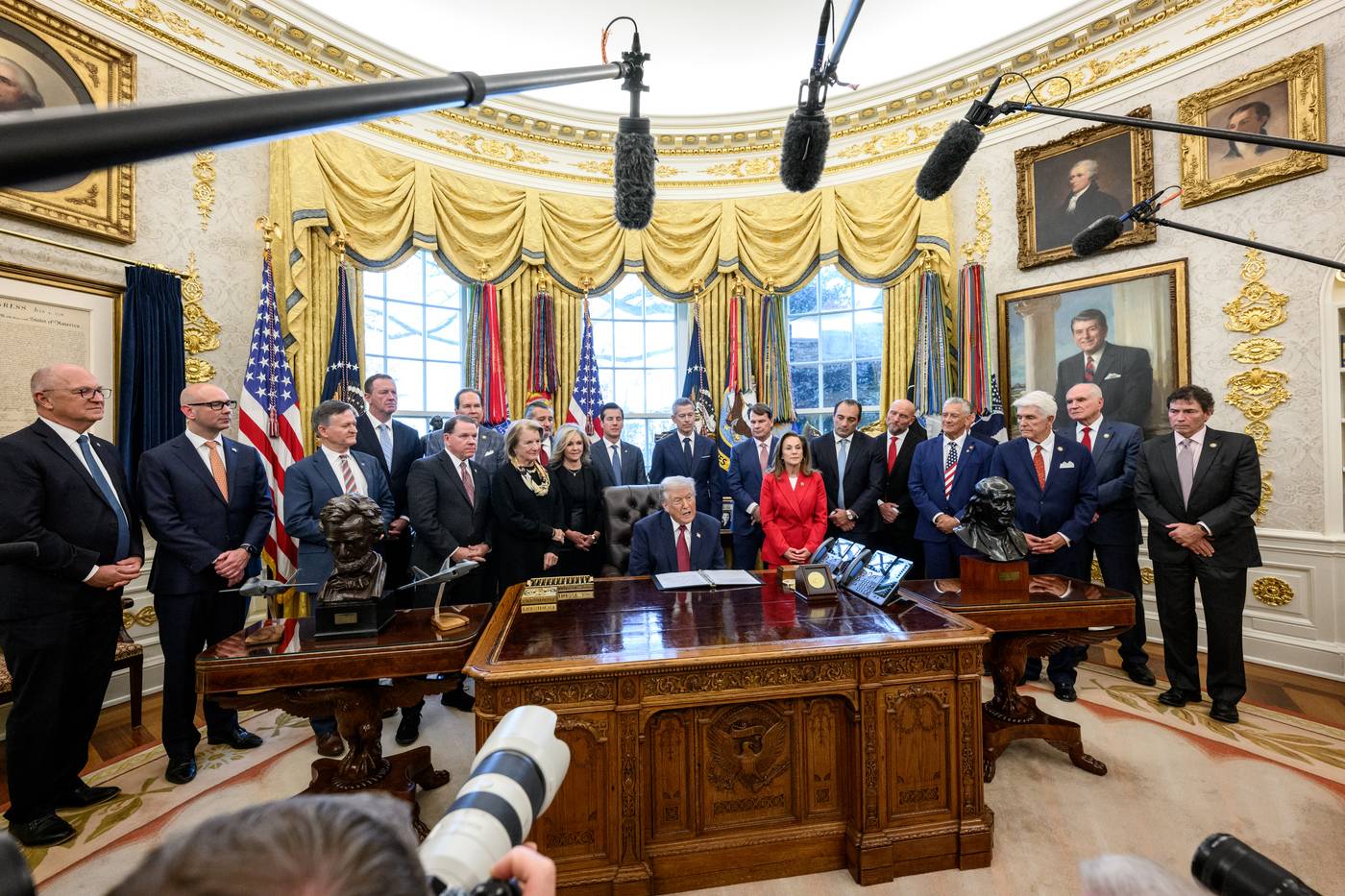
President Donald Trump made it official on December 3: the White House is proposing to fundamentally reset the regulatory direction of the American auto industry. Standing in the Oval Office surrounded by auto executives and administration officials, Trump signed off on a plan to return Corporate Average Fuel Economy (CAFE) standards to levels achievable with conventional gasoline and diesel powertrains — effectively abandoning the Biden-era framework that had pushed automakers toward electrification.
The fact sheet released by the White House was blunt. “The Biden Administration standards imposed unrealistic fuel economy targets that effectively resulted in an electric vehicle mandate,” it read. “President Trump is returning CAFE standards to levels that can actually be met with conventional gasoline and diesel vehicles.”
The Specifics: What Changes
Under the Biden rules finalized in 2022, the target was a fleet-wide average of approximately 49 miles per gallon for model year 2026 — the highest standard in U.S. history. Automakers were required to continue improving efficiency by 8-10 percent annually through 2031, eventually reaching 50.4 mpg on a combined basis.
The Trump proposal, advanced by the National Highway Traffic Safety Administration (NHTSA), takes a different approach. Rather than requiring continuous improvement, the new standard would effectively freeze fuel economy requirements near current levels, with minimal annual increases of 0.25 to 0.5 percent through 2031. The 2031 target would be approximately 34.5 mpg — closer to where the fleet already sits today than to where the Biden rules were headed.
The practical effect: an automaker selling a mix of full-size trucks and SUVs with 22-mpg combined ratings would face no regulatory penalty as long as the overall fleet average hovered around that mark. Under the Biden rules, they would have needed to sell significantly more hybrids and EVs to offset those gas guzzlers.
The Political Coalition
The announcement reflected an unusual alignment of interests. Automakers had lobbied for years against the Biden targets, warning they were building compliance costs into vehicle prices that consumers weren’t willing to pay. The United Auto Workers, which had historically supported fuel economy regulations as a way to drive technology leadership, broke with that position in 2024, citing thousands of EV-related job losses as demand for electric vehicles fell short of projections.
Environmental groups condemned the move. The Union of Concerned Scientists released an analysis suggesting the rollback would cost American consumers $23 billion in additional fuel costs over the lifetimes of affected vehicles, while adding the carbon equivalent of roughly 700 million metric tons of CO2 to the atmosphere.
Immediate Market Reaction
Automotive stocks rallied on the news, with Ford, GM, and Stellantis all posting gains in afternoon trading. The logic was straightforward: looser fuel economy rules reduce capital requirements for compliance technologies, free up engineering resources currently devoted to meeting EV and hybrid targets, and reduce the financial exposure of the ICE truck and SUV portfolio that remains the primary profit driver for Detroit’s legacy automakers.
Tesla’s stock dipped on the announcement, as investors interpreted weaker CAFE standards as reducing the competitive advantage that EVs enjoy in fleet compliance calculations. By contrast, the shares of traditional powertrain suppliers — especially those serving the full-size truck segment — held firm.
What This Doesn’t Change
It’s worth noting what the CAFE reset doesn’t do. The EPA operates on a separate regulatory track for tailpipe emissions, and those rules remain in place — for now. California retains its authority under the Clean Air Act to set its own vehicle standards, though the state’s EV mandate has already been suspended pending review by the new administration.
The broader consumer trends toward more efficient vehicles — driven by fuel costs, not regulations — also continue. The average new vehicle’s real-world fuel economy has improved steadily over the past decade regardless of regulatory requirements, as engine downsizing, hybridization, and improved aerodynamics became competitive differentiators in a crowded market.