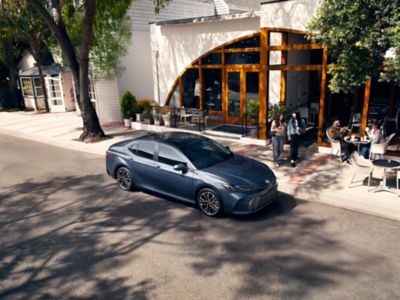
Toyota and Kia Bucked the EV Slide as the Industry's Charging Revolution Hit a Pothole
December 2025 saw EV deliveries crater across the industry — but Toyota and Kia proved that when you give buyers hybrids and plug-in hybrids, they'll take them. Here's what the divergent sales data tells us about where the market actually is.
While the rest of the U.S. auto industry was watching EV sales fall off a cliff in December, Toyota and Kia were celebrating. Both brands posted sales gains for the month — driven almost entirely by their hybrid and electrified lineups — in what is becoming one of the clearest illustrations of where the American car buyer actually stands versus where the industry thought they were going.
Toyota Motor North America moved 231,513 units for the month, up 11.8 percent on the year. More telling: electrified vehicles accounted for roughly 90,000 of those sales, and the division’s full-year hybrid volume crossed the one-million-unit threshold for the first time. The RAV4 Hybrid and Camry Hybrid continue to be two of the highest-volume electrified vehicles in the country — neither of which can be plugged in for a meaningful EV-only range.
Kia’s story was similar. The brand’s hybrid and plug-in hybrid sales surged even as its fully electric EV6 and EV9 continued to struggle at the dealership level. Niro Hybrid and Sportage Hybrid drove the volume, with the Sportage PHEV posting its best month since launch.
The EV Cliff Was Real
Let’s not sugarcoat what happened to the broader EV market in December. With the federal $7,500 EV tax credit eliminated for most vehicles at the end of November, EV sales fell sharply. Industry analysts had warned this would happen; the magnitude still surprised. Several brands saw pure EV transaction volumes drop by 40 percent or more compared to November.
The one outlier worth watching: December BEV sales did manage a small gain on a year-over-year basis, driven almost entirely by Tesla’s year-end push and a handful of deeply discounted models from GM and Volkswagen. Excluding those fire-sale transactions, the underlying trend was unmistakable — the EV market without subsidies looks a lot smaller than the one with them.
What Toyota Got Right
Toyota’s success wasn’t accidental. The company spent years building hybrid awareness and dealer inventory at a scale competitors ignored. Where Ford was educating customers about the F-150 Lightning’s frunk, Toyota was quietly ensuring every RAV4 Hybrid on the lot had $0 markup and a six-week waitlist. Where GM was explaining Ultium range specs, Toyota was selling 50,000 Prii a month at full price.
The 2025 model year also brought meaningful hybrid updates: the updated Toyota Hybrid System in the Camry and RAV4 delivered better throttle response and improved CVT calibration, addressing two of the longstanding criticisms of the brand’s hybrid driving feel. The result is a vehicle that customers enjoy driving, that gets 42 mpg combined, and that costs roughly the same as a comparable ICE vehicle at today’s interest rates.
The Road Ahead
December 2025 data will take months to fully analyze, but one conclusion is already clear: the mass-market EV transition as planned by Detroit and Washington is running about five years behind schedule. That doesn’t mean BEVs are going away — they’ll continue to grow in the premium segments and for buyers with consistent home charging access. But the idea that mainstream truck and SUV buyers would go electric in bulk, at $50,000-plus price points, without a charging infrastructure that works for them, was always optimistic.
Toyota and Kia’s December results suggest the pragmatic middle ground — hybrids and PHEVs that reduce fuel consumption without demanding customers change their behavior — is exactly where a large chunk of the market wants to live.