EV Charging Idle Fees in Canada: When the Clock Starts
Idle, overstay and congestion charges are not the same as an EV charging rate. Here's how Canadian drivers can check the rules and avoid an expensive stop.
Quick Verdict
Treat a public charger as a timed parking space as well as an energy source. Before plugging in, read the station’s full tariff, check when any grace period ends, and make sure you can return to move the car. A cheap per-kWh rate can stop looking cheap if the vehicle occupies the connector after the useful part of the session.
For a quick highway stop, set an app notification or phone alarm and return before charging is scheduled to finish. For a long meal, movie or overnight stay, choose a station whose parking and connection rules actually fit that visit. The important caveat: there is no single Canadian idle-fee rule. Operators—and sometimes individual site owners—set different conditions.
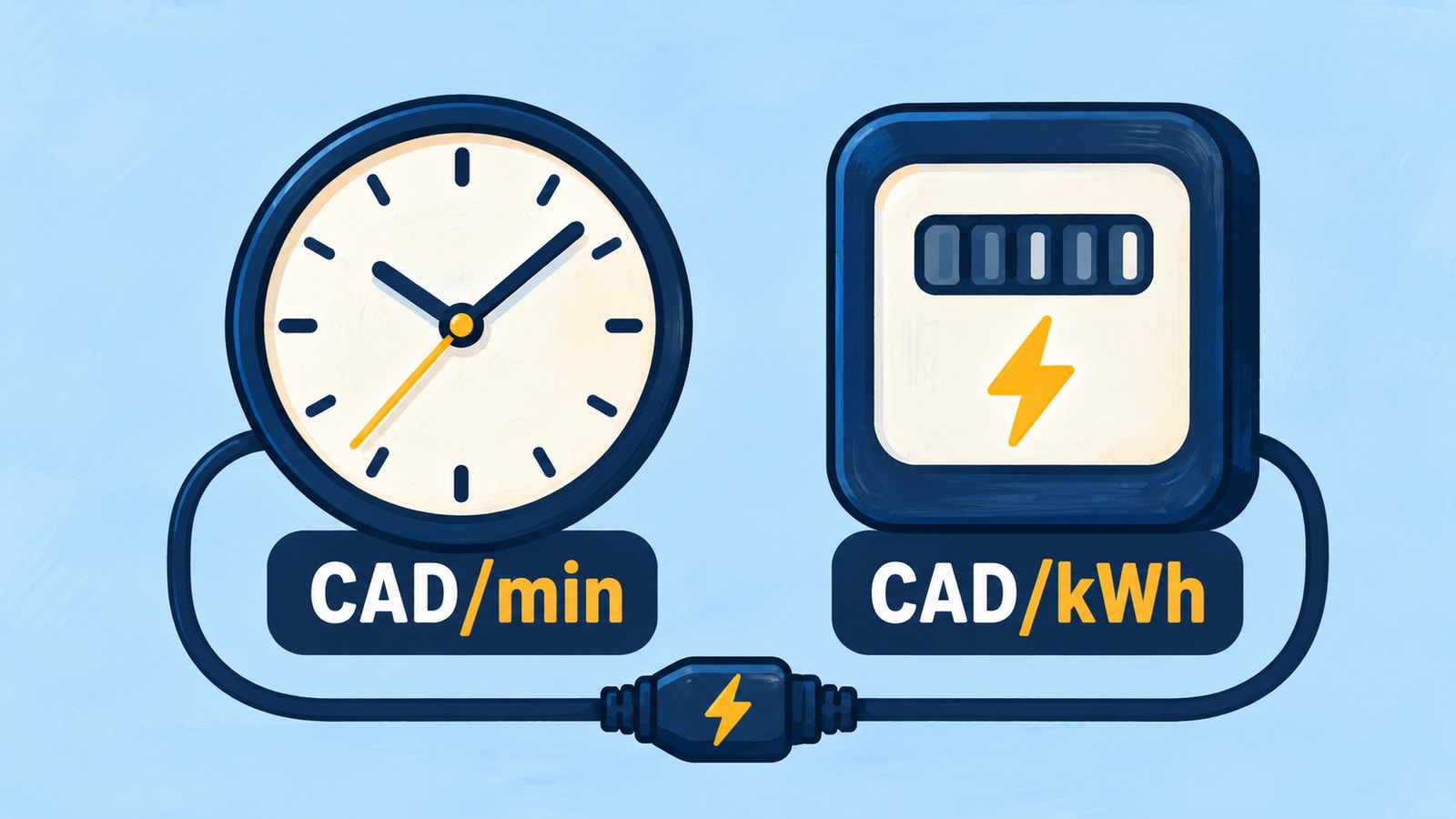
Motorlinks AI-created illustration of a charging-price clock and energy meter. It depicts the billing concept, not a particular charging network.
Three Different Clocks to Watch
The energy charge pays for electricity delivered, commonly measured in kilowatt-hours (kWh), though some Canadian stations still use time-based charging. It is not automatically the entire bill.
An idle or overstay fee generally addresses a vehicle occupying a connector beyond the allowed charging period. A grace period may apply, but its length is a station rule, not a universal entitlement. An all-connected-time rate is different: the clock can run while your EV is still receiving power. A congestion fee may be tied to a busy site or a battery-charge threshold, so merely seeing the charging animation does not necessarily prevent it.
ChargePoint’s explanation of pricing policies is a useful vocabulary guide. It says independently owned stations and roaming partners choose their tariffs, including connected-time rates and overstay rates. ChargePoint defines an overstay rate as a time charge that can begin after charging ends and a grace period passes, or after a maximum connection time is reached. That second condition matters if you plan to leave the vehicle plugged in for hours.
What Canadian Networks Actually Tell Drivers
Electrify Canada’s pricing page says charging prices vary by location and plan. It also warns that idle fees may be imposed for parking after a session ends, and directs drivers to the app or charger screen for current site-specific prices, power levels and idle fees. Do not assume the fee you saw at another Electrify Canada stop applies here.
ChargePoint is different from a single-price network: its station owner or roaming partner sets the price. Its published tariff categories include energy, station time while connected, session, and overstay charges. A “free charging” label also deserves a closer look if there is a separate parking or connection rule at the property.
Tesla’s Canadian Supercharger fee guidance describes congestion charges at busy sites, including circumstances where a vehicle has reached a charge threshold or charging has ended. The practical lesson extends beyond Tesla: check the live station card, not a remembered network-wide number. Fees and thresholds can differ by site and change. If your car or route planner suggests charging to 100%, that does not override a posted congestion policy.
A Better Stop Plan Than “I’ll Be Back Eventually”
Before starting a public session:
- Open the exact station in the operator’s app, then read the charger screen. Confirm the energy or time rate, idle or overstay terms, grace period, parking restrictions and any maximum connection time.
- Estimate the energy you actually need to reach the next reliable charger. A battery percentage target is useful, but it is not a reason to monopolize a busy connector after power has slowed or the session has ended.
- Turn on session notifications and set a separate alarm. Phone notifications can be delayed, silenced or lost with poor reception. Leave walking time to get back to the car.
- Unplug and move promptly when done. Ending a session in the app is not necessarily the same thing as freeing the parking space or connector; follow the site’s instructions.
- Keep the receipt or screenshot if a charge looks wrong. The displayed tariff, session timeline and final bill are more useful for a billing dispute than a recollection of another station’s price.
For a destination stop, ask a different question: can the car legally and economically stay connected for the whole visit? A lower-power Level 2 charger can suit a long stop better than a DC fast charger, but its site owner may still impose a time or overstay fee. The property may also have parking limits separate from the charging bill.
Don’t Confuse an Idle Fee with Slow Charging
Cold batteries and high states of charge can reduce charging power. If a station bills per minute for charging, slow power delivery can increase the effective price per kWh even before any idle charge begins. That is a pricing problem, not necessarily an idle-fee problem. Our Canadian per-minute versus per-kWh guide shows the calculation.
Likewise, a posted grace period is not a promise that you can safely abandon the car until the last minute. Chargers can finish earlier than forecast; other users need the connector; and some tariffs switch at a time limit rather than the moment energy stops. Read the rule for this site, watch the session, and move when finished.
FAQ
When does an EV charger idle fee start?
It depends on the station. Some idle or overstay fees begin after charging ends and a grace period expires; other time-based charges can apply while the car remains connected. Check the station’s current terms before starting.
Can an idle fee apply if my EV is still charging?
Yes, depending on the operator and tariff. A connected-time rate can run while energy is delivered, and a congestion policy may start at a stated battery threshold. Read the station-specific rules.
Does per-kWh charging include parking time?
Not necessarily. The energy rate and a possible idle, parking, overstay or session fee are separate parts of the tariff. Review all charges shown by the app or charger.
Sources
- ChargePoint: pricing policies, connected-time rates and overstay fees
- Electrify Canada: station-specific pricing and possible idle fees
- Tesla Canada: Supercharger fees