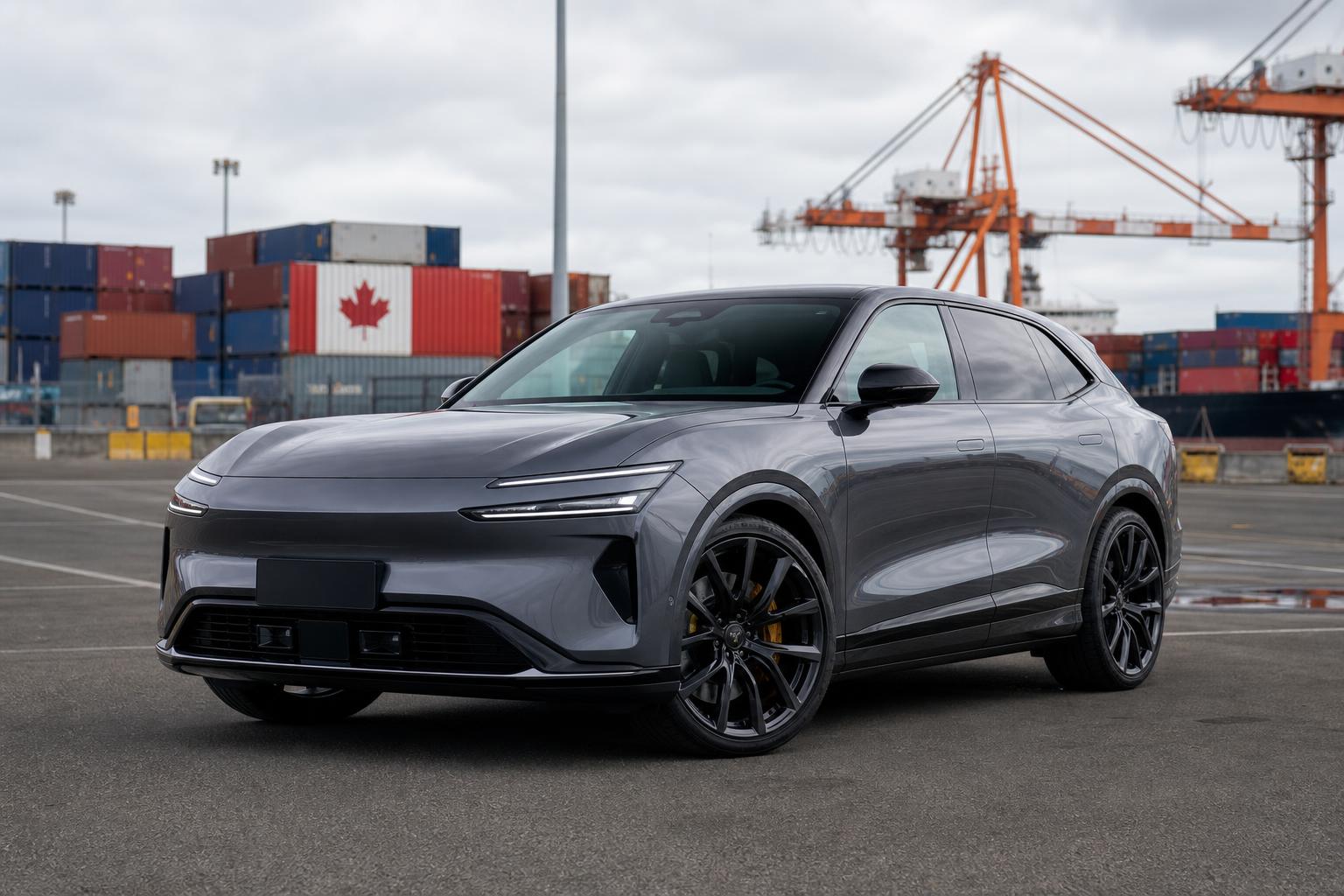
Canada's Chinese EV Quota Is Real Now, But Lotus Shows It Won't Start Cheap
Lotus Eletre arrivals turn Canada's Chinese EV quota from policy into product, but the first visible wave is more premium signal than instant affordable-EV fix.
Canada’s Chinese-EV quota has moved past the policy-paper stage. The first visible proof is not a bargain hatchback, though. It is a Lotus.
Reuters reported that Geely Holding Group’s Lotus electric vehicles are due to arrive in Canada in July under the Canada-China arrangement announced earlier this year. Global Affairs Canada says that arrangement gives Canada an initial country-specific quota of 49,000 EVs from China per year at a 6.1 percent most-favoured-nation tariff rate, with the quota implemented on March 1, 2026.
That matters because it turns a trade story into a showroom story. But it also shows why Canadian buyers should be careful with the simple version of the headline. The first wave of Chinese-origin EVs is not automatically a wave of cheap EVs. Lotus Canada lists the Eletre from $119,900 CAD, and Lotus Tech says the all-electric Eletre brings 800V electrified architecture into Canada’s high-performance luxury SUV segment.
In other words: the door is open. The affordable-EV payoff is still much less certain.
Quick Verdict
Canada’s Chinese EV quota is now real enough for shoppers to watch closely, but Lotus proves the first arrivals may be more about premium positioning than instant affordability.
The Eletre is useful as a signal. It shows that China-built, China-linked EVs can move through the new quota framework, clear the retail conversation, and put real pressure on the North American market. It does not mean Canadians are suddenly weeks away from a flood of $25,000 electric cars with full warranty, service, financing, parts support, charging guidance, and incentive eligibility.
If you are shopping now, compare what is actually certified and supported in Canada: Chevrolet Equinox EV, Nissan LEAF, Tesla Model 3, Kia EV3 or EV4 availability, Hyundai IONIQ 5, Toyota bZ, and the current incentive list. If you can wait, the quota is worth watching because BYD, Chery, Geely-linked brands, Tesla, Polestar, and other China-origin supply could sharpen pricing over the next year.
The Quota At A Glance
| Question | Current Answer | Buyer Takeaway |
|---|---|---|
| How many vehicles? | Global Affairs Canada says the initial quota is 49,000 EVs from China per year. | Supply is capped, so early allocation can shape which brands and price points Canadians actually see. |
| What tariff applies? | EVs inside the quota use the 6.1 percent most-favoured-nation tariff rate. | That is a major cost change from the prior 100 percent surtax, but it is not the same as a rebate. |
| When did it start? | The quota was implemented on March 1, 2026. | This is active policy, not a future proposal. |
| Why does Lotus matter? | Reuters says Lotus EVs are arriving in Canada in July, while Lotus lists the Eletre from $119,900 CAD. | The first visible proof point is premium, not mass-market. |
| Does this guarantee cheap EVs? | No. Every model still needs Canadian compliance, retail support, warranty backing, pricing, and incentive clarity. | Treat the quota as pressure on the market, not a confirmed shopping list. |
Why Lotus Is The Right First Signal
Lotus is a strange but revealing first act.
The brand still carries British sports-car history, but modern Lotus is tied to Geely, and the Eletre is part of a much broader China-linked EV strategy. Lotus Tech said in April that the Eletre had been introduced in Canada, with a starting price of $119,900 CAD, advanced 800V architecture, and a plan to build presence across key Canadian cities.
That is a very different proposition from the “cheap Chinese EV” idea that dominates the comment sections. The Eletre is not trying to undercut a Nissan LEAF or Chevrolet Equinox EV. It is aimed at luxury SUV shoppers who might otherwise look at a Porsche Cayenne E-Hybrid, BMW iX, Mercedes-Benz EQE SUV, or performance-trim electric crossover.
And that is exactly why it matters. Premium vehicles can absorb compliance costs, launch complexity, shipping, smaller early volumes, and brand-building expenses more easily than budget cars can. A six-figure EV only needs to convince a smaller buyer pool. A genuinely affordable EV has to survive far harsher math: price caps, financing, winter range expectations, dealership reach, insurance, parts supply, and resale confidence.
So Lotus does not prove that Canada’s affordable-EV problem is solved. It proves that the import lane works.
Why Cheap EVs Are Harder Than They Look
Canada needs more affordable electric vehicles, but the path from “cheap in China” to “good buy in Canada” is longer than it sounds.
A vehicle has to meet Canadian Motor Vehicle Safety Standards. It needs a warranty structure shoppers can trust. It needs bilingual documentation, software support, trained technicians, crash and compliance paperwork, parts inventory, financing partners, and a retail channel that can actually answer questions after delivery.
Then there is the incentive question. Canada’s lower tariff quota is separate from federal and provincial EV incentives. A China-origin vehicle can be cheaper because of tariff treatment and still fail to qualify for a rebate a shopper expected. That is why checking the current Canadian EV incentive guide matters before treating any imported EV as a bargain.
This is where a premium Lotus and a possible low-cost Geely, BYD, or Chery product diverge. The premium vehicle can be interesting even without mass affordability. The low-cost vehicle has to land with enough price advantage to overcome unfamiliar-brand risk and enough support to keep buyers comfortable.
What This Means For Tesla
Tesla may be one of the biggest early winners from the quota, even though the political debate often focuses on Chinese automakers.
Tesla already sells in Canada. It already has service, Superchargers, app support, financing familiarity, and brand recognition. If China-built Model 3 supply moves through the quota, Tesla does not have to teach buyers what the company is. It only has to make the price, origin, and incentive math work.
MotorLinks covered that earlier when Chinese-made Tesla Model 3s started arriving in Canada. Lotus now adds a second kind of proof point: not only can China-origin supply enter the conversation, but non-Tesla brands can start building around it too.
For shoppers, this could mean more pricing pressure before it means more nameplates. A cheaper Model 3, a more aggressive lease on a familiar EV, or a better-equipped rival reacting to quota pressure may matter sooner than a brand-new Chinese mass-market launch.
What To Watch Next
The useful buyer question is not “Are Chinese EVs coming?” They are already becoming part of the Canadian story. The better question is which ones will be easy to own?
Watch for five things:
- Canadian certification, not just overseas sales
- Real dealer, service, parts, and warranty plans
- Final transaction prices after freight, fees, taxes, and tariffs
- Federal and provincial incentive eligibility
- Charging hardware, adapter support, and cold-weather range information
Those details separate a serious Canadian product from an interesting import headline.
The most important brands to watch are not only BYD and Chery. Geely is already relevant through Lotus, Volvo, Polestar, and China-market models such as the small EX2/Xingyuan. Tesla remains relevant because it can use China-built supply with an existing Canadian footprint. Polestar matters because it has brand presence but faces complicated North American trade and production questions. Mainstream legacy brands matter because quota pressure can force sharper pricing even when they are not importing from China.
The Affordable-EV Pressure Is Real
Even if the first visible arrivals are expensive, the quota still puts pressure on Canada’s EV market.
Automakers now know Ottawa is not copying the U.S. wall exactly. Canada has chosen a controlled opening: limited volume, lower tariff inside the quota, and public consultation on allocation and administration. That is enough to make every affordable-EV plan look more urgent.
It also gives Canadian consumers a new reference point. If China-origin vehicles can arrive with competitive batteries, strong software, and sharper pricing, shoppers will start asking why a mainstream EV still costs so much. That pressure can show up in discounts, lease support, equipment levels, or faster product decisions.
The danger is overpromising. A quota does not guarantee a healthy ownership experience. It can also create allocation fights, supply bottlenecks, and confusion over which vehicles qualify for which programs. The upside is real, but it will be uneven.
Bottom Line
Lotus turning the Chinese EV quota into a real Canadian product story is important. It makes the policy visible. It shows the import lane can be used. It gives Canadian shoppers another reason to watch pricing and supply this summer.
But the Eletre also keeps the story grounded. A $119,900 CAD electric luxury SUV is not the affordable-EV breakthrough many buyers are waiting for. It is the opening scene.
For now, Canadian EV shoppers should treat the quota as market pressure, not a shopping shortcut. Buy what is certified, supported, and priced clearly today. Watch the China-origin pipeline closely. And when a new low-cost EV finally claims to be Canada-ready, judge it by the boring details: warranty, service, parts, charging, incentives, and the final number on the bill.
FAQ
What is Canada’s Chinese EV quota?
Global Affairs Canada says Canada has an initial country-specific quota of 49,000 electric vehicles from China per year at a 6.1 percent most-favoured-nation tariff rate. The quota was implemented on March 1, 2026.
Does the Lotus Eletre mean cheap Chinese EVs are arriving in Canada?
Not by itself. The Lotus Eletre is a premium electric SUV, and Lotus Canada lists it from $119,900 CAD. It proves the quota can support real vehicle arrivals, but it does not prove that mass-market Chinese EVs are ready for Canadian buyers yet.
Should Canadian buyers wait for Chinese-brand EVs?
Wait only if your timing is flexible and you are comfortable watching a developing market. If you need an EV soon, compare vehicles already certified, supported, and priced in Canada, then keep an eye on whether the quota pushes discounts or new launches.