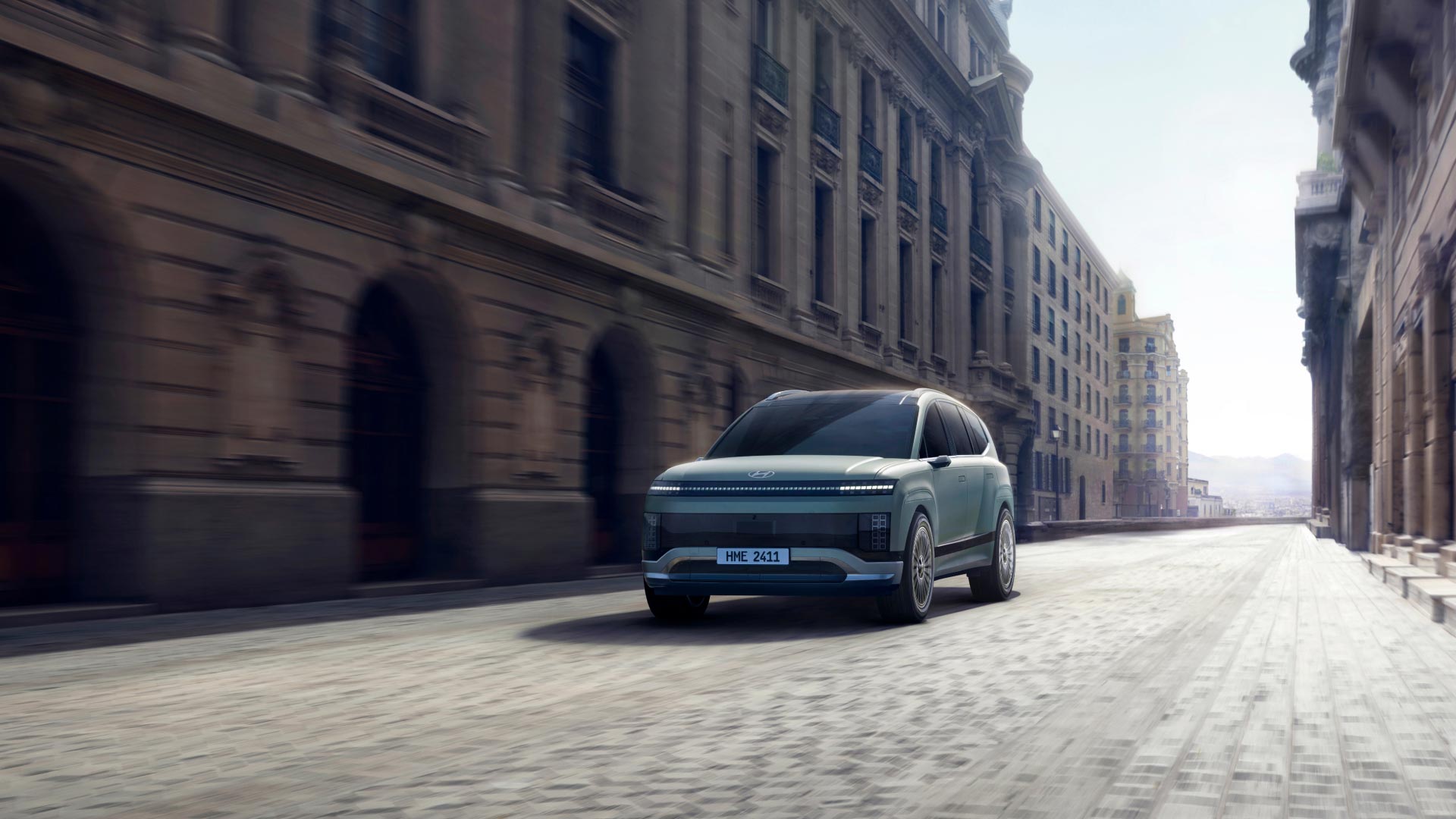
Volvo EX90 vs Hyundai IONIQ 9: Luxury Positioning or Mainstream EV Value?
The Volvo EX90 and Hyundai IONIQ 9 both promise three rows, fast charging, and 300-mile EV range. The smarter buy depends on whether you want Volvo's luxury positioning or Hyundai's bigger value play.
Photo: Hyundai
The 305-mile maximum belongs to AWD with 21-inch wheels, and six-seat availability is configuration-dependent; these headlines are not one base vehicle. Volvo labels power figures preliminary and specifies a preconditioned battery and suitable 350-kW charger for its 22-minute estimate. Hyundai launch pricing, output and charging details below remain pending a matched dated primary-source check, so this is not a fully verified purchase ranking.
The three-row electric SUV class is finally getting interesting in a normal-family way. Not cheap, exactly, but no longer limited to one obvious answer.
The Hyundai IONIQ 9 is the new mainstream-value play. Hyundai’s U.S. launch announcement put the big EV at $60,555 including destination, with every trim rated above 300 miles and the rear-drive S reaching up to 335 miles. It also brings a standard NACS port, CCS adapter support, and a claimed 10-to-80-percent DC fast charge in as little as 24 minutes on a 350-kW charger.
The Volvo EX90 attacks the same problem from the other direction. Volvo lists the 2026 EX90 from $78,090 MSRP, with six- or seven-seat layouts, up to 305 miles of EPA-estimated range, a claimed 22-minute 10-to-80-percent DC fast charge, and powertrains ranging up to 670 hp in Twin Motor Performance form.
So this is not a simple “which one has more range?” comparison. The Hyundai has the stronger value and range story. The Volvo has the richer safety, luxury, and brand-positioning story. The better answer depends on what kind of family EV buyer you are.
The Numbers Tell You Where Each SUV Is Aimed
| Item | Hyundai IONIQ 9 | Volvo EX90 |
|---|---|---|
| Starting price | $60,555 including destination in Hyundai’s U.S. launch announcement | $78,090 MSRP listed by Volvo USA |
| Best range figure | Up to 335 miles EPA-estimated for RWD S; all trims above 300 miles | Up to 305 miles EPA-estimated for AWD models with 21-inch wheels |
| Fast charging claim | 10-80% in as little as 24 minutes on a 350-kW DC fast charger | 10-80% as fast as 22 minutes on a 350-kW DC fast charger |
| Power headline | Up to 422 hp in higher-performance AWD trim | Up to 670 hp in Twin Motor Performance form |
| Seating | Three rows, six- or seven-seat positioning depending on configuration | Six- or seven-seat luxury family SUV |
| Charging connector story | Standard NACS port plus CCS adapter support | Exact 2026 inlet and adapter equipment require confirmation |
Those numbers make the personalities obvious. Hyundai is trying to make the IONIQ 9 feel like the rational big EV: plenty of range, fast charging, real family space, and a price that starts closer to well-equipped gas and hybrid three-row SUVs than to six-figure luxury EVs.
Volvo is not trying to win the spreadsheet on entry price. Volvo positions the EX90 as a premium flagship.
Buy the Hyundai IONIQ 9 if Range and Value Matter Most
If your goal is to get the most useful electric family SUV for the money, the IONIQ 9 has the cleaner case.
A starting price around $60,000 including destination is still a serious purchase, but it is meaningfully below the EX90. That gap is big enough to change the conversation. A family could step into a better-equipped IONIQ 9, keep monthly payments lower, or simply avoid paying luxury money for a vehicle that will spend most of its life doing school runs, highway trips, airport pickups, and Costco duty.
Range helps Hyundai even more. The 335-mile headline gives the IONIQ 9 more breathing room than the EX90’s 305-mile best figure. That does not mean the Hyundai automatically goes 30 miles farther in every real-world situation. Speed, weather, tires, payload, roof boxes, and charging habits all matter. But for road-trip confidence, the bigger EPA number gives Hyundai an advantage shoppers will notice immediately.
The fast-charging story is also strong enough that Hyundai does not feel like the budget alternative. A 24-minute 10-to-80 claim is competitive in this class, and the standard NACS port matters because North American buyers are increasingly expecting Tesla-style plug compatibility without awkward long-term workarounds.
The IONIQ 9 is the better fit if you want a large EV that feels premium enough without paying for a luxury badge. It is also the better fit if your main questions are practical: how far does it go, how quickly does it charge, how much does it cost, and how much room does my family get?
Three-row EV gallery: Hyundai IONIQ 9 and Volvo EX90 official images
13


The IONIQ 9 is the value-forward choice here: big range, big space, and a starting price far below the Volvo EX90.
Consider the Volvo EX90 for Its Luxury Positioning
The EX90’s best argument is not that it beats Hyundai on range or price. It does not.
Its argument is that some buyers want the family EV to feel like a luxury flagship first. Volvo has built the EX90 around that idea: a calm cabin, careful material choices, advanced sensing hardware, Google-based software, three-row flexibility, and the kind of safety-first brand identity that still matters when parents are shopping for a vehicle that will carry kids every day.
The performance ceiling is also much higher. Volvo lists up to 670 hp for the Twin Motor Performance version, with a 0-to-60 mph claim as quick as 4.0 seconds. That is not necessary in a three-row family SUV, but it does give the EX90 a different character from the Hyundai. The IONIQ 9 can be quick. The EX90 can be properly rapid.
There is also a cabin difference that numbers do not fully capture. Hyundai’s interior looks airy and modern. Volvo’s is more restrained and expensive-feeling. If you like quiet design, minimal visual clutter, and a more premium atmosphere, the EX90 will probably feel more special.
The catch is obvious: you pay for that. A base EX90 already starts above a well-equipped IONIQ 9, and higher trims move deeper into luxury-SUV territory. For some buyers that will be fine. For others, the Hyundai will look like the same broad capability with less financial drama.
The Charging Difference Is Smaller Than It Looks
On paper, Volvo’s 22-minute 10-to-80-percent claim is two minutes quicker than Hyundai’s 24-minute claim. In real life, that difference should not be the deciding factor.
Both numbers depend on ideal conditions: a capable charger, a warm and preconditioned battery, a suitable state of charge, and a station that is not throttling power. Once you are dealing with public charging, two minutes can vanish behind a slower dispenser, a cold battery, or the time it takes to get the kids out for snacks.
The more important point is that both SUVs are in the right fast-charging conversation. Neither looks like an old first-generation EV trying to survive in a 2026 family-road-trip world. If charging speed is your deciding factor, you are probably better off looking at route planning, charger access, battery preconditioning, and how cleanly each vehicle integrates station information into navigation.
Check each exact model-year vehicle’s inlet and approved adapters before planning a charging route.
The Smart Pick Depends on Your Definition of Family Luxury
The IONIQ 9 and EX90 both want to make a three-row EV feel normal. They just define “normal” differently.
Hyundai’s version is: give families lots of range, lots of room, fast charging, a modern cabin, and a price that does not immediately force them into luxury-SUV math. That is the more practical win.
Volvo’s version is: market the electric family SUV through luxury design and technology, even if the price reflects that. That is the more emotional and brand-driven win.
If you are replacing a Palisade, Telluride, Highlander, Pilot, or Grand Highlander and want to go electric without jumping too far upmarket, the Hyundai IONIQ 9 is the one that makes more sense. It has the stronger range figure, the lower starting price, and enough charging speed to work as a real family EV.
If you are replacing a luxury SUV and want the EV to feel like a flagship, the Volvo EX90 is easier to justify. The range is lower, but still usable. The price is higher, but so is the luxury positioning. And for buyers who specifically trust Volvo’s safety-first image, that may be the entire point.
The Bottom Line
The Hyundai IONIQ 9 is the smarter value pick. The Volvo EX90 is the richer, more premium pick.
That sounds simple, but it is actually good news for EV shoppers. Three-row electric SUVs are no longer all trying to be the same thing. Hyundai is making the big EV more attainable and more range-focused. Volvo emphasizes premium positioning; this article establishes no comparative crash-safety result.
If this were my money, I would start with the IONIQ 9 unless the Volvo badge, cabin, safety hardware, and luxury feel were must-haves. The Hyundai’s range-and-price combination is hard to ignore, especially when both SUVs are already in the same fast-charging neighborhood.
But if the family EV also needs to feel like a proper luxury object, the EX90 still has a strong lane. It just has to earn a much bigger check.